
Bony fishes · Paralichthyidae
Fine flounder
Paralichthys adspersus (Steindachner, 1867)
Spanish: Lenguado
- Names in Peru
- Lenguado
- Peruvian Register of Marine Species
- Listed in PeRMS (IMARPE)
Species account
Summary
Paralichthys adspersus is a flatfish of the family Paralichthyidae, in the order Pleuronectiformes [1]. It lives in the southeast Pacific, from Paita in northern Peru to south-central Chile and the Juan Fernández Islands [2],[3]. It is a flounder of commercial interest, taken by artisanal and trawl fleets, and one of the species that Peru and Chile have tried in aquaculture [2],[4]. Its global category on the IUCN Red List is Least Concern [5].
Identification and similar species
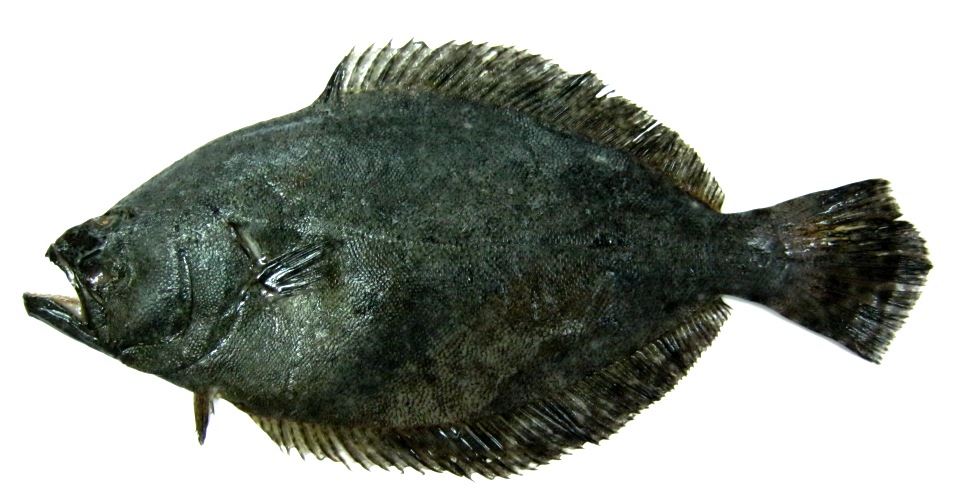
Like other Paralichthyidae, it has both eyes on one side of the head, and most species in the family are sinistral, with the eyes on the left side [6]. A wild individual of this species measuring 52.6 cm total length and with both eyes on the right side was recorded at Caldera, in Chile, in January 1996 at about 25 m depth; among fish produced in an experimental culture, 2.2 % came out with reversed eyes [6].
In 150 specimens from the central coast of Peru, ray counts ranged from 65 to 77 in the dorsal fin, 52 to 61 in the anal fin and 10 to 13 in the pectoral fin, with 6 to 9 gill rakers on the upper limb of the first arch and 15 to 19 on the lower limb [2].
None of the 5 meristic and 10 morphometric characters measured on those specimens could separate males from females. External anatomy did: females have 3 separate openings (anal, urinary and genital), while males have only 2 (anal and urogenital) [2]. A maturing female also shows a visibly swollen belly [3].
Similar species
- Paralichthys microps: Paralichthys microps, from Chilean waters, is very similar. It is told apart by the origin of the dorsal fin, which in Paralichthys microps sits above the front half of the eye and in Paralichthys adspersus above the front edge of the eye or behind it; by the gill rakers on the upper limb of the first arch (6 or 7 in Paralichthys adspersus and 9 or 10 in Paralichthys microps), although the Peruvian count reached 9; and by the excurrent nostril, visibly wider in Paralichthys microps [3],[2].
Distribution and habitat
Its range runs along the southeast Pacific coast from Paita, in northern Peru, to the Gulf of Arauco, in Chile, and includes the Juan Fernández archipelago [3]. Other authors put the southern limit at Lota [2], and a study of Chilean specimens extends it from Ecuador to Aysén [6].
Its usual habitat is shallow gulfs and bays with soft sandy bottoms, where it finds shelter from predators, suitable temperatures and abundant food [3]. The wild individual from Caldera was caught near the coast, at about 25 m depth [6].
Biology
On the central coast of Peru, age was read from otoliths: each year an opaque zone forms, in summer, and a hyaline one, in winter [2]. Females grow larger than males: the estimated asymptotic length was 101.17 cm in females and 60.53 cm in males [2]. At 4 years, back-calculated length was 48.55 cm in females and 39.69 cm in males [2]. In the wild, females and males reach a commercial size of 40 to 47 cm and 770 to 1400 g between 3 and 4 years of age [2].
It is an asynchronous partial spawner: the ovaries hold batches of oocytes at different stages, and mature ones measure between 0.665 and 0.805 mm. Mean total fecundity was estimated at 2125000 eggs per female and relative fecundity at 1500 eggs per gram of fish [2]. The Peruvian flounders in the study were taken from September 1993 to June 1994, which the authors regard as the season of greatest reproductive activity [2].
In Chile it is estimated to reach first maturity at about 24 cm total length, and spawning is most intense from late winter to early spring, at 10.3 to 16.8 °C in Concepción Bay and 13 to 17 °C in Coquimbo Bay [3]. In captivity, wild broodstock take about 2 years to spawn for the first time, and the eggs are floating, transparent, with one oil droplet and about 0.8 mm in diameter [3].
Ecology
It is a carnivore that eats fishes, crustaceans and molluscs, and the weight of each prey group changes with locality and season [3]. In central Chile it feeds mainly on anchoveta (Engraulis ringens) and mysids; in northern Chile, mainly on anchoveta and, occasionally, on the benthic crustacean Emerita analoga [3].
The diet changes with age: juveniles eat many small epifaunal prey, and adults a few large pelagic ones [3]. In the culture work cited, once fish reach first maturity their food intake rises in the months before spawning and falls during the breeding season [3].
At a hatchery on the central coast of Áncash, in Peru, an outbreak of scuticociliatosis caused by the ciliate Miamiensis avidus in January 2014 caused mortality of around 70 % among flounders reared in captivity; the dying fish examined weighed between 10 and 400 g, and infected fish went through a period of lethargy and died, with secondary bacterial infections, chiefly by Vibrio alginolyticus [4].
Conservation
Its global category on the IUCN Red List is Least Concern [5].
In Peru, flounder landings rose in steps and were highest between 1984 and 1992; they then fell markedly (the series runs to 2003), which the authors attribute possibly to intense fishing [2].
In Chile, about 99 % of flounder landings are made by artisanal fishers, and they are recorded without distinguishing this species from Paralichthys microps; catches fell from 821 t in 1990 to only 55 t in 2008 [3].
Human relevance
In Peru it is taken both by artisanal boats and by commercial trawlers, and the authors describe it as a species of great abundance and high commercial value [2]. According to a study of Chilean specimens, it is caught mostly by artisanal fishers, with trawl nets, gillnets, longlines and handlines [6].
The fall in catches led researchers and private companies to look into farming it [2]. In Peru it is among the species prioritised for diversifying marine aquaculture, and it is reared both for research and at pilot commercial scale on the central coast [4].
A review concluded that the knowledge already exists to complete its life cycle in captivity and produce fish of commercial size, although results are still only moderately repeatable [3]. According to the growth equations for wild Peruvian flounders, an average fish reaches 700 g at about 3 years [3].
Where to see it in Peru
The flounders studied on the central coast of Peru were obtained at the ports of Ancón, Callao, Chorrillos and Pucusana between September 1993 and June 1994 [2]. Paita, in the north, is regarded as the species' northern limit [3]. Its usual habitat is sandy bottoms of shallow gulfs and bays [3]; the literature reviewed describes landed or farmed fish, not diving sightings [2].
References (6)
- WoRMS Editorial Board (2026). Paralichthys adspersus (Steindachner, 1867). World Register of Marine Species. https://www.marinespecies.org/aphia.php?p=taxdetails&id=275806 (accessed 2026-10-25)
- Angeles, B., Mendo, J. (2016). CRECIMIENTO, FECUNDIDAD Y DIFERENCIACIÓN SEXUAL DEL LENGUADO Paralichthys adspersus (Steindachner) DE LA COSTA CENTRAL DEL PERÚ. Ecología Aplicada, 105-112. doi:10.21704/rea.v4i1-2.304 (accessed 2026-10-25)
- Silva, A., Oliva, M. (2011). Review of the biology and cultivation of Chilean flounder (Paralichthys adspersus). Latin American Journal of Aquatic Research, 377-386. doi:10.3856/vol38-issue3-fulltext-3 (accessed 2026-10-25)
- Medina, M., Sotil, G., Flores, V. et al. (2016). Ocurrencia de escuticociliatosis en el lenguado Paralichthys adspersus causado por Miamiensis avidus, en Perú. Revista Peruana de Biología, 261-270. doi:10.15381/rpb.v23i3.12861 (accessed 2026-10-25)
- Nielsen, J.G., Munroe, T., Tyler, J. et al. (2008). Paralichthys adspersus: Nielsen, J.G., Munroe, T., Tyler, J. & Bussing, W. The IUCN Red List of Threatened Species 2010: e.T183528A8129027. doi:10.2305/IUCN.UK.2010-3.RLTS.T183528A8129027.en (accessed 2026-10-25)
- Flores, H., Martínez, P. (2013). Inversion ocular en Paralichthys adspersus (Steindachner, 1867) lenguado de ojos chicos (Pleuronectiformes, Paralichthyidae): un caso del ambiente y un analisis en ejemplares cultivados. Latin American Journal of Aquatic Research, 57-67. doi:10.3856/vol41-issue1-fulltext-4 (accessed 2026-10-25)
More pictures
Where it has been recorded
- Filled: scientific records, or confirmed by a curator
- Hatched: isolated record
- Dotted outline: no scientific records and no curator's confirmation (an ORKA sighting is not drawn here)
- Cold central sea
Scientific records (19 records)
- Cold southern sea
Scientific records (16 records)
From openly licensed OBIS and GBIF records (CC0 or CC BY). How each list is built.
Related species
From the same genus (Paralichthys) and from the same family (Paralichthyidae).
Dappled flounder
Paralichthys woolmani
IUCN status: DD · Data Deficient
Paralichthys microps
IUCN status: LC · Least ConcernGulf sanddab
Citharichthys fragilis
IUCN status: LC · Least ConcernSmall sanddab
Citharichthys platophrys
IUCN status: LC · Least ConcernBigeye Flounder
Hippoglossina macrops
IUCN status: LC · Least Concern
Threespot sand flounder
Ancylopsetta dendritica
IUCN status: LC · Least Concern- No openly licensed image yet
Bigmouth sanddab
Citharichthys gilberti
IUCN status: LC · Least Concern Spotted flounder
Hippoglossina bollmani
IUCN status: LC · Least Concern
Names and sources
In Spanish
- Lenguado — Peru; SERNANP (2016). Plan Maestro de la Reserva Nacional Sistema de Islas, Islotes y Puntas Guaneras 2016-2020, p. 65 of the PDF; Wikidata · main name
- Lenguado fino — Wikidata
In English
- Fine flounder — Wikidata
Classification
Learn more
Conservation status: Least Concern (IUCN Red List, according to Wikidata). Taxonomy: PeRMS / WoRMS (CC BY 4.0).