
Bony fishes · Serranidae
Sea bass
Paralabrax humeralis (Valenciennes, 1828)
Spanish: Cabrilla
- Names in Peru
- Cabrilla · Cabrilla común
- Peruvian Register of Marine Species
- Listed in PeRMS (IMARPE)
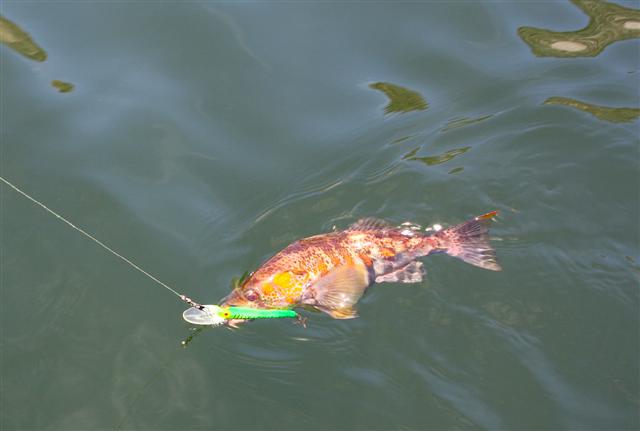
Species account
Summary
Paralabrax humeralis is a fish of the family Serranidae described by Valenciennes in 1828 [1]. In Peru it is known as «cabrilla» or «cabrilla común», and it is one of the most important species of the demersal subsystem; it is caught mainly by small-scale fishers, and most landings are recorded in the north of the country [2]. On the IUCN Red List it is assessed as Data Deficient [3].
Identification and similar species
In Peruvian small-scale landings measured between 1996 and 2018, rock seabass ranged from 10 to 59 cm total length [2].
Underwater it tends to be easy to spot because it roams in the open: in scuba censuses south of Iquique, in northern Chile, it was the most abundant serranid, and it was seen swimming in groups where rock gives way to soft bottom, among loose boulders, shell beds and forests of the brown alga Lessonia trabeculata [4].
Similar species
- Hemilutjanus macrophthalmos: It shares the rocky subtidal with the rock seabass but lives as a specialist of large caves, over 0.5 m across, whereas the rock seabass roams in the open over rock, sand and algae [4].
- Acanthistius pictus: It shelters in small cavities, under 0.5 m across, where it is easily overlooked; the rock seabass instead moves over the bottom outside the holes and usually travels in groups [4].
Distribution and habitat
According to IMARPE, the species occurs from Ecuador to southern Chile, including the Juan Fernández and Galápagos Islands; in Peru it lives from shallow water down to about 200 m, and it is most frequent between 50 and 100 m along the coastal strip between 4° and 6° S [2]. It is a benthopelagic fish of coastal bottoms where rock and sand mix [5].
The same IMARPE review notes that it has been found at temperatures of 13.6 to 17.2 °C and oxygen levels of 0.34 to 2.77 mL/L, and that during El Niño it turned up at 14.3 to 25.1 °C [2]. South of Iquique, 397 individuals were counted throughout the first rocky fringe and at every depth between 0 and 25 m [4].
Biology
It is a hermaphrodite: according to work compiled by IMARPE, it changes from female to male at 17.5 to 24.2 cm total length, once it is more than 1 year old [2]. In 65537 fish sampled between 1996 and 2018, the gonadosomatic index began to rise in August and peaked in February, so ripening and spawning are concentrated from December to March, in spring and summer [2]. Females reach first maturity at 25.05 cm total length, equivalent to an age of about 2.56 to 2.76 years [2].
A maturity scale of its own allows its reproductive state to be read by eye; it was checked against histological sections of 197 ovaries and 188 testes gathered in 2005, and it describes 6 stages, from 0, virgin, to 5, which is recovery in females and the post-release phase in males [5].
At Callao, reading 720 pairs of otoliths from fish of 14 to 43 cm collected in 1996 gave ages of 1 to 8 years; mean length was 18.3 cm in the first year and 40.8 cm at 8 years [6].
In captivity, a group of broodstock spawned on its own in November 2018. The eggs float, are spherical, measure 0.98 mm and carry one oil droplet; at 17.2 °C the larvae hatched after 47.9 hours, at 2.22 mm, and began feeding on the third day [7]. In a culture in northern Chile followed to day 35, the larvae went through 5 stages, from yolk sac to early juvenile, and grew at a specific rate of 7.2 % per day [8].
Ecology
It is a carnivorous predator. Of 28684 stomachs examined at Callao between 1996 and 2018, 24.9 % held food; 86 prey items were identified, mostly crustaceans and fishes, led by the squat lobster Pleuroncodes monodon, the anchoveta Engraulis ringens and the porcelain crab Petrolisthes desmarestii [2]. Its trophic level ranged between 3.1 and 4.2 [2].
It copes very well with low oxygen: in the laboratory, juvenile rock seabass spent 31 days at 5 % saturation without a single death, whereas in the Peruvian grunt Anisotremus scapularis half the fish died within 36 minutes at 60 % saturation [9].
In 369 rock seabass from the Chorrillos fish terminal in Lima, examined between 1996 and 2009, 10 parasite species were found, and only 7.1 % of the fish carried none [10]. Larvae of the tapeworm Diphyllobothrium pacificum found in it suggest that it is part of the diet of the sea lions Otaria flavescens and Arctocephalus australis, the parasite's final hosts [10]. Another study found that the nematode Philometra sp. infects it only after its first maturity [11].
Conservation
Its global category is Data Deficient [3]. In Peru its capture has a minimum size of 32 cm total length, yet the mean size of landings stayed below that figure between 1996 and 2018 [2]. Two stock assessment models, CMSY and JABBA, place it at full exploitation, with a few hints of overexploitation; the maximum sustainable yield estimated with CMSY was 3970 t [2].
In the Guano Islands, Islets and Capes National Reserve System it is one of the prioritised conservation targets of the subtidal ecosystem [12]. Its management plan lists it among 3 fishes of high economic importance to local fishers that are under fishing pressure, and warns that, although there are no precise data on overexploitation, that pressure could make their populations decline [12].
In Chile, according to a 2026 study, its population has fallen since the 1980s because of fishing pressure and it is considered fully exploited in the north of the country [8].
Health, toxicological and chemical relevance
Not medical advice. For a sting, a poisoning or an allergy, seek medical care.
Plerocercoid larvae of Diphyllobothrium pacificum were known from more than 16 species of bony fishes on the Peruvian coast, and the Chorrillos study recorded them in the rock seabass for the first time [10]. Their prevalence there was very low, but the authors caution that their presence in these fish implies a zoonotic potential [10].
Human relevance
It is one of the most important species of Peru's demersal subsystem and is sold fresh, frozen and salted [2]. In the landings analysed by IMARPE, 87 % came from the north, above all from Piura (50 %) and Tumbes (26 %); between 1996 and 2018 the gears in most consistent use were handlines (37 %), gillnets (20 %) and purse seines (15 %), while compressor diving reached about 40 % of landings only between 2001 and 2008 and then fell to around 9 % [2].
From 1950 to the late 1970s landings stayed above 4000 t a year; the largest landings were recorded in the mid-1980s, a long decline followed from the 1990s to the mid-2000s, and landings rose from 2007 onwards [2].
Its farming is also being trialled: juveniles kept for 90 days at 12, 17 and 22 °C soon accepted pelleted feed and 95 % survived, although their muscle lost fatty acids such as DHA and EPA, so the authors call for diets richer in them [13]. In Chile it is targeted by artisanal and sport fishers for the quality of its flesh [8].
Where to see it in Peru
Studies of the species in Peru draw on landings from the whole coast, concentrated in the north, above all in Piura and Tumbes, with data from 1996 to 2018 [2], on fish from Callao collected in 1996 [6] and on fish from Chorrillos, Lima, from 1996 to 2009 [10]. In the Guano Islands, Islets and Capes National Reserve System, the 2016 management plan prioritises it in 10 of its sectors, among them the Lobos de Tierra, Lobos de Afuera and Macabí islands in the north and the Chincha and Ballestas islands and Punta San Juan farther south [12].
References (13)
- WoRMS Editorial Board (2026). Paralabrax humeralis (Valenciennes, 1828). World Register of Marine Species. https://www.marinespecies.org/aphia.php?p=taxdetails&id=282056 (accessed 2026-10-20)
- Argumedo Guillén, E., Tacuri Santisteban, P., Pérez Huaripata, M. et al. (2021). Indicadores biológicos, pesqueros y poblacionales de la cabrilla Paralabrax humeralis en el litoral peruano. Informe Instituto del Mar del Perú 48(4), 511-531. https://alicia.concytec.gob.pe/vufind/Record/IMAR_9d38ced4c5950f0804ee058517bab584 (accessed 2026-10-20)
- Smith-Vaniz, B., Robertson, R., Dominici-Arosemena, A. et al. (2008). Paralabrax humeralis: Smith-Vaniz, B, Robertson, R., Dominici-Arosemena, A., Molina, H., Salas, E., Guzman-Mora, A.G. & Bearez, P. The IUCN Red List of Threatened Species 2010: e.T183746A8169144. doi:10.2305/IUCN.UK.2010-3.RLTS.T183746A8169144.en (accessed 2026-10-20)
- Cisternas, F., Sielfeld, W. (2008). Habitat overlap of Paralabrax humeralis (Cuvier & Valenciennes, 1828), Hemilutjanus macrophthalmos (Tschudi, 1845), and Acanthistius pictus (Tschudi, 1845) (Pisces; Serranidae) in the rocky subtidal south of Iquique, Chile. Latin American Journal of Aquatic Research, 153-158. doi:10.3856/vol36-issue2-fulltext-2 (accessed 2026-10-20)
- Sánchez, J., Gálvez, M.A. (2015). Escala de madurez gonadal de cabrilla Paralabrax humeralis (Valenciennes, 1828). Boletín Instituto del Mar del Perú 30(1-2), 58-65. https://revistas.imarpe.gob.pe/index.php/boletin/article/view/100 (accessed 2026-10-20)
- Goicochea, C., Moquillaza, P., Mostacero, J. (2012). Edad y crecimiento de Paralabrax humeralis (Valenciennes) en el mar del Callao, 1996. Informe Instituto del Mar del Perú 39(1-2), 23-25. https://alicia.concytec.gob.pe/vufind/Record/IMAR_cad8022fe55d3b9f5f61c924ffe3cfdd (accessed 2026-10-20)
- Futagawa, M., Pizarro, J., Bueno, G. et al. (2021). Early development of the Peruvian rock seabass Paralabrax humeralis (Teleostei: Serranidae): morphological description of the embryonic and yolk-sac larval stages. Latin American Journal of Aquatic Research, 520-525. doi:10.3856/vol49-issue3-fulltext-2631 (accessed 2026-10-20)
- Azocar, C., Pepe-Victoriano, R., Futagawa, M. et al. (2026). Ontogenetic development and allometric growth patterns of the Peruvian rock seabass Paralabrax humeralis (Valenciennes, 1828) under culture conditions in Northern Chile. Frontiers in Marine Science. doi:10.3389/fmars.2025.1700126 (accessed 2026-10-20)
- Montero-Taboada, R., Sotil, G., Dionicio-Acedo, J. et al. (2022). Tolerance of juvenile Peruvian rock seabass (Paralabrax humeralis Valenciennes, 1828) and Peruvian grunt (Anisotremus scapularis Tschudi, 1846) to low-oxygen conditions. Journal of Fish Biology, 1497-1509. doi:10.1111/jfb.15060 (accessed 2026-10-20)
- Iannacone, J., Alvariño, L. (2009). Dinámica poblacional de la diversidad parasitaria de la "cabrilla" Paralabrax humeralis (Teleostei: Serranidae) en Chorrillos, Lima, Perú. Neotropical Helminthology, 73-88. doi:10.24039/rnh2009321115 (accessed 2026-10-20)
- Oliva, M.E., Bórquez, A.S., Olivares, A.N. (1992). Sexual status of Paralabrax humeralis (Serranidae) and infection by Philometra sp. (Nematoda: Dracunculoidea). Journal of Fish Biology, 979-980. doi:10.1111/j.1095-8649.1992.tb02645.x (accessed 2026-10-20)
- Servicio Nacional de Áreas Naturales Protegidas por el Estado (2016). Plan Maestro de la Reserva Nacional Sistema de Islas, Islotes y Puntas Guaneras 2016-2020. SERNANP (aprobado por R.P. N.° 048-2016-SERNANP). https://sinia.minam.gob.pe/sites/default/files/archivos/public/docs/PM_RNSIIPG_2016-2020.pdf (accessed 2026-10-20)
- Rosado-Salazar, M., Dionicio-Acedo, J., Flores-Mego, J. et al. (2018). Perfil de ácidos grasos y contenido energético en músculo de juveniles de cabrilla (Paralabrax humeralis) acondicionados al cautiverio. Revista de Investigaciones Veterinarias del Perú, 142-150. doi:10.15381/rivep.v29i1.14196 (accessed 2026-10-20)
Where it has been recorded
- Filled: scientific records, or confirmed by a curator
- Hatched: isolated record
- Dotted outline: no scientific records and no curator's confirmation (an ORKA sighting is not drawn here)
- Tropical–cold transition zone
Scientific records (983 records)
- Cold central sea
Scientific records (32 records)
- Cold southern sea
Scientific records (12 records)
From openly licensed OBIS and GBIF records (CC0 or CC BY). How each list is built.
Related species
From the same genus (Paralabrax) and from the same family (Serranidae).
Sea bass
Paralabrax callaensis
IUCN status: DD · Data Deficient
Barred serrano
Serranus psittacinus
IUCN status: LC · Least ConcernGraery threadfin seabass
Cratinus agassizii
IUCN status: NT · Near ThreatenedBighead sand perch
Diplectrum euryplectrum
IUCN status: LC · Least Concern- No openly licensed image yet
Greater sand perch
Diplectrum maximum
IUCN status: LC · Least Concern - No openly licensed image yet
Sand-perch
Diplectrum conceptione
IUCN status: LC · Least Concern - No openly licensed image yet
Orange-spotted sand perch
Diplectrum eumelum
IUCN status: LC · Least Concern - No openly licensed image yet
Highfin sand perch
Diplectrum labarum
IUCN status: LC · Least Concern
Names and sources
In Spanish
- Cabrilla — Peru; SERNANP (2016). Plan Maestro de la Reserva Nacional Sistema de Islas, Islotes y Puntas Guaneras 2016-2020, p. 65 of the PDF; fishbase; Wikidata · main name
- Bagalo — Wikidata
- Cabrilla común — Peru; fishbase; Wikidata
- Cabrilla loca — Wikidata
- Cabrilla lucero — Wikidata
- Cabrillones — Wikidata
- Cagalo — Wikidata
- Muñi — Wikidata
- Perela — Wikidata
- Serran cabrilla — Wikidata
In English
- Sea bass — Wikidata
- Peruvian rock seabass — Wikidata
Classification
Learn more
Conservation status: Data Deficient (IUCN Red List, according to Wikidata). Taxonomy: PeRMS / WoRMS (CC BY 4.0).