
Sea snails · Olividae
Pachyoliva columellaris
Pachyoliva columellaris (G. B. Sowerby I, 1825)
- Peruvian Register of Marine Species
- Listed in PeRMS (IMARPE)
Species account
Summary
Pachyoliva columellaris is a small snail of tropical eastern Pacific sandy beaches, formerly called Olivella columellaris, that moves with the tide [1],[2].
In the region studied north of Paita, Piura, it reaches densities above 80000 individuals per metre of beach, and in Ecuador it is among the most abundant members of the intertidal fauna [2],[3].
Identification and similar species
It is a small snail with a smooth, bullet-shaped shell reaching about 15 mm in length; specimens over 10-11 mm develop a thick columellar callus, while small ones are hard to tell from Pachyoliva semistriata. On a beach in Manabí, Ecuador, measured sizes grouped into two modes, at 5.71 mm and 9.91 mm [2],[3].
The foot has a main posterior part and a small crescent-shaped anterior propodium with two elongated lateral appendages, with which the snail spreads mucus sheets into the backwash to catch particles [4].
These propodial appendages are unique to the genus Pachyoliva, which comprises two species [2],[3].
Similar species
- Pachyoliva semistriata: The two species resemble each other in form and behaviour and have often been confused; Pachyoliva semistriata occurs from Central America northward and Pachyoliva columellaris in South America, overlapping in Panama. Most Peruvian records of Pachyoliva semistriata appear to be misidentifications [4],[2],[3].
Distribution and habitat
The species inhabits sandy beaches of the tropical eastern Pacific, and within the genus Pachyoliva it is the one found in South America [1],[3].
It lives in the intertidal zone and concentrates in the backwash of each wave; when resting it burrows into the sand [4],[2].
In Piura, north of Paita, the studied beach has tides ranging from 0.5 m at neap to 2.2 m at spring tide, so the waterline shifts between 10 and more than 80 m [4].
In Manabí, Ecuador, the 2023 sampling placed the species between the upper and lower limits of the intertidal zone of a beach with little human activity [3].
Biology
Pachyoliva columellaris feeds mostly by filtering suspended particles: it deploys mucus sheets from the propodial appendages into the flow and eats them, with attached particles, at short intervals [2].
It can also act as a carnivore: in August 2013, 6 individuals out of 2699 examined were found with a polychaete worm in the proboscis, and 5 of 9 snails in aquaria accepted shrimp meat [4].
It makes tidal migrations: in the backwash zone the median density was 5817 individuals per square metre at high tide and 0 at the following low tide [4].
Not all animals complete the migration, and a notable share stays above the waterline at low tide; small animals predominate near the waterline and large ones in the lower zones [2].
An internal clock has been proposed to drive the rhythm, but the snails change behaviour when flow channels form below tide pools and keep feeding while water runs, which questions the importance of that clock [1],[2].
Ecology
It is one of the most abundant macrofauna species of sandy beaches in Ecuador and Peru; on one Ecuadorian beach it was recorded as 66% of the macrofauna, at an average of 243 individuals per square metre (then cited as Olivella semistriata) [4],[3].
At Colán, Piura, other invertebrates never exceeded 90 individuals per square metre, including another snail (Mazatlania), bivalves (Donax), some polychaetes and small crustaceans [4].
One author argues that where it is very dense it might be described as a dominant carnivore that holds its prey populations in continuous breakdown, although this is a hypothesis and not a measurement [4].
The Ecuadorian study notes that the species retains organic matter in the intertidal zone and that it has been evaluated as a bioindicator [3].
Human relevance
According to that Ecuadorian study, the species has been found as ornamental objects (bracelets, necklaces and pendants) at the archaeological sites of Chan Chan in Peru and Atacames in Ecuador [3].
The Ecuadorian authors note that their results, from a beach with little human activity, can serve as a baseline for detecting physical and environmental change in the population [3].
Where to see it in Peru
The best Peruvian documentation comes from Colán beach in Piura, north of Paita, studied in August 2013 and March 2014, where at any tidal phase a dense band of feeding individuals was observed in the backwash zone [4],[2].
The author considers the stretch of coast north of Paita a good place for follow-up work on this snail and its tidal movements [2].
References (4)
- Morse, A.P., Peters, W.S. (2016). Opportunistic suspension feeding in the intertidal gastropod Olivella columellaris and its implications for the regulation of tidal migrations. Ciencias Marinas. doi:10.7773/cm.v42i4.2640 (accessed 2026-10-25)
- Peters, W.S. (2023). Pachyoliva columellaris G.B. Sowerby I, 1825 (Olividae, Caenogastropoda) in Peru: tidal migrations and population density. Revista Peruana de Biología. doi:10.15381/rpb.v30i3.24995 (accessed 2026-10-25)
- Minchala, M., Zambrano, R. (2025). Densidad poblacional de Pachyoliva columellaris (G. B. Sowerby I, 1825) (Mollusca, Gastropoda) en una playa arenosa de la provincia de Manabí, Ecuador. The Biologist (Lima). doi:10.62430/rtb20252311949 (accessed 2026-10-25)
- Peters, W.S., Pastorino, G., Fiege, D. (2022). Predatory suspension feeders: an unusual feeding mode switch in Olivella columellaris (Caenogastropoda: Olividae) and its possible ecological effects. Journal of Molluscan Studies. doi:10.1093/mollus/eyac017 (accessed 2026-10-25)
More pictures
Where it has been recorded
- Filled: scientific records, or confirmed by a curator
- Hatched: isolated record
- Dotted outline: no scientific records and no curator's confirmation (an ORKA sighting is not drawn here)
- Tropical northern sea
Scientific records (4 records)
- Tropical–cold transition zone
Scientific records (2 records)
From openly licensed OBIS and GBIF records (CC0 or CC BY). How each list is built.
Related species
From the same genus (Pachyoliva) and from the same family (Olividae).
Pachyoliva semistriata
IUCN status: Not evaluated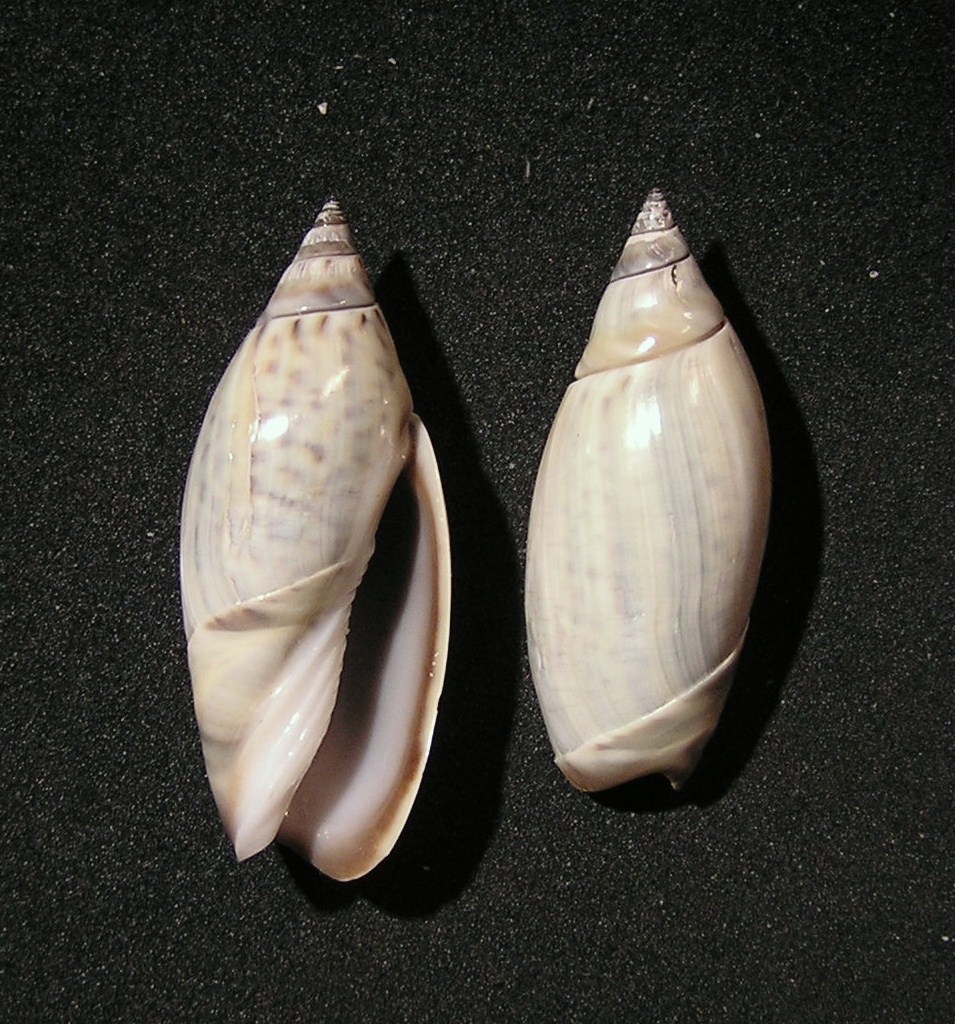
Agaronia testacea
IUCN status: Not evaluated
Felicioliva kaleontina
IUCN status: Not evaluatedFelicioliva peruviana
IUCN status: Not evaluated
Oliva julieta
IUCN status: Not evaluated
Volute-shaped olive
Olivella volutella
IUCN status: Not evaluatedVullietoliva splendidula
IUCN status: Not evaluated
Giant olive
Oliva incrassata
IUCN status: Not evaluated
Names and sources
Classification
Learn more
Conservation status: no data (IUCN). Taxonomy: PeRMS / WoRMS (CC BY 4.0).