
Bony fishes · Ophichthidae
Yellow snake eel
Ophichthus zophochir Jordan & Gilbert, 1882
Spanish: Anguila amarilla
- Names in Peru
- Anguila amarilla · Culebra marina
- Peruvian Register of Marine Species
- Listed in PeRMS (IMARPE)
Species account
Summary
Distribution and habitat
It is a bottom-dwelling species of the continental margin of the tropical eastern Pacific, from Eureka in California to Paita in the northern Peruvian transition zone; at Huacho and Callao in central Peru it turns up only occasionally, perhaps because of El Niño events. The authors doubt that the northeastern Pacific records reflect a self-sustaining population, and note that larvae of ophichthid eels have never been caught north of Punta San Juanico in Baja California (26°N) [4].
It has not been recorded from the Galápagos or from any other island area [4]. A study of shorefish larvae likewise places it along the continental margin from California to Peru, and lists a maximum depth of 100 m for the species [5].
Biology
Like other eels, it passes through a larval stage called a leptocephalus. In March 1985, 8 larvae of this species were caught over the Galápagos Rift, with standard lengths between 93.5 and 161.0 mm; they were identified by their DNA barcode [5].
In an analysis of the mitochondrial COI gene from 177 samples of rocky-reef fishes in northern Peru, individuals of Ophichthus zophochir showed a divergence of 2.19 %, above 2 %. When compared with sequences from elsewhere in the eastern Pacific, the authors separated 4 lineages, three from the tropical eastern Pacific and one from the northeastern Pacific, and suggest they could represent more than one species, something other studies must confirm [4].
Ecology
The larvae of most shorefishes stay close to shore, but eel leptocephali, including those of shelf-dwelling ophichthids, are a known exception because they can turn up far out at sea. The catch of 1338 shorefish larvae over the Galápagos Rift, at a single site on the equator, included larvae of 77 species or more, many of continental origin [5].
For the two Ophichthus zophochir larvae found in the open ocean, the authors of the genetic study consider that currents may have carried them from Baja California, since the adult has not been recorded on islands [4].
Conservation
Where to see it in Peru
The Peruvian specimens of this species known from the literature come from scuba sampling on rocky reefs of northern Peru, under a permit from the Ministry of Production, at Isla Foca, along the stretch between Cabo Blanco and Los Órganos and at Punta Sal. In total 226 fishes of 82 species were collected, and the study does not say at which of those places each specimen was found, nor does it document sightings by divers [4].
References (5)
- WoRMS Editorial Board (2026). Ophichthus zophochir Jordan & Gilbert, 1882. World Register of Marine Species. https://www.marinespecies.org/aphia.php?p=taxdetails&id=271991 (accessed 2026-10-25)
- Froese, R., Pauly, D. (2026). Ophichthus zophochir Jordan & Gilbert, 1882, Yellow snake eel. FishBase. https://www.fishbase.se/summary/Ophichthus-zophochir.html (accessed 2026-10-25)
- McCosker, J., Béarez, P., Lea, B. (2007). Ophichthus zophochir: McCosker, J., Béarez, P. & and Lea, B. The IUCN Red List of Threatened Species 2010: e.T183678A8156942. doi:10.2305/iucn.uk.2010-3.rlts.t183678a8156942.en (accessed 2026-10-25)
- Zavala, E., Britzke, R., Siccha-Ramírez, Z. et al. (2025). DNA barcoding of marine rocky reef fishes from northern Peru suggests a parapatric speciation in the Tropical Eastern Pacific. Ecology and Evolution, e70125. doi:10.1002/ece3.70125 (accessed 2026-10-25)
- Victor, B.C. (2024). Rapid long-distance multispecies transport of shorefish larvae to the oceanic tropical eastern Pacific, revealed by DNA barcodes and otolith aging of larvae captured over the Galapagos Rift. NOAA Professional Paper NMFS. doi:10.7755/pp.24.19 (accessed 2026-10-25)
More pictures
Where it has been recorded
- Filled: scientific records, or confirmed by a curator
- Hatched: isolated record
- Dotted outline: no scientific records and no curator's confirmation (an ORKA sighting is not drawn here)
- Tropical northern sea
Scientific records (6 records)
- Tropical–cold transition zone
Scientific records (2 records)
From openly licensed OBIS and GBIF records (CC0 or CC BY). How each list is built.
Related species
From the same genus (Ophichthus) and from the same family (Ophichthidae).
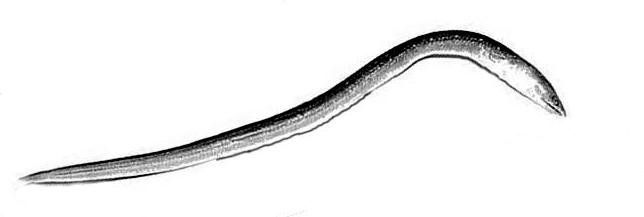
Punctuated snake-eel
Ophichthus remiger
IUCN status: LC · Least Concern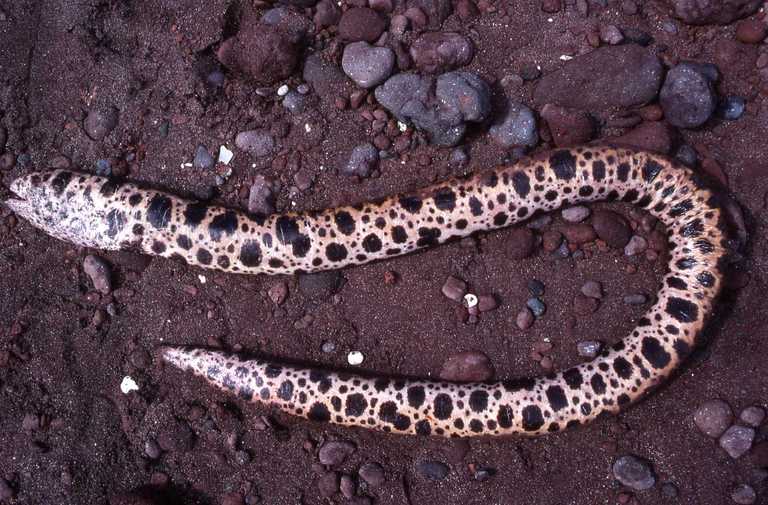
Pacific snake eel
Ophichthus triserialis
IUCN status: LC · Least ConcernDeathbanded snake eel
Ophichthus frontalis
IUCN status: LC · Least Concern- No openly licensed image yet
Ophichthus tetratrema
IUCN status: LC · Least Concern Ophichthus unicolor
IUCN status: DD · Data DeficientFangjaw eel
Echiophis brunneus
IUCN status: LC · Least ConcernMustachioed snake eel
Herpetoichthys fossatus
IUCN status: LC · Least Concern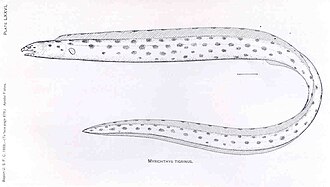
Tiger snake eel
Myrichthys tigrinus
IUCN status: LC · Least Concern
Names and sources
In Spanish
- Anguila amarilla — Peru; fishbase; Wikidata · main name
- Culebra marina — Peru; fishbase
- Tieso amarillo — WoRMS
In English
- Yellow snake eel — WoRMS; Wikidata
Classification
Learn more
Conservation status: Least Concern (IUCN Red List, according to Wikidata). Taxonomy: PeRMS / WoRMS (CC BY 4.0).