
Bony fishes · Ophichthidae
Punctuated snake-eel
Ophichthus remiger (Valenciennes, 1837)
Spanish: Anguila común
- Names in Peru
- Anguila común
- Peruvian Register of Marine Species
- Listed in PeRMS (IMARPE)
Species account
Summary
Ophichthus remiger is a snake-eel of the family Ophichthidae, order Anguilliformes [1]. It lives in the eastern Pacific, from Nicaragua to Chile, at depths of 15 to 277 m, and can reach 85 cm in total length [2]. It inhabits muddy and sandy-mud bottoms, and in northern Peru it supports one of the most important fisheries for the species, with output going mainly to the Asian market [3]. Its global IUCN Red List category is Least Concern [4].
Etymology
The genus name joins two Greek words, ophis, meaning serpent, and ichthys, meaning fish [2]. The epithet remiger refers to the type locality of the species, Port Rame in Chile, which today corresponds to Estero Rama, south of Valparaíso [2]. The species was described by Valenciennes in 1837 and the WoRMS record accepts it as the valid name [1].
In Peru it is known as «anguila común» [2]. The 2008 rule that set its minimum size lists it under the common name anguila in its annex of marine fishes [5].
Identification and similar species
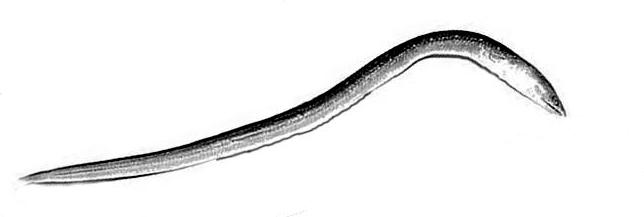
The body is elongate and eel-like, with 150 to 160 vertebrae [2]. The largest recorded length is 85 cm in total length, and a typical fish measures about 60 cm [2]. The minimum catch size set in Peru is 42 cm in total length [6].
Young fish of 19 to 25 cm in total length, obtained by IMARPE off Paita in 2023, were used to describe the sagittal otoliths of the species: they are oval, laterally compressed and slightly crenulated at the edge, with a roughly circular opaque centre [3]. The age of the species has mostly been estimated from the annual rings of these otoliths [3].
Distribution and habitat
It inhabits the eastern Pacific, from Nicaragua to Chile [2]. It is a marine, demersal species that lives between 15 and 277 m depth [2]. It is associated with muddy and sandy-mud bottoms [3].
In Peru the biological information comes mostly from the north of the country, where IMARPE obtained specimens off Paita during the summer and winter of 2023 [3]. A 2026 study notes that specimens have been recorded at depths close to 400 m, with a clear stratification of sizes by depth [3]. The fishery regulation applies throughout the Peruvian maritime domain [6].
Biology
Like other eels of the order, its early development includes a leptocephalus phase before metamorphosis [3]. The otoliths of 35 juveniles between 19 and 25 cm in total length, analysed in the study, keep marks of the nucleus, hatching, first feeding and metamorphosis [3].
According to the count of daily increments in those otoliths, the leptocephalus phase lasts more than 3 months: the first metamorphic mark appears at about 101 days and the metamorphic zone ends at about 142 days [3]. The intervals between marks were estimated at 13 days during metamorphosis and 25 days in the postmetamorphic phase [3]. The otolith grows about 1.20 micrometres per day in the first increments, 2.11 micrometres per day in mid-metamorphosis and 2.0 micrometres per day in its final phase [3].
In adults, age has been estimated from the annual rings of the sagittal otoliths, but the published growth parameters differ between studies [3]. FishBase gives 48.5 cm in total length as the size at first maturity, without stating the range of that value [2].
Conservation
Its global IUCN Red List category is Least Concern [4].
In February 2008 IMARPE concluded, from biological and fishery indicators that had declined throughout the whole historical series, that the resource was at risk of overexploitation, because of falling abundance indices and annual mean sizes and an excessive increase in fishing effort [5]. On 14 May 2008 the Ministry of Production therefore set a minimum catch size of 42 cm in total length, with a maximum tolerance of 20 % in number of undersized fish, which must be released at sea during fishing [5].
Supreme Decree 018-2024-PRODUCE, of December 2024, approved a new regulation that keeps that minimum size and that 20 % tolerance [6]. If the catch of undersized fish exceeds 20 % for 3 consecutive days, or on 5 alternate days within a period of 7 days, the Ministry, on IMARPE's recommendation, suspends fishing in the area for up to 7 consecutive days [6]. The regulation also provides for reproductive closures, whose start, area and duration are set according to IMARPE's recommendations, and for an annual total allowable catch [6].
Human relevance
In northern Peru it supports one of the most important fisheries for the species, and its output goes mainly to the Asian market [3]. The 2024 regulation reserves the catch exclusively for direct human consumption [6].
The fishery is small-scale: it uses national-flag vessels fitted with pot-type eel traps [6]. Vessels may not exceed 17 m in length or 32.6 m³ of hold capacity, and the number of traps depends on length: up to 500 below 8.99 m, up to 700 between 9.00 and 13.00 m and up to 1000 above 13.00 m [6]. Owners must keep a satellite tracking system operating and vessels must keep a fishing logbook; in addition, when IMARPE requires it, they must carry a scientific technician from that institute on board [6].
References (6)
- WoRMS Editorial Board (2026). Ophichthus remiger (Valenciennes, 1837). World Register of Marine Species. https://www.marinespecies.org/aphia.php?p=taxdetails&id=271976 (accessed 2026-10-25)
- Froese, R., Pauly, D. (2026). Ophichthus remiger (Valenciennes, 1837), Punctuated snake-eel. FishBase. https://www.fishbase.se/summary/Ophichthus-remiger.html (accessed 2026-10-25)
- Usca, L., Alarco, A., Orosco, E. et al. (2026). Caracterización de microestructuras en otolitos de juveniles de anguila Ophichthus remiger del norte del Perú. Boletín del Instituto del Mar del Perú, e459. doi:10.53554/boletin.v41i1.459 (accessed 2026-10-25)
- McCosker, J., Béarez, P., Lea, B. (2007). Ophichthus remiger: McCosker, J., Béarez, P. & and Lea, B. The IUCN Red List of Threatened Species 2010: e.T183666A8154753. doi:10.2305/iucn.uk.2010-3.rlts.t183666a8154753.en (accessed 2026-10-25)
- Ministerio de la Producción (2008). Resolución Ministerial N° 486-2008-PRODUCE: Establecen la talla mínima de captura del recurso anguila Ophichthus remiger y prohíben su extracción, descarga, transporte, procesamiento y comercialización en tallas inferiores a la establecida. Diario Oficial El Peruano, 14 May 2008. https://faolex.fao.org/docs/pdf/per85567.pdf (accessed 2026-10-25)
- Ministerio de la Producción (2024). Decreto Supremo N° 018-2024-PRODUCE: Decreto Supremo que aprueba el Reglamento de Ordenamiento Pesquero del recurso anguila (Ophichthus remiger). Diario Oficial El Peruano, diciembre de 2024. https://www.gob.pe/institucion/produce/normas-legales/6254554-018-2024-produce (accessed 2026-10-25)
More pictures
Where it has been recorded
- Filled: scientific records, or confirmed by a curator
- Hatched: isolated record
- Dotted outline: no scientific records and no curator's confirmation (an ORKA sighting is not drawn here)
- Tropical northern sea
Scientific records (1 record)
- Tropical–cold transition zone
Scientific records (2 records)
- Cold central sea
Scientific records (9 records)
- Cold southern sea
Scientific records (7 records)
From openly licensed OBIS and GBIF records (CC0 or CC BY). How each list is built.
Related species
From the same genus (Ophichthus) and from the same family (Ophichthidae).
Pacific snake eel
Ophichthus triserialis
IUCN status: LC · Least ConcernYellow snake eel
Ophichthus zophochir
IUCN status: LC · Least ConcernDeathbanded snake eel
Ophichthus frontalis
IUCN status: LC · Least Concern- No openly licensed image yet
Ophichthus tetratrema
IUCN status: LC · Least Concern Ophichthus unicolor
IUCN status: DD · Data DeficientFangjaw eel
Echiophis brunneus
IUCN status: LC · Least ConcernMustachioed snake eel
Herpetoichthys fossatus
IUCN status: LC · Least Concern
Tiger snake eel
Myrichthys tigrinus
IUCN status: LC · Least Concern
Names and sources
In Spanish
- Anguila común — Peru; fishbase; Wikidata · main name
In English
- Punctuated snake-eel — Wikidata
Classification
Learn more
Conservation status: Least Concern (IUCN Red List, according to Wikidata). Taxonomy: PeRMS / WoRMS (CC BY 4.0).