
Seabirds · Hydrobatidae
Wedge-rumped storm petrel
Oceanodroma tethys (Bonaparte, 1852)
Spanish: Golondrina de la tempestad peruana
- Names in Peru
- Golondrina de la tempestad peruana
- Peruvian Register of Marine Species
- Listed in PeRMS (IMARPE)
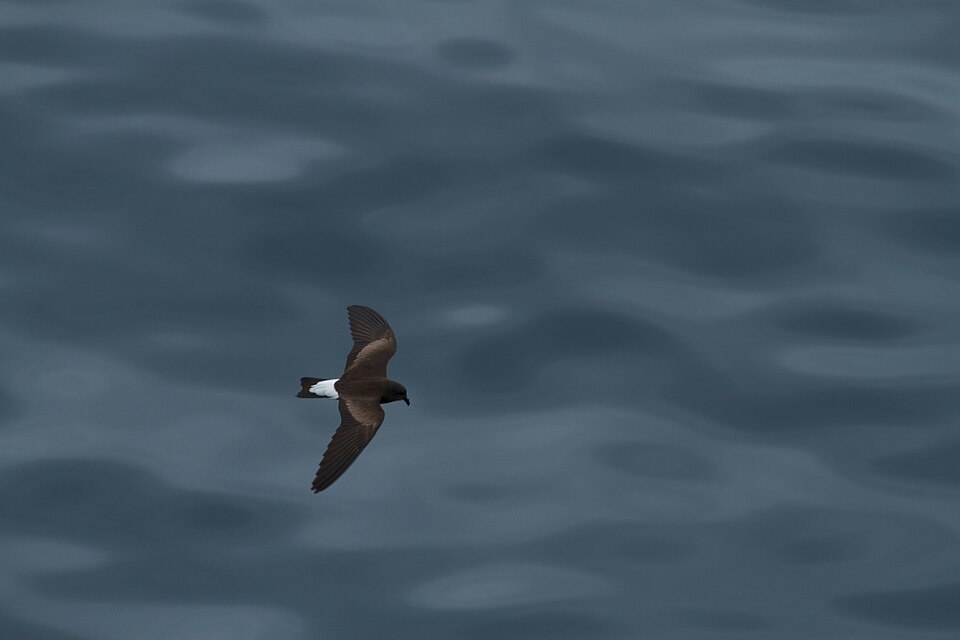
Species account
Summary
Oceanodroma tethys is a storm-petrel of the family Hydrobatidae described by Bonaparte in 1852; some authors now place it in Hydrobates [1],[2]. In Peru it is called «golondrina de la tempestad peruana» [3]. Birds breeding on the Peruvian coast belong to the subspecies Oceanodroma tethys kelsalli, and those of the Galápagos Islands to the nominate subspecies [4]. Until 2008 only about 800 breeding pairs were known, spread over one island in Chile and four in Peru [5].
Identification and similar species
It is a small storm-petrel: six adults measured on Chao and Corcovado islands averaged a wing of 123 mm and a tarsus of 21.7 mm, and seven adults a mass of 23 g [6]. What separates it from other white-rumped storm-petrels is the extent of the white, which covers more than half the length of the tail; in addition, the webbing between the toes is black, not yellow as in Oceanites oceanicus [4].
Oceanodroma leucorhoa is larger, and in it and in Oceanodroma socorroensis the pale diagonal wing bar is distinct and the white rump patch much smaller, whereas in Oceanodroma tethys that bar is indistinct or absent [4]. The subspecies can only be told apart from measurements taken in the hand, so at sea kelsalli cannot be separated from the nominate form [4],[5]. Eggs from Santa Island averaged 26.2 mm by 19.9 mm, and the chicks were covered in down [5].
Distribution and habitat
It is a species of the tropical eastern Pacific, recorded at sea along a stretch running from Baja California Sur down to northern Chile [4]. The nominate subspecies breeds in the Galápagos and ranges north over oceanic waters; kelsalli breeds in Peru and moves from Mexico to Chile over the continental shelf [4]. The northernmost record is a bird found dead in Humboldt Bay, California, at 40.7° N, on 1 May 2016 [4]; four of California's 13 records date from 2015, a year of near-record El Niño [4].
In Peru it was first found breeding in 1912, in natural crevices on the islets of Gallinazo and Guaca, in the Pescadores Islands, and on San Gallán Island [5]. Colonies were later found on Chao and Corcovado islands, at 8°46′ S and 8°56′ S [6], on Ferrol, with 176 nests [5], and on Santa Island, at 9°01′ S [5]. Farther north, Foca Island holds the northernmost known colony of the subspecies [2]; the master plan of the Mar Tropical de Grau National Reserve states that it is only known to nest on five islands of the Peruvian coast [3].
Most nests are in the gaps of pircas, dry-stone walls built on guano islands to avoid losing guano; some are in natural crevices [6]. On Chao, 11 nest openings averaged 100 mm across the widest side and 47 mm across the narrowest, and the mean depth was 300 mm [6].
Biology
In Peru laying peaks in April and May [5]. The April 2003 censuses already found eggs on Chao, 35 of 42 occupied nests (83%), and on Corcovado, 25 of 45 (56%) [6]. On Santa Island, on 29 and 30 April 2007, 407 active nests were counted, 92 with eggs and 7 with chicks [5]. On Foca Island, in April 2006, 28 nests were recorded: 46% held chicks and 54% eggs; the nests were small holes in the rock, with no building material [2].
The season may be longer than assumed: on Santa Island abandoned eggs were found on 24 and 25 December 2002, with no adults, and island staff said the birds had nested several months earlier [5]. Censuses were made at dusk and at night, between 18 and 20 h on Chao and Corcovado and between 18 and 23 h on Santa, and counted only nests with a visible egg or an adult in view [6],[5].
Eggs from Chao and Corcovado averaged 26.2 mm by 19.5 mm [6]. Adults on Santa averaged 20.7 g [5].
Ecology
On Santa Island, most nests were near the keeper's house in the east; a single wall held 82 [5]. In the south and southwest, where about 4500 boobies (Sula variegata) and 500 guanay cormorants (Phalacrocorax bougainvillii) nested, only 65 nests were found, and ticks were abundant, which can kill chicks and make birds desert nests [5]. On walls covered with moss and algae, because of the humidity, there were no nests at all [5].
In the north of Santa 26 nests were counted in a sector with a large colony of terns (Larosterna inca); where storm-petrels are numerous the terns do not nest, although where terns are numerous some storm-petrels do [5]. Possible predators on the island include the Kelp Gull (Larus dominicanus) and the Peregrine Falcon (Falco peregrinus), and the island has no terrestrial predators; beside the northern walls a pair of dismembered wings of a storm-petrel of this species was found [5].
The authors note that Chimbote Bay lies near an important upwelling zone and that the nesting season seems to coincide with the peak of anchoveta (Engraulis ringens) recruitment [5].
Conservation
In 2008 the authors noted that it was not protected by the Peruvian state for lack of information [5]. Against 800 known pairs stand offshore estimates of 1,258,700 and 1,451,800 birds of the subspecies, which the same authors take from another work; for that reason they call for more surveys of nesting areas [5].
Chao and Corcovado have no large colonies of guano birds, and no guano has been taken there for more than 20 years; it was therefore suggested that the storm-petrels may have colonised the islands as disturbance fell, or else had always been in the walls unseen [6]. Foca Island is listed as an Important Bird Area and forms part of the Mar Tropical de Grau National Reserve [3].
Where to see it in Peru
Storm-petrels of this subspecies nest on Peruvian islands: Chao, Corcovado, Ferrol and Santa, on the north-central coast, and Foca Island, in Piura [5],[2],[3]. Santa Island is administered by PROABONOS, which regulates disturbance of the guano birds, and these authors' research on Chao, Corcovado and Santa required its authorisation [6],[5].
The nests are hidden in stone walls and their activity cannot be detected from outside, so on Santa they were searched for with a torch and, where they were few, with playback of calls [5].
References (6)
- WoRMS Editorial Board (2026). Oceanodroma tethys (Bonaparte, 1852). World Register of Marine Species. https://www.marinespecies.org/aphia.php?p=taxdetails&id=343969 (accessed 2026-10-21)
- García-Olaechea, D.A., Chávez-Villavicencio, C.L., Novoa-Cova, J.J. (2020). A new breeding colony of the Wedge-rumped Storm-Petrel (Hydrobates tethys kelsalli, Lowe 1925) on Foca Island, extreme Northwestern Peru. Revista Peruana de Biología, 225-228. doi:10.15381/rpb.v27i2.15497 (accessed 2026-10-21)
- Servicio Nacional de Áreas Naturales Protegidas por el Estado (2026). Plan Maestro de la Reserva Nacional Mar Tropical de Grau 2026–2031. SERNANP, RPE N.° 000052-2026-SERNANP. https://cdn.www.gob.pe/uploads/document/file/9468842/7752998-5-pm_2026-2031_rnmtg-f-f-f-f.pdf (accessed 2026-10-21)
- Kammerichs-Berke, D. (2018). Northernmost record of the Wedge-rumped Storm-Petrel (Oceanodroma tethys). Western Birds, 74-76. doi:10.21199/wb49.1.5 (accessed 2026-10-21)
- Ayala, L., Sanchez Scaglioni, R., Amoros, S. et al. (2008). Una colonia reproductiva de la Golondrina de la Tempestad Peruana, Oceanodroma tethys kelsalli (Lowe 1925), en la Isla Santa, Perú. Revista Peruana de Biología, 117-120. doi:10.15381/rpb.v15i1.1687 (accessed 2026-10-21)
- Ayala, L., Mendoza, C., Perez, J. (2004). Two New Breeding Localities for Wedge-rumped Storm-petrel Oceanodroma Tethys Kelsalli in Peru. Marine Ornithology, 107-108. doi:10.5038/2074-1235.32.1.604 (accessed 2026-10-21)
More pictures
Where it has been recorded
- Filled: scientific records, or confirmed by a curator
- Hatched: isolated record
- Dotted outline: no scientific records and no curator's confirmation (an ORKA sighting is not drawn here)
- Tropical northern sea
Scientific records (57 records)
- Tropical–cold transition zone
Scientific records (63 records)
- Cold central sea
Scientific records (484 records)
- Cold southern sea
Scientific records (653 records)
From openly licensed OBIS and GBIF records (CC0 or CC BY). How each list is built.
Related species
From the same genus (Oceanodroma) and from the same family (Hydrobatidae).
Hornby's storm petrel
Oceanodroma hornbyi
IUCN status: Not evaluatedMarkham's storm petrel
Oceanodroma markhami
IUCN status: Not evaluatedProtected in Peru
Black storm petrel
Oceanodroma melania
IUCN status: Not evaluated
Least storm petrel
Oceanodroma microsoma
IUCN status: Not evaluated
White-bellied storm petrel
Fregetta grallaria
IUCN status: LC · Least Concern
Elliot's storm petrel
Oceanites gracilis
IUCN status: DD · Data Deficient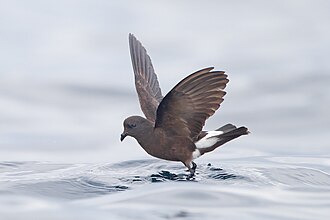
Wilson's storm petrel
Oceanites oceanicus
IUCN status: LC · Least Concern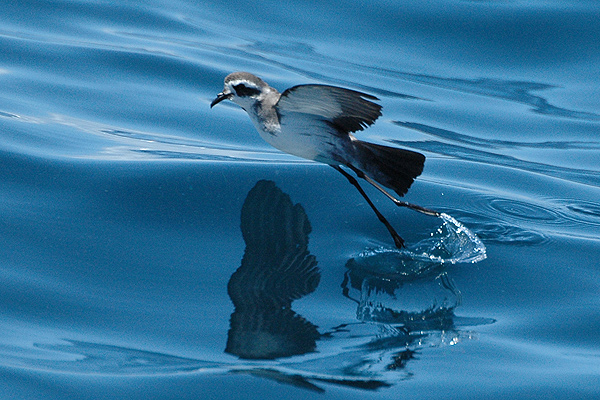
White-faced storm petrel
Pelagodroma marina
IUCN status: LC · Least Concern
Names and sources
In Spanish
- Golondrina de la tempestad peruana — Peru; SERNANP (2026). Plan Maestro de la Reserva Nacional Mar Tropical de Grau 2026–2031. RPE N.° 000052-2026-SERNANP, p. 29 of the PDF · main name
- Paíño de Galápagos — Wikidata
In English
- Wedge-rumped storm petrel — WoRMS; Wikidata
- Galapagos storm-petrel — WoRMS
Also cited as
- Hydrobates tethys
Classification
Learn more
Conservation status: no data (IUCN). Taxonomy: PeRMS / WoRMS (CC BY 4.0).