
Seabirds · Hydrobatidae
Hornby's storm petrel
Oceanodroma hornbyi (G. R. Gray, 1864)
Spanish: Paíño acollarado
- Peruvian Register of Marine Species
- Listed in PeRMS (IMARPE)

Species account
Summary
Oceanodroma hornbyi (G. R. Gray, 1864) is a storm petrel, one of the smallest seabirds of the order Procellariiformes, belonging to the Humboldt Current ecosystem [1], with a range from Ecuador to Chile [2]. Its accepted name in WoRMS is Oceanodroma hornbyi [3].
In Peruvian waters it is one of the two most common storm petrels. In 2019, observers on IMARPE cruises counted 556 birds in summer, 331 in autumn and 496 in spring [1]. No breeding colony is yet known in Peru, and what is best known about it in Peru comes from birds that fall in coastal cities, disoriented by lights [1],[4].
Identification and similar species
It is a small seabird of the family Hydrobatidae, among the tiniest members of the order that also holds albatrosses, petrels and shearwaters [1]. SERFOR asks that it not be mistaken for pigeons, doves or ground-doves when one turns up in a city, and names tube-shaped nostrils and webbed feet as features [4].
At sea off Peru it shares its range with Oceanodroma markhami, the other most common storm petrel there [1]. In the 2019 shipboard counts they were logged separately: 556, 331 and 496 individuals of Oceanodroma hornbyi in summer, autumn and spring, against 231, 154 and 333 of Oceanodroma markhami [1].
Distribution and habitat
The species is restricted to the cold waters of the Humboldt Current in the Pacific, from northern Ecuador to central Chile [2]. A bird that looked exhausted was found on 25 April 2020 in San Martín de los Andes, Neuquén (Argentina), more than 1000 km south of its known range; the day before there had been a brief, intense thunderstorm [2].
In summer 2019 it was seen off the Peruvian coast between Paita (5° S) and the Chilean border (18° S), with moderate concentrations south of Huarmey (10° S) and the highest one between 14° S and 16° S and at 18° S [1]. In autumn the pattern repeated, with more presence south of 14° S and the largest aggregation south of 13° S, off Ica, Arequipa, Moquegua and Tacna; in spring there were large (100 to 500 birds) and medium (50 to 100) concentrations throughout its range [1].
The mean distance of sightings from the coast was 42.8 nautical miles in summer, 38.5 in autumn and 63.4 in spring, with a minimum of 2.8 and a maximum of 112.9 miles across the year [1]. It was found in cold coastal waters, in subtropical surface waters and in the mixed waters between the two [1].
Biology
No breeding colony that can be monitored has been found in Peru. The first colony of the species on the South American coast was discovered in Chile, in the Atacama Desert, where the nests were in crevices and crusts [1]. It has been suggested that in Peru it might breed in high Andean areas, but its nesting place is still not known with precision [1],[4].
Romero, drawing on other authors' studies, reports that the breeding cycle would run from December to June and that juveniles still downy land on the coast from April to July, when they would be leaving the nest for the sea [1]. SERFOR notes that in Arequipa these birds are frequently found between June and September, and in a note of 3 April 2025 it reported the rescue of a juvenile in Tacna [4],[5]. In 2019 the southward pull-back in summer and autumn matched that season, which the author takes as a clue to where the nests are [1].
Ecology
Because it was seen in three water masses, Romero infers a flexible diet, and proposes that during breeding (summer and autumn), when it is mostly in cold coastal waters, it could be feeding on a very abundant resource such as anchoveta; this is a hypothesis based on where it was seen, not a verified diet [1].
According to that author, an earlier study found the highest autumn concentration off Paracas and higher density where salinity is higher; she found a similar relation in her own data between the number of birds (both species) and salinity [1]. The breeding periods of this species and of Oceanodroma markhami would overlap for only a few months, which could ease competition for prey and space [1].
For birds of the Humboldt Current, El Niño is one of the main causes of dispersal, because it reduces food in the eastern Pacific and forces many to move [2].
Conservation
The Peruvian State protects the species, as SERFOR states on the basis of the first complementary final provision of Supreme Decree 019-2015-MINAGRI [5].
The best-documented threat in Peru is artificial light. SERFOR explains that intense lighting disrupts the birds' navigation and can cause disorientation, momentary blindness and collisions with buildings, poles and vehicles [5]. Romero recommends identifying and protecting breeding areas, avoiding human settlements that cast light pollution on juveniles heading out to sea [1].
By 1 July 2025, SERFOR had received 29 birds from urban Arequipa that season, and since 2020 more than 400 have been reported in the region and returned to their habitat [4].
Human relevance
Most of what is known about its biology in Peru comes from birds that fell on the coast: reports from local people and rehabilitation projects, promoted by scientists and by the State, have supplied data that the open sea does not give [1].
SERFOR treats and rehabilitates the birds and releases them on the beaches of Islay province, in Arequipa. For anyone who finds a bird, it advises using gloves or a cloth, placing it in a cardboard box with ventilation holes and a soft base, and not feeding it, because it has a special diet [4].
Where to see it in Peru
It is an open-sea bird: on the 2019 IMARPE cruises it was seen between 2.8 and 112.9 nautical miles from the coast, with a mean of 38.5 to 63.4 depending on the season, so seeing it depends on going far out by boat [1]. The three 2019 cruises covered, depending on the season, from Tumbes or Lobos de Tierra island to Tacna (and in spring to 18°20' S) [1].
Juveniles that turn up in yards and streets of coastal cities between June and September in Arequipa are disoriented birds that fell by accident, not a way of watching the species; SERFOR asks that they be handed in to its offices [4]. No breeding site is known in Peru [1].
References (5)
- Romero, C. (2021). Distribución espacio-temporal de la golondrina de mar de Markham Oceanodroma markhami (Salvin, 1883) y la golondrina de mar acollarada O. hornbyi (Gray, 1854) en Perú. 2019. Boletín del Instituto del Mar del Perú, 68-84. doi:10.53554/boletin.v36i1.320 (accessed 2026-10-25)
- Astete, M., Gingins, R. (2020). Hallazgo del Paíño De Collar (Oceanodroma hornbyi) en el noroeste patagónico: una nueva especie para la avifauna argentina. Nuestras Aves, 92-93. doi:10.56178/na.vi65.171 (accessed 2026-10-25)
- WoRMS Editorial Board (2026). Oceanodroma hornbyi (G. R. Gray, 1864). World Register of Marine Species. https://www.marinespecies.org/aphia.php?p=taxdetails&id=343964 (accessed 2026-10-25)
- SERFOR (2025). Arequipa: SERFOR rescata y libera 29 golondrinas de la tempestad de collar encontradas en zona urbana. Nota de prensa, Servicio Nacional Forestal y de Fauna Silvestre (1 July 2025). https://www.gob.pe/institucion/serfor/noticias/1201767-arequipa-serfor-rescata-y-libera-29-golondrinas-de-la-tempestad-de-collar-encontradas-en-zona-urbana (accessed 2026-10-25)
- SERFOR (2025). SERFOR rescata a golondrina de mar encontrada en urbanización de Tacna. Nota de prensa, Servicio Nacional Forestal y de Fauna Silvestre (3 April 2025). https://www.gob.pe/institucion/serfor/noticias/1139535-serfor-rescata-a-golondrina-de-mar-encontrada-en-urbanizacion-de-tacna (accessed 2026-10-25)
More pictures
Where it has been recorded
- Filled: scientific records, or confirmed by a curator
- Hatched: isolated record
- Dotted outline: no scientific records and no curator's confirmation (an ORKA sighting is not drawn here)
- Tropical northern sea
Scientific records (21 records)
- Tropical–cold transition zone
Scientific records (36 records)
- Cold central sea
Scientific records (366 records)
- Cold southern sea
Scientific records (889 records)
From openly licensed OBIS and GBIF records (CC0 or CC BY). How each list is built.
Related species
From the same genus (Oceanodroma) and from the same family (Hydrobatidae).
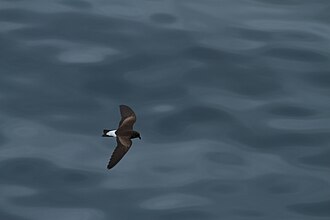
Wedge-rumped storm petrel
Oceanodroma tethys
IUCN status: Not evaluatedMarkham's storm petrel
Oceanodroma markhami
IUCN status: Not evaluatedProtected in Peru
Black storm petrel
Oceanodroma melania
IUCN status: Not evaluated
Least storm petrel
Oceanodroma microsoma
IUCN status: Not evaluated
White-bellied storm petrel
Fregetta grallaria
IUCN status: LC · Least Concern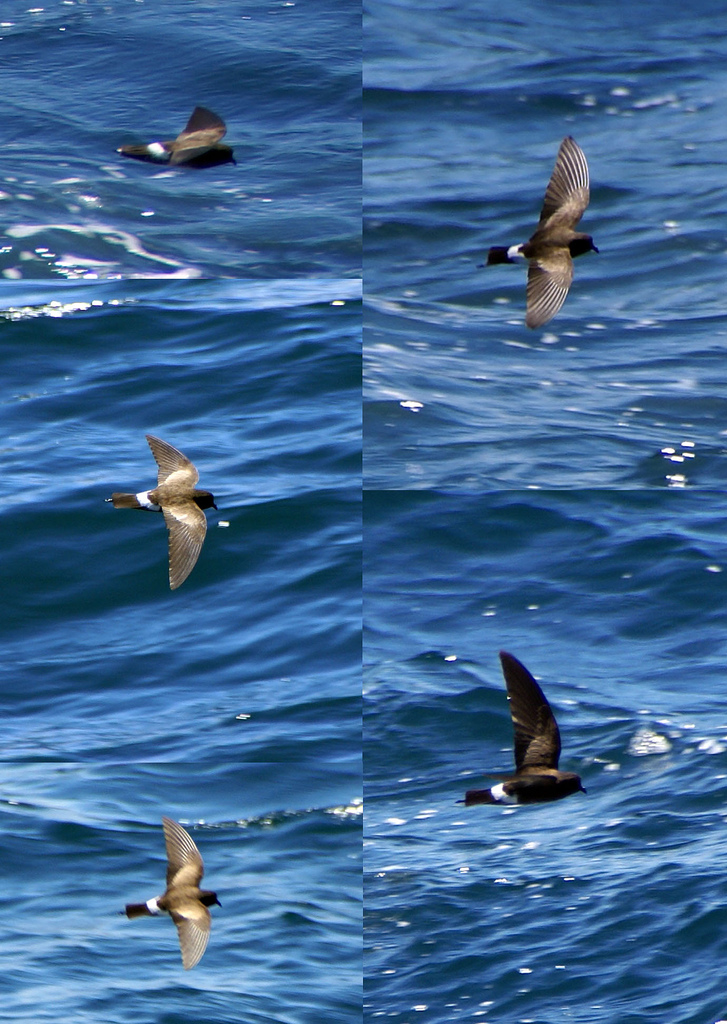
Elliot's storm petrel
Oceanites gracilis
IUCN status: DD · Data Deficient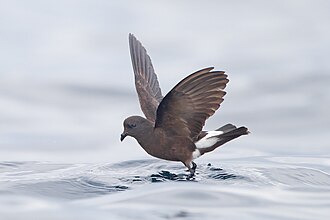
Wilson's storm petrel
Oceanites oceanicus
IUCN status: LC · Least Concern
White-faced storm petrel
Pelagodroma marina
IUCN status: LC · Least Concern
Names and sources
In Spanish
- Paíño acollarado — Wikidata · main name
In English
- Hornby's storm petrel — WoRMS; Wikidata
Classification
Learn more
Conservation status: no data (IUCN). Taxonomy: PeRMS / WoRMS (CC BY 4.0).