
Bony fishes · Myctophidae
Lanternfish
Myctophum nitidulum Garman, 1899
Spanish: Mictófido
- Names in Peru
- Mictófido · Pez linterna
- Peruvian Register of Marine Species
- Listed in PeRMS (IMARPE)

Species account
Summary
Myctophum nitidulum is a small lanternfish, up to 8.3 cm in standard length, that lives in tropical and subtropical waters of almost every ocean [1]. It belongs to the myctophids, deep-water fishes that rise toward the surface at night [2].
In Peru it is known mainly from its larvae, found on the 2015 surveys of the Instituto del Mar del Perú, and adults have been caught in the southeastern Pacific off northern Chile [3],[4].
Identification and similar species
It has cycloid scales, that is, without a toothed edge, and shows no spines in the dorsal or anal fins [1]. The dorsal fin has 12 to 14 soft rays and the anal fin 18 to 21, and the backbone has between 36 and 39 vertebrae [1].
Within its genus, the angular, unserrated rear-upper margin of the gill cover separates it from the other Myctophum species with cycloid scales [1]. Males carry 5 to 8 luminous spots on the supracaudal gland and females 2 to 6 small ones on the infracaudal gland [1].
It is small: the largest specimen of the Chilean survey measured 85 mm in standard length, somewhat above the 75 mm that had been considered the maximum [4]. Females mature at about 4.8 cm and males at about 3.5 cm [1].
Distribution and habitat
It is a circumglobal species of tropical and subtropical waters. In the Pacific it ranges from about 32° N to about 31° S, and reaches about 40° N with the Kuroshio Current [1]. It is recorded between 412 and 1537 m depth, although at night it rises toward shallower water [1].
In the southeastern Pacific, a Chilean survey using a midwater trawl caught the species in summer north of 23° S, and with a surface net as far as 26°30' S, between 70°30' and 73° W [4]. The author places it among the species that extend southward in summer within the Peru-northern Chile district, whose southern limit lies near 24° S [4].
Nearly all myctophid specimens on that survey were caught in night-time sampling [4].
Biology
It is a vertical migrant that rises into the surface layer at night; in the Kuroshio, specimens of 50.3 to 78.8 mm standard length were taken in night tows of a surface net, less than a metre below the water line [2]. In 10 of the 18 years studied (before 1975 and after 1991) it fed mainly on small crustaceans such as euphausiids, copepods and amphipods [2].
Its feeding follows a night-time rhythm, with peaks between 20:00 and 21:00 h and between 03:00 and 04:00 h, and a daily ration of between 5.2% and 7.8% of its wet weight was estimated [2].
It is oviparous, and its eggs and larvae are planktonic [1]. Larvae appear in zooplankton samples taken down to 50 m depth off Peru [3].
Ecology
In the Kuroshio, over the years 1976 to 1990, Japanese sardine larvae dominated its diet in 7 of 8 years studied, between 20.2% and 61.8% of the weight of stomach contents [2]. Before 1975 and after 1991 small crustaceans dominated, so its diet shifted with the prey available [2].
Surface-migrating myctophids can thus prey on small pelagic fishes in their larval stage [2]. Off Peru its larvae made up only 0.2% of total ichthyoplankton abundance in summer-autumn 2015, in a community dominated by the anchoveta [3].
In winter-spring 2015 larvae of this species were still among the myctophid larvae recorded, although at densities of only 3 to 6 larvae per m2 [5].
Conservation
Human relevance
It has no known commercial value in the sources reviewed; its importance is ecological. As both prey and predator of larvae, it forms part of the food web of the epipelagic zone and can affect small pelagic fishes such as the sardine [2].
In the Kuroshio, one study estimated that the species consumed 24 to 52 billion sardine larvae per night between January and March of the years 1976 to 1990, an estimate its authors regard as conservative [2].
Where to see it in Peru
Adults live in open water and come to the surface only at night [2], and there are no known viewing sites on the Peruvian coast. The Peruvian data come from plankton hauls: larvae were recorded in 2015 mainly in the northern zone, between Punta Sal and Paita, during the summer-autumn cruise, from samples taken at 50 m depth or less [3].
On the August to October cruise of the same year, which covered the sea from Punta Sal to Morro Sama, its larvae were recorded at densities of 3 to 6 larvae per m2 [5].
References (6)
- Froese, R., Pauly, D. (2026). Myctophum nitidulum, Pearly lanternfish. FishBase. https://www.fishbase.se/summary/4490 (accessed 2026-10-25)
- Watanabe, H., Kawaguchi, K. (2003). Decadal change in the diets of the surface migratory myctophid fish Myctophum nitidulum in the Kuroshio region of the western North Pacific: Predation on sardine larvae by myctophids. Fisheries Science, 716-721. doi:10.1046/j.1444-2906.2003.00678.x (accessed 2026-10-25)
- Katia, Aronés, Ayón, P. (2022). Ictioplancton, eufáusidos y biovolúmenes de zooplancton durante el verano-otoño 2015. Boletín del Instituto del Mar del Perú, 234-255. doi:10.53554/boletin.v37i2.370 (accessed 2026-10-25)
- Acuña, E.S. (2024). Distribution of myctophid fishes in the Eastern Pacific Ocean off northern Chile (18°30´ TO 30°30'S). Biologia Pesquera, 63-78. doi:10.21703/0067-8767.1987.16.2515 (accessed 2026-10-25)
- Pinedo, E., Ayón, P. (2023). Ictioplancton, eufáusidos y biovolúmenes de zooplancton del mar peruano, invierno-primavera 2015. Boletín del Instituto del Mar del Perú, 195-214. doi:10.53554/boletin.v38i2.387 (accessed 2026-10-25)
- Hulley, P. (2012). Myctophum nitidulum: Hulley, P. The IUCN Red List of Threatened Species 2015-4: e.T15600453A15603840. doi:10.2305/IUCN.UK.2015-4.RLTS.T15600453A15603840.en (accessed 2026-10-25)
More pictures
Where it has been recorded
- Filled: scientific records, or confirmed by a curator
- Hatched: isolated record
- Dotted outline: no scientific records and no curator's confirmation (an ORKA sighting is not drawn here)
- Tropical northern sea
Scientific records (2 records)
- Tropical–cold transition zone
Scientific records (2 records)
- Cold central sea
Scientific records (5 records)
- Cold southern sea
Scientific records (11 records)
From openly licensed OBIS and GBIF records (CC0 or CC BY). How each list is built.
Related species
From the same genus (Myctophum) and from the same family (Myctophidae).
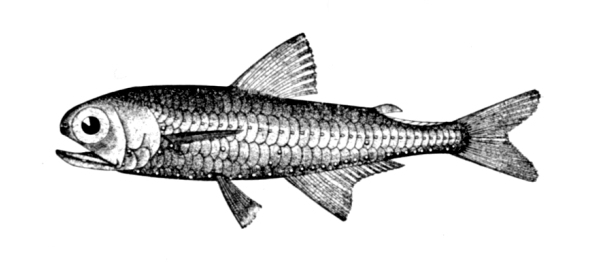
Metallic lanternfish
Myctophum affine
IUCN status: LC · Least ConcernMyctophum aurolaternatum
IUCN status: LC · Least Concern- No openly licensed image yet
Diogenes lanternfish
Diogenichthys laternatus
IUCN status: LC · Least Concern 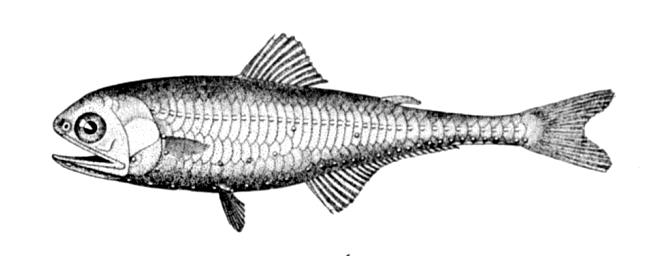
Lanternfish
Gonichthys cocco
IUCN status: LC · Least Concern- No openly licensed image yet
Firefly lanternfish
Hygophum proximum
IUCN status: LC · Least Concern Reinhardt's lanternfish
Hygophum reinhardtii
IUCN status: LC · Least Concern
Lampanyctus omostigma
IUCN status: LC · Least ConcernLampanyctus parvicauda
IUCN status: LC · Least Concern
Names and sources
In Spanish
- Mictófido — Peru; fishbase · main name
- Pez linterna — Peru; fishbase
In English
- Lanternfish — WoRMS
- Pearly lanternfish — WoRMS
- Spotted Lanternfish — Wikidata
Classification
Learn more
Conservation status: Least Concern (IUCN Red List, according to Wikidata). Taxonomy: PeRMS / WoRMS (CC BY 4.0).