
Bony fishes · Myctophidae
Myctophum aurolaternatum
Myctophum aurolaternatum Garman, 1899
Spanish: Pez linterna
- Names in Peru
- Pez linterna · Sardina luminosa
- Peruvian Register of Marine Species
- Listed in PeRMS (IMARPE)
Species account
Summary
Myctophum aurolaternatum is a small lanternfish, reaching 11 cm in standard length, that lives in the open sea and is known in Peru as pez linterna and sardina luminosa [1]. It belongs to the myctophids, deep-water fishes that carry light organs on the body, and it occurs in the Indian and Pacific oceans in a band running roughly from 25° N to 31° S [1].
In the eastern Pacific it has been recorded from about 25° N to about 17° S, and a specimen taken in the summer of 1982 off northern Chile pushed that limit to 18°30' S [2]. In Peruvian waters it is known mainly from larvae found in plankton samples of the Instituto del Mar del Perú in 2015 [3],[4].
Etymology
The genus name, Myctophum, comes from Greek: mykter, nose, and ophis, serpent [1].
Identification and similar species
It is an elongated fish reaching 11 cm in standard length. The dorsal fin has no spines and 9 to 14 soft rays; the anal fin has 21 to 27 soft rays, and the backbone has between 42 and 46 vertebrae [1]. The specimen caught in the summer of 1982 off northern Chile measured 81 mm in standard length, while the largest size known in the literature is 105 mm [2].
Like other myctophids it has luminous organs (photophores) on the body. Males carry a luminous gland above the base of the tail made of 6 to 9 triangular, overlapping scales, and females a gland below the tail with 3 to 7 rounded luminous scales, usually touching one another [1].
Distribution and habitat
The species lives in the open sea, in the mesopelagic zone, and is regarded as oceanodromous, meaning that it travels within the ocean without entering fresh water [1]. It has been reported from the western Indian Ocean, from the Gulf of Aden to the Sofala Bank, from the eastern Indian Ocean, from the seas of southeast Asia and from the eastern Pacific, Hawaii included [1].
In the eastern Pacific it is commonly taken from about 25° N to about 17° S, and westward to about 170° W. The 1982 record off northern Chile, at 18°30' S, extended its range at least during the summer [2]. That study places it among the species of the Peruvian-North Chilean zoogeographic district, which runs roughly from 3° to 24° S, and notes that several of them move farther south in summer [2].
Larval surveys by the Instituto del Mar del Perú confirm its presence in Peruvian waters: on the cruise of 22 February to 31 March 2015 it appeared in 1.44 % of the samples, at 3 larvae per m2 [3], and on a second cruise, between August and October 2015 and between Punta Sal and Morro Sama, in a single sample, also at 3 larvae per m2 [4].
Biology
It is an egg-laying fish, with planktonic eggs and larvae [1]. At night it can be found from the surface down to about 300 m [1]. This agrees with what was seen off Chile, where almost all myctophids were caught at night, suggesting that by day and by night they occupy different depths [2].
In that study, which sampled in 1981 and 1982, the only specimen of this species fell into a surface CalCOFI net, and not into the midwater trawl or the Bongo net, both fished down to 200 m [2].
Conservation
Where to see it in Peru
The only adult reported off northern Chile was caught on an offshore research cruise, with a surface net, and not from the shore [2]. The Peruvian data come from vertical plankton tows with a Hensen net down to 50 m deep, made from research vessels in 2015, with no observation sites open to the public [3],[4].
References (5)
- Froese, R., Pauly, D. (2026). Myctophum aurolaternatum, Golden lanternfish. FishBase. https://www.fishbase.se/summary/Myctophum-aurolaternatum.html (accessed 2026-10-25)
- Acuña, E.S. (2024). Distribution of myctophid fishes in the Eastern Pacific Ocean off northern Chile (18°30´ TO 30°30'S). Biologia Pesquera, 63-78. doi:10.21703/0067-8767.1987.16.2515 (accessed 2026-10-25)
- Katia, Aronés, Ayón, P. (2022). Ictioplancton, eufáusidos y biovolúmenes de zooplancton durante el verano-otoño 2015. Boletín del Instituto del Mar del Perú, 234-255. doi:10.53554/boletin.v37i2.370 (accessed 2026-10-25)
- Pinedo, E., Ayón, P. (2023). Ictioplancton, eufáusidos y biovolúmenes de zooplancton del mar peruano, invierno-primavera 2015. Boletín del Instituto del Mar del Perú, 195-214. doi:10.53554/boletin.v38i2.387 (accessed 2026-10-25)
- Williams, A. (2018). Myctophum aurolaternatum: Williams, A. The IUCN Red List of Threatened Species 2019-2: e.T130350312A130540622. doi:10.2305/IUCN.UK.2019-2.RLTS.T130350312A130540622.en (accessed 2026-10-25)
Where it has been recorded
- Filled: scientific records, or confirmed by a curator
- Hatched: isolated record
- Dotted outline: no scientific records and no curator's confirmation (an ORKA sighting is not drawn here)
- Tropical–cold transition zone
Scientific records (2 records)
- Cold central sea
Scientific records (3 records)
- Cold southern sea
Scientific records (4 records)
From openly licensed OBIS and GBIF records (CC0 or CC BY). How each list is built.
Related species
From the same genus (Myctophum) and from the same family (Myctophidae).
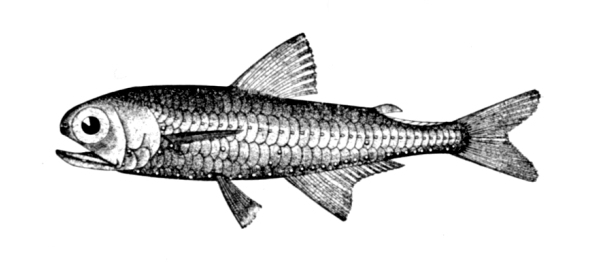
Metallic lanternfish
Myctophum affine
IUCN status: LC · Least Concern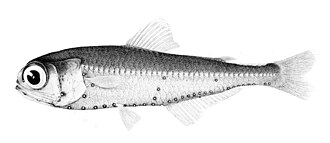
Lanternfish
Myctophum nitidulum
IUCN status: LC · Least Concern- No openly licensed image yet
Diogenes lanternfish
Diogenichthys laternatus
IUCN status: LC · Least Concern 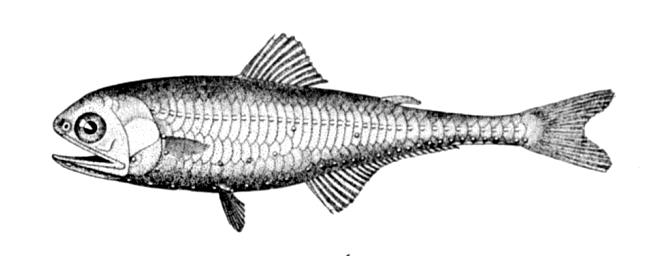
Lanternfish
Gonichthys cocco
IUCN status: LC · Least Concern- No openly licensed image yet
Firefly lanternfish
Hygophum proximum
IUCN status: LC · Least Concern Reinhardt's lanternfish
Hygophum reinhardtii
IUCN status: LC · Least Concern
Lampanyctus omostigma
IUCN status: LC · Least ConcernLampanyctus parvicauda
IUCN status: LC · Least Concern
Names and sources
In Spanish
- Pez linterna — Peru; fishbase · main name
- Sardina luminosa — Peru; fishbase
Classification
Learn more
Conservation status: Least Concern (IUCN Red List, according to Wikidata). Taxonomy: PeRMS / WoRMS (CC BY 4.0).