
Sharks, rays and chimaeras · Triakidae
Speckled smooth-hound
Mustelus mento Cope, 1877
Spanish: Tollo con bandas
- Names in Peru
- Tollo con bandas · Tollo fino
- Peruvian Register of Marine Species
- Listed in PeRMS (IMARPE)
Species account
Summary
Mustelus mento is a shark of the family Triakidae, order Carcharhiniformes [1]. It is a coastal shark, endemic to the southeastern Pacific, living from northern Peru to south-central Chile [2]. In Peru it is known as «tollo fino» or «tollo con bandas» [3]. The IUCN classifies it as Critically Endangered (CR) [4].
Etymology
Identification and similar species
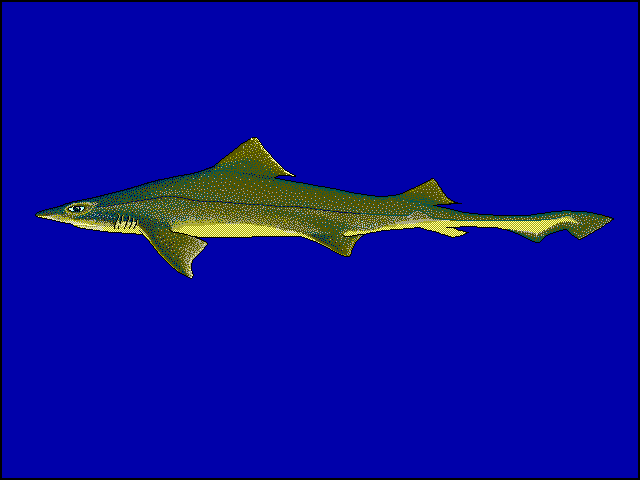
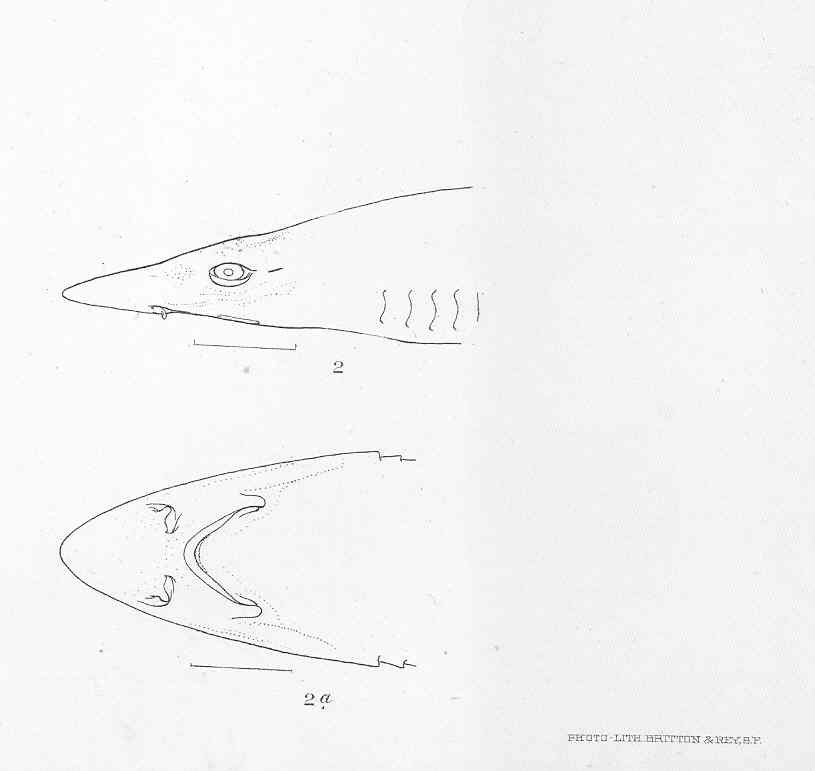
It is a stout-bodied smooth-hound with a short snout, angular and blunt in profile, and a short tail stalk [5]. Its teeth are molar-like and symmetrical, without a cusp and with a broad, rounded crown, a trait that sets it apart from almost every other Mustelus [5]. The rear edge of its dorsal fins is covered with denticles and leaves no fin rays exposed [5].
The back is a uniform grey or grey-brown and the belly pale; it carries many white spots and no dark ones, and individuals under 35 cm also show dark bars [5]. Embryos close to birth already have dark bands on the back and fins edged in dark brown or black [2].
The FAO catalogue gave it a maximum size of 130 cm [5]. However, between 2021 and 2023 females of up to 159.3 cm and males of up to 165.0 cm total length were measured at Antofagasta, northern Chile [2].
Similar species
- Mustelus whitneyi: It is another smooth-hound of the genus, common off Peru, but it has neither white nor dark spots, its teeth carry a distinct cusp and the rear edge of its dorsal fins is bare and dark; it also lives deeper, mostly between 70 and 100 m [5].
Distribution and habitat
It has been reported from the Galápagos Islands, Peru, Chile and the Juan Fernández archipelago; old records from Argentina, in the Atlantic, may belong to other species of the genus [5]. A recent study regards it as endemic to the southeastern Pacific, between northern Peru and south-central Chile [2]. It appears in the updated checklist of cartilaginous fishes of the Peruvian sea [6].
It is a bottom shark of temperate waters, found on continental and island shelves both near the coast and offshore, at depths of 16 to 50 m [5]. In San Jorge Bay, Antofagasta, it is caught with gillnets at 25 to 35 m over sand and mud, in an upwelling area where sea surface temperature ranges from 16 to 22 °C with the season [2].
Biology
Its reproduction had not been described at the population level until 925 individuals landed at Antofagasta were examined between November 2021 and October 2023 [2]. The size at which half of the individuals are mature turned out to be 53.6 cm in females and 48.7 cm in males, far below the 86 to 90 cm and 65 to 76 cm given before [2],[5].
It is viviparous without a placenta: each embryo grows inside a thin, transparent capsule and feeds on its yolk sac, which stays attached throughout development, correcting the idea that it was placental [2]. Nine pregnant females, 106 to 139 cm long, carried 71 embryos in all, in litters of 4 to 12 young split evenly between the two uteri [2].
Embryos appeared only in summer: the smallest, averaging 6.79 cm, in January, and the largest, averaging 12.97 cm, in March [2]. It is estimated to be born at 13 to 14 cm, to give birth in early austral autumn and to have a gestation of about one year [2]. An earlier source spoke of 7 young per litter and about 30 cm at birth [5].
Ecology
In northern Chile both sexes were much more frequent in summer landings, from December to February, than in winter and early spring [2]. The summer abundance of pregnant females suggests that San Jorge Bay serves it in that season as a breeding or nursery area [2].
It shares the coastal bottoms with other elasmobranchs caught in the same nets, such as Mustelus whitneyi, Triakis maculata and Galeorhinus galeus [2]. Because its range is small and it is highly vulnerable to gillnets, the authors of that study propose monitoring it as a sentinel species for the effect of fishing on coastal sharks [2].
Conservation
The IUCN classifies it as Critically Endangered (CR) [4]. The reasons given are that it is fished hard and that no management measure targets this particular species anywhere it occurs [2]. Chile also considers it Critically Endangered in its official classification [2].
It is landed under the market category «tollo», which lumps it with Mustelus whitneyi, Triakis maculata and Galeorhinus galeus, so catch data specific to the species are missing [2]. In Peru, IMARPE reported smooth-hound landings as a single group until 1996, without separating them by species [7].
Most of what was landed in the Antofagasta sample were juveniles: 70.6% of the females and 66.0% of the males had not yet reached their size at maturity [2]. In Peru, the 2001 regulation on minimum sizes sets 60 cm total length for the species, with a tolerance of 20% juveniles [8],[2].
Human relevance
It is regularly caught together with other smooth-hounds for human consumption [5]. Peruvian landing statistics for 1996 to 2010 include records of the species [7].
In northern Chile it is caught mainly with coastal gillnets set for reef fishes such as Sarda chiliensis, Paralabrax humeralis and Paralichthys adspersus; in that fleet, sharks and rays make up about 60 to 75% of the yearly landings [2].
Its skin has also been studied as a raw material: researchers from universities in Trujillo obtained gelatin from it by alkaline hydrolysis and found that the best combination, 220 to 240 minutes at 60 to 65 °C, gave 27 to 28% gelatin; more time meant more yield, and a lower temperature a firmer gel [9].
Where to see it in Peru
In Peru it is known mostly from fishing: official landing statistics for 1996 to 2010 count it among the sharks landed in the country [7]. The 2015 checklist of cartilaginous fishes of Peru documents its presence in Peruvian waters with publications from 1973, 2001 and 2014 [6]. The FAO catalogue places it on bottoms at 16 to 50 m depth [5].
References (9)
- WoRMS Editorial Board (2026). Mustelus mento Cope, 1877. World Register of Marine Species. https://www.marinespecies.org/aphia.php?p=taxdetails&id=271390 (accessed 2026-10-20)
- Tapia, K., Mancilla, A., Brizuela, L. et al. (2026). Reproductive Biology of the Speckled Smooth-Hound Shark Mustelus mento (Carcharhiniformes: Triakidae) from the Southeastern Pacific. Fishes 11(1), 28. doi:10.3390/fishes11010028 (accessed 2026-10-20)
- Froese, R., Pauly, D. (2026). Common names of Mustelus mento. FishBase. https://www.fishbase.se/comnames/CommonNamesList.php?ID=5934 (accessed 2026-10-20)
- Dulvy, N.K., Acuña, E., Bustamante, C. et al. (2021). Mustelus mento: Dulvy, N.K., Acuña, E., Bustamante, C., Concha, F., Herman, K. & Velez-Zuazo, X. The IUCN Red List of Threatened Species 2021: e.T63128A203720849. doi:10.2305/IUCN.UK.2021-2.RLTS.T63128A203720849.en (accessed 2026-10-20)
- Compagno, L.J.V. (1984). FAO species catalogue. Vol. 4. Sharks of the world. An annotated and illustrated catalogue of shark species known to date. Part 2. Carcharhiniformes. FAO Fisheries Synopsis No. 125, Vol. 4, Part 2. FAO, Rome, 417-418, 425-426. https://www.fao.org/4/ad123e/ad123e00.htm (accessed 2026-10-20)
- Cornejo, R., Vélez-Zuazo, X., González-Pestana, A. et al. (2015). An updated checklist of Chondrichthyes from the southeast Pacific off Peru. Check List 11(6), 1809. doi:10.15560/11.6.1809 (accessed 2026-10-20)
- Gonzalez-Pestana, A., Kouri J., C., Velez-Zuazo, X. (2016). Shark fisheries in the Southeast Pacific: A 61-year analysis from Peru. F1000Research 3, 164. doi:10.12688/f1000research.4412.2 (accessed 2026-10-20)
- Ministerio de Pesquería (2001). Resolución Ministerial N.° 209-2001-PE: aprueban relación de tallas mínimas de captura y tolerancia máxima de ejemplares juveniles de principales peces marinos e invertebrados. El Peruano, Normas Legales (26-06-2001); texto en FAOLEX. https://faolex.fao.org/docs/pdf/per31908.pdf (accessed 2026-10-20)
- Miano, A., Rojas, C., Barraza, G. (2014). Influence of temperature and extraction time on gel strength and yield of gelatin from speckled smooth-hound skin (Mustelus mento). Scientia Agropecuaria 5(3), 140-147. doi:10.17268/sci.agropecu.2014.03.04 (accessed 2026-10-20)
If you come across it
Protected or threatened species. Watch it without touching, feeding, chasing or taking it, and keep the recommended viewing distances.
Where it has been recorded
- Filled: scientific records, or confirmed by a curator
- Hatched: isolated record
- Dotted outline: no scientific records and no curator's confirmation (an ORKA sighting is not drawn here)
- Cold central sea
Scientific records (3 records)
- Cold southern sea
Scientific records (3 records)
From openly licensed OBIS and GBIF records (CC0 or CC BY). How each list is built.
Related species
From the same genus (Mustelus) and from the same family (Triakidae).
Sharptooth smoothhound
Mustelus dorsalis
IUCN status: VU · Vulnerable
Brown smoothhound
Mustelus henlei
IUCN status: LC · Least Concern
Humpback smoothhoun
Mustelus whitneyi
IUCN status: CR · Critically Endangered
Sicklefin smoothhound
Mustelus lunulatus
IUCN status: NT · Near Threatened
Tope
Galeorhinus galeus
IUCN status: CR · Critically Endangered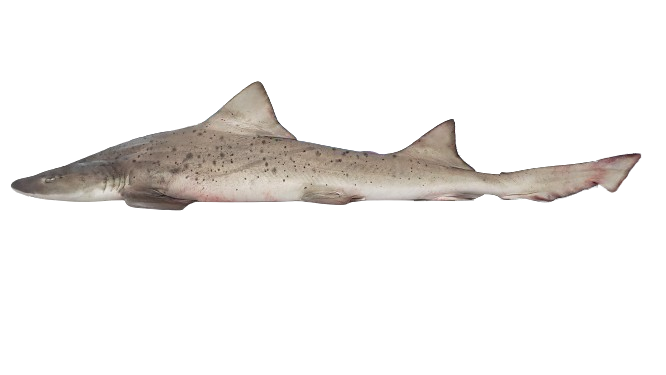
Spotted Houndshark
Triakis maculata
IUCN status: CR · Critically EndangeredTollo
Triakis acutipinna
IUCN status: Not evaluated
Names and sources
In Spanish
- Tollo con bandas — Peru; fishbase; Wikidata · main name
- Musola Fina — Wikidata
- Tollo — Wikidata
- Tollo fino — Peru; fishbase
In English
- Speckled smooth-hound — Wikidata
- Speckled Smoothhound — Wikidata
Classification
Learn more
Conservation status: Critically Endangered (IUCN Red List, according to Wikidata). Taxonomy: PeRMS / WoRMS (CC BY 4.0).