
Sharks, rays and chimaeras · Triakidae
Brown smoothhound
Mustelus henlei (Gill, 1863)
Spanish: Cazón hilacho
- Peruvian Register of Marine Species
- Listed in PeRMS (IMARPE)

Species account
Summary
Mustelus henlei is a small houndshark (family Triakidae) [1], bronzy and unspotted, that lives on the bottom of eastern Pacific continental shelves between northern California and the Gulf of California, and also in Ecuador and Peru [2]. It was originally described as Rhinotriacis henlei by Gill in 1863 [1]. Adults measure 52 to 90 cm, and the maximum size is about 95 cm [2]. The checklist of Peruvian chondrichthyans includes it, citing Chirichigno and Cornejo (2001) [3]. The IUCN classifies it as Least Concern [4].
Identification and similar species
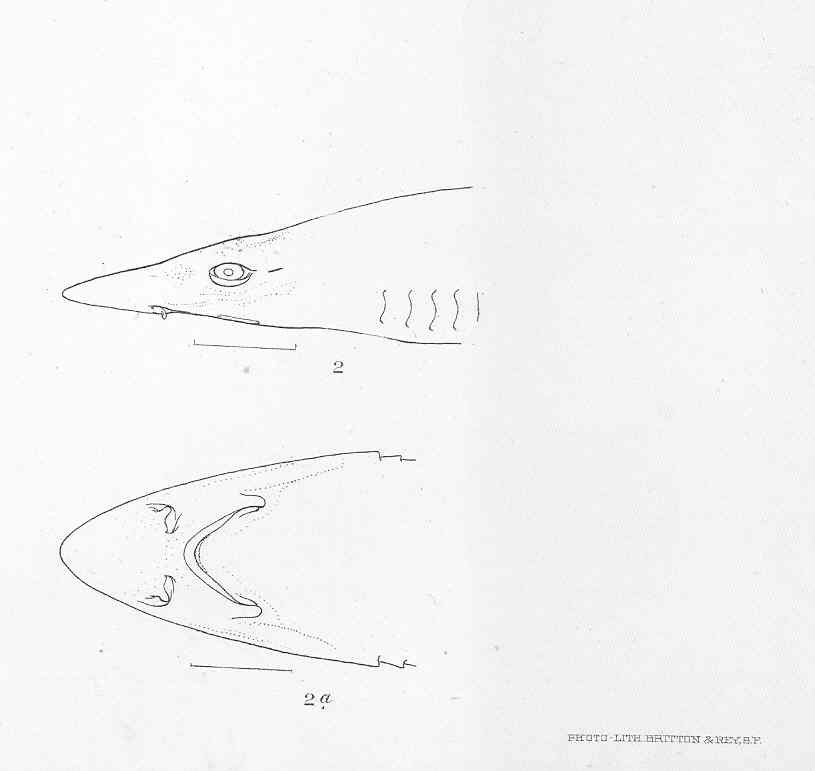
It is a slender Mustelus, iridescent bronzy-brown above, sometimes greyish, and white below, with no white spots, dark spots or bars [2]. Its teeth have a strong primary cusp and usually small cusplets at any age, and most skin denticles have three points [2].
The trailing edge of the dorsal fins, and sometimes of the anal and caudal fins, is naked, with a broad dark band of uncovered ceratotrichia; the caudal peduncle is long [2]. The FAO catalogue gives adults as 52 to 90 cm, and a maximum of about 95 cm [2].
Similar species
- Mustelus mento: It is a stocky houndshark with numerous white spots, a short blunt snout, a short caudal peduncle and broad, rounded teeth without a cusp; Mustelus henlei has no spots and its teeth bear a cusp [2].
- Mustelus lunulatus: It is also unspotted, but its teeth are molariform with the cusp reduced to a low point, the trailing edge of its dorsal fins is covered with denticles and its fins are strongly falcate [2].
Distribution and habitat
The FAO describes its range in the eastern Pacific, running from the north of California down to the Gulf of California, plus Ecuador and Peru; Heemstra was the first to record it in the southern hemisphere [2].
It is a bottom-dwelling shark, abundant from inshore to more open water and recorded from the intertidal zone to at least 200 m depth; it is very common in shallow muddy bays [2]. Of the three Mustelus species in California it is the most cold-tolerant, and it is resident in the north of that state [2].
Its local distribution can be very patchy: in north-central California the centres of abundance are enclosed bays such as Humboldt, Tomales and San Francisco [2]. One tagged individual moved about 160 km in 3 months, but the nature of its local movements remains uncertain [2].
Biology
It is viviparous with a yolk-sac placenta, and the FAO gives 3 to 5 young per litter; newborns measure 19 to 21 cm [2]. In the northern Gulf of California females reproduce every year: they carry developing oocytes and uterine embryos at the same time, and gestation lasts about 10 months [5].
In that population litter size ranges from 1 to 21 pups and increases with maternal length, whereas on the California coast it ranges from 1 to 10 [5]. Females mature at 570 to 660 mm and males at 550 to 560 mm total length [5].
In large aquaria it behaves as an active swimmer that patrols a few millimetres above the bottom and sometimes swims in midwater or at the surface [2]. A large set of fin and body-girth measurements showed that its shape changes with growth, in a way the authors do not consider consistent with migratory behaviour [6].
Ecology
It eats mainly crustaceans, such as crabs, shrimps and isopods, followed by polychaete worms and small fishes; squid, tunicates and topsmelt eggs are also taken [2]. Sharks under 60 cm eat more small shore crabs, and those of 80 cm or more more often take larger crabs, ghost shrimp, fishes and squid [2].
Shore crabs in the stomach contents indicate that it hunts in the intertidal zone [2]. In the north of its range it shares habitat with the leopard shark, Triakis semifasciata, which differs in eating more and larger fishes, more fish eggs and innkeeper worms of the genus Urechis [2].
A morphometric study suggests that predation pressure and ecological differences between the sexes influence how its shape changes, and that its scaling trends do not contradict a trophic niche shift [6].
Conservation
The IUCN, in its current assessment, classifies it as Least Concern [4]. The FAO describes it as an abundant inshore shark that is fished commercially in the Gulf of California [2].
For Peru, the checklist of Peruvian chondrichthyans only records it as present, with no data on abundance or fishing [3].
Human relevance
References (6)
- WoRMS Editorial Board (2026). Mustelus henlei (Gill, 1863). World Register of Marine Species. https://www.marinespecies.org/aphia.php?p=taxdetails&id=271386 (accessed 2026-10-25)
- Compagno, L.J.V. (1984). FAO species catalogue. Vol. 4. Sharks of the world. An annotated and illustrated catalogue of shark species known to date. Part 2. Carcharhiniformes. FAO Fisheries Synopsis No. 125, Vol. 4, Part 2. FAO, Rome, 411-413, 415-416, 418-419. https://www.fao.org/4/ad123e/ad123e00.htm (accessed 2026-10-25)
- Cornejo, R., Vélez-Zuazo, X., González-Pestana, A. et al. (2015). An updated checklist of Chondrichthyes from the southeast Pacific off Peru. Check List, 1809. doi:10.15560/11.6.1809 (accessed 2026-10-25)
- Rigby, C.L., Pérez-Jiménez, J.C., Ebert, D.A. et al. (2024). Mustelus henlei: Rigby, C.L., Pérez-Jiménez, J.C., Ebert, D.A. & Charles, R. The IUCN Red List of Threatened Species 2024: e.T161648A124521269. doi:10.2305/IUCN.UK.2025-2.RLTS.T161648A124521269.EN (accessed 2026-10-25)
- Pérez-Jiménez, J.C., Sosa-Nishizaki, O. (2008). Reproductive biology of the brown smoothhound shark Mustelus henlei, in the northern Gulf of California, México. Journal of Fish Biology 73(4), 782-792. doi:10.1111/j.1095-8649.2008.01939.x (accessed 2026-10-25)
- Gayford, J.H., Godfrey, M., Whitehead, D.A. (2023). Ontogenetic morphometry of the brown smoothhound shark Mustelus henlei with implications for ecology and evolution. Journal of Morphology 284. doi:10.1002/jmor.21608 (accessed 2026-10-25)
More pictures
Where it has been recorded
- Filled: scientific records, or confirmed by a curator
- Hatched: isolated record
- Dotted outline: no scientific records and no curator's confirmation (an ORKA sighting is not drawn here)
- Tropical northern sea
Scientific records (1 record)
- Tropical–cold transition zone
Scientific records (2 records)
From openly licensed OBIS and GBIF records (CC0 or CC BY). How each list is built.
Related species
From the same genus (Mustelus) and from the same family (Triakidae).
Sharptooth smoothhound
Mustelus dorsalis
IUCN status: VU · Vulnerable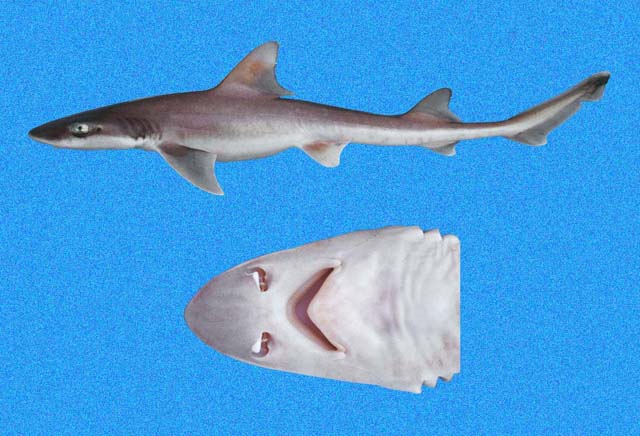
Humpback smoothhoun
Mustelus whitneyi
IUCN status: CR · Critically Endangered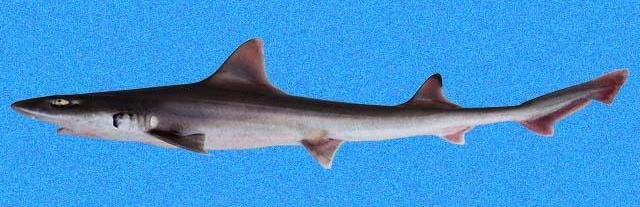
Sicklefin smoothhound
Mustelus lunulatus
IUCN status: NT · Near Threatened
Speckled smooth-hound
Mustelus mento
IUCN status: CR · Critically Endangered
Tope
Galeorhinus galeus
IUCN status: CR · Critically Endangered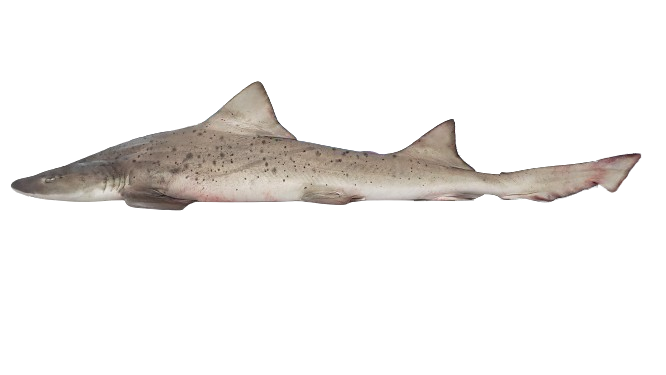
Spotted Houndshark
Triakis maculata
IUCN status: CR · Critically EndangeredTollo
Triakis acutipinna
IUCN status: Not evaluated
Names and sources
In Spanish
- Cazón hilacho — WoRMS · main name
In English
- Brown smoothhound — WoRMS; Wikidata
- Brown smooth-hound — Wikidata
Classification
Learn more
Conservation status: Least Concern (IUCN Red List, according to Wikidata). Taxonomy: PeRMS / WoRMS (CC BY 4.0).