
Sharks, rays and chimaeras · Triakidae
Sharptooth smoothhound
Mustelus dorsalis Gill, 1864
Spanish: Tollo blanco
- Names in Peru
- Tollo blanco
- Peruvian Register of Marine Species
- Listed in PeRMS (IMARPE)
Species account
Summary
Mustelus dorsalis is a small shark of the family Triakidae, order Carcharhiniformes [1]. It lives on the bottom in tropical coastal waters of the eastern Pacific, and FAO gives it a maximum size of 64 cm [2]. In Peru it is called «tollo blanco» [3]. Its reproduction and diet, on which no data had been published, were described from 311 individuals from the Gulf of Nicoya, Costa Rica [4]. The IUCN classifies it as Vulnerable (VU) [5].
Etymology
Gill described it in 1864 from two specimens of 430 to 450 mm from Panama, kept at the United States National Museum of Natural History; a third specimen stored under the same catalogue number is in fact Mustelus lunulatus [2]. The FAO catalogue recognises no synonyms, and WoRMS lists the combination Galeus dorsalis as a name not accepted [2],[1].
Identification and similar species
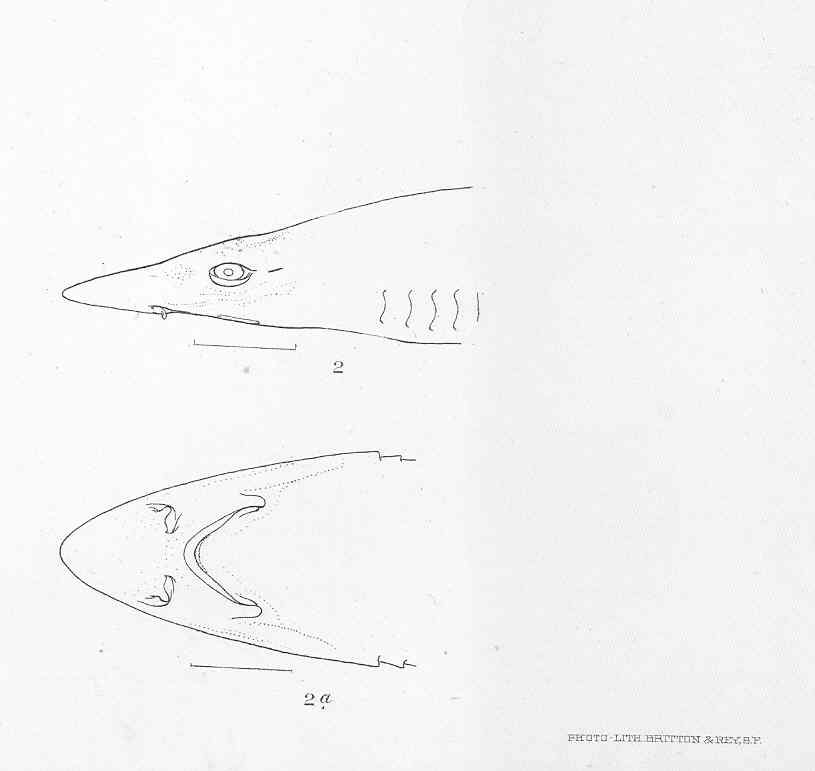
It is a plain, unspotted smooth-hound with a fairly slender body, a long snout ending in a sharp point, very small eyes and a very wide space between them [2]. Its teeth are asymmetrical and carry a tall, well-marked cusp, and the rear edge of its dorsal fins is covered with denticles, with no bare fin rays [2]. The back is a uniform grey or grey-brown and the belly pale, with no white or dark spots and no bars [2].
FAO gives a maximum size of 64 cm, with adults of 43 to 64 cm [2]. In the Gulf of Nicoya females measured 550 to 660 mm and weighed 400 to 1000 g, while males measured 500 to 585 mm and weighed 200 to 300 g [4].
Similar species
- Mustelus whitneyi: It is a common species off Peru; it also has cusped teeth, but it is stockier, almost humpbacked, its dorsal fins have a dark margin of bare rays and adults measure 68 to 87 cm [2].
- Mustelus henlei: It also reaches Ecuador and Peru and has cusped teeth, but it is bronze-coloured, has larger eyes, a narrower space between them and a bare, dark rear edge on the dorsal fins [2].
- Mustelus mento: It stands out for its many white spots and its molar-like teeth without a cusp [2].
Distribution and habitat
The 1984 FAO catalogue gave it a range from southern Mexico to the Gulf of Guayaquil, Ecuador [2]. The 2015 updated checklist of cartilaginous fishes of the Peruvian sea includes it on the basis of publications from 2001 and 2014 [6].
It is an uncommon, little-known bottom shark of the continental shelves of Central and South America [2]. In the Gulf of Nicoya it was caught at 25 to 100 m depth and never turned up in the catches of boats working more than 10 nautical miles from the coast, which points to a resident coastal population of adults [4].
Biology
It is viviparous, with a yolk-sac placenta; FAO credits it with litters of 4 young, a size at birth of 21 to 23 cm and maturity at about 43 cm in both sexes [2].
In the Gulf of Nicoya 311 individuals, 250 females and 61 males, were examined between March 1999 and May 2000, and all of them were mature; the smallest mature female measured 500 mm and the smallest mature male 541 mm [4]. A total of 1259 embryos were measured, 130 to 205 mm long and 6 to 35 g in weight, with 4 to 10 embryos per female [4].
Females carried embryos all year round, but the largest ones, apparently close to birth, were seen between September and March [4]. According to the author, this species must reach 76 to 90% of its total size before maturing, a higher proportion than in other Mustelus [4].
Ecology
It is an opportunistic carnivore that eats mostly crustaceans, then fishes and very few molluscs [4]. Crustaceans appeared in 88.5% of the stomachs with food and made up 58.4% of the biomass; the main prey was the mantis shrimp Squilla hancocki, present in 65.1% of them [4]. Among fishes it ate anchovies, jacks, snappers and sardines [4].
Of the stomachs examined, 119, or 38.2%, were empty, and the time of capture suggests that adults hunt at night [4]. Because not a single juvenile was caught, the author proposes that adults and young occupy different areas and that this part of the gulf may work as essential habitat for the species [4].
Conservation
The IUCN classifies it as Vulnerable (VU) [5].
In the Gulf of Nicoya it is fished with no management measures of its own, and shrimp trawling depletes the crustaceans it feeds on; pollution and unplanned coastal growth add to this [4]. The author proposed releasing sharks under 50 cm and considering closed seasons and a minimum catch size [4].
In Peru the species appears among the sharks with recorded landings, but the national regulation setting minimum catch sizes for sharks does not assign it one [7].
Human relevance
In 1984 FAO assumed it was caught along with other smooth-hounds, although without concrete data [2]. In Costa Rica it is part of the night-time artisanal hook-and-line fishery of the Gulf of Nicoya, and demand for it is growing because of the quality of its meat and because traditional fishes such as snappers, groupers and corvinas are becoming scarce [4].
In Peru, landing statistics by species for 1996 to 2010 include it among 12 shark species that together made up 2% of the total landed [7].
Where to see it in Peru
In Peru it is known almost only from the fisheries literature and species lists: the 2015 checklist of cartilaginous fishes supports its presence with publications from 2001 and 2014 [6], and landing statistics for 1996 to 2010 count it among the sharks landed in the country [7]. In 2006 records were cited from the Gulf of California to Peru [4], whereas in 1984 its range was given as ending at the Gulf of Guayaquil [2].
References (7)
- WoRMS Editorial Board (2026). Mustelus dorsalis Gill, 1864. World Register of Marine Species. https://www.marinespecies.org/aphia.php?p=taxdetails&id=271382 (accessed 2026-10-20)
- Compagno, L.J.V. (1984). FAO species catalogue. Vol. 4. Sharks of the world. An annotated and illustrated catalogue of shark species known to date. Part 2. Carcharhiniformes. FAO Fisheries Synopsis No. 125, Vol. 4, Part 2. FAO, Rome, 407, 410-411, 417-418, 426. https://www.fao.org/4/ad123e/ad123e00.htm (accessed 2026-10-20)
- Froese, R., Pauly, D. (2026). Common names of Mustelus dorsalis. FishBase. https://www.fishbase.se/comnames/CommonNamesList.php?ID=5940 (accessed 2026-10-20)
- Rojas M., J.R. (n.d.). Reproducción y alimentación del tiburón enano Mustelus dorsalis (Pisces: Triakidae) en el Golfo de Nicoya, Costa Rica: Elementos para un manejo sostenible. Revista de Biología Tropical 54(3), 2006, 861-871. doi:10.15517/rbt.v54i3.13683 (accessed 2026-10-20)
- Kyne, P.M., Charvet, P., Areano, E.M. et al. (2020). Mustelus dorsalis: Kyne, P.M., Charvet, P., Areano, E.M., Cevallos, A., Espinoza, M., González, A., Herman, K., Mejía-Falla, P.A., Morales-Saldaña, J.M. & Navia, A.F. The IUCN Red List of Threatened Species 2020: e.T44580A124433729. doi:10.2305/IUCN.UK.2020-3.RLTS.T44580A124433729.en (accessed 2026-10-20)
- Cornejo, R., Vélez-Zuazo, X., González-Pestana, A. et al. (2015). An updated checklist of Chondrichthyes from the southeast Pacific off Peru. Check List 11(6), 1809. doi:10.15560/11.6.1809 (accessed 2026-10-20)
- Gonzalez-Pestana, A., Kouri J., C., Velez-Zuazo, X. (2016). Shark fisheries in the Southeast Pacific: A 61-year analysis from Peru. F1000Research 3, 164. doi:10.12688/f1000research.4412.2 (accessed 2026-10-20)
More pictures
If you come across it
Protected or threatened species. Watch it without touching, feeding, chasing or taking it, and keep the recommended viewing distances.
Where it has been recorded
- Filled: scientific records, or confirmed by a curator
- Hatched: isolated record
- Dotted outline: no scientific records and no curator's confirmation (an ORKA sighting is not drawn here)
- Tropical northern sea
Scientific records (2 records)
- Tropical–cold transition zone
Scientific records (3 records)
- Cold central sea
Scientific records (3 records)
From openly licensed OBIS and GBIF records (CC0 or CC BY). How each list is built.
Related species
From the same genus (Mustelus) and from the same family (Triakidae).

Brown smoothhound
Mustelus henlei
IUCN status: LC · Least Concern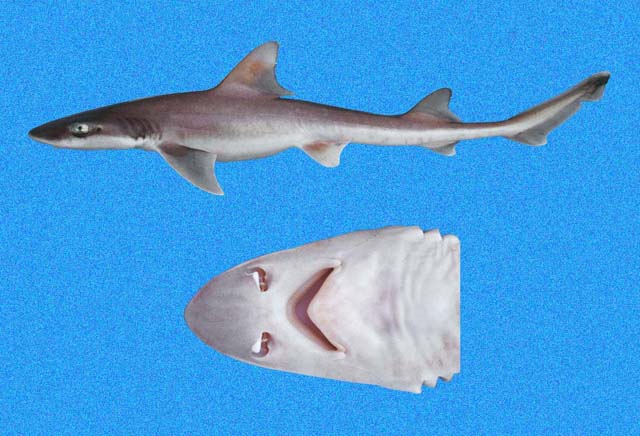
Humpback smoothhoun
Mustelus whitneyi
IUCN status: CR · Critically Endangered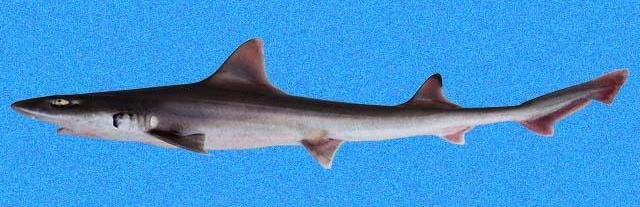
Sicklefin smoothhound
Mustelus lunulatus
IUCN status: NT · Near Threatened
Speckled smooth-hound
Mustelus mento
IUCN status: CR · Critically Endangered
Tope
Galeorhinus galeus
IUCN status: CR · Critically Endangered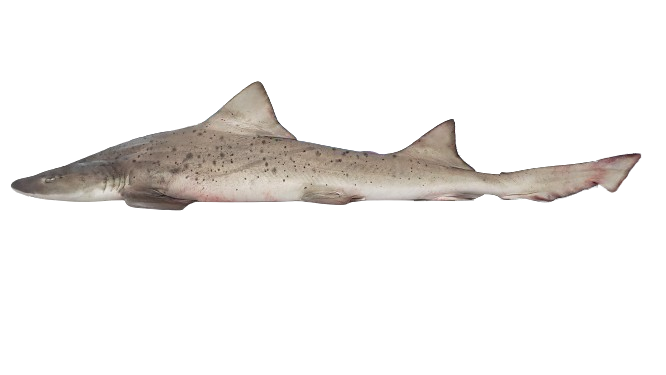
Spotted Houndshark
Triakis maculata
IUCN status: CR · Critically EndangeredTollo
Triakis acutipinna
IUCN status: Not evaluated
Names and sources
In Spanish
- Tollo blanco — Peru; fishbase · main name
- Cazón tripa — WoRMS
- Musola Blanca — Wikidata
In English
- Sharptooth smoothhound — WoRMS; Wikidata
- Sharptooth smooth-hound — Wikidata
Classification
Learn more
Conservation status: Vulnerable (IUCN Red List, according to Wikidata). Taxonomy: PeRMS / WoRMS (CC BY 4.0).