
Bony fishes · Muraenidae
Jewel moray
Muraena lentiginosa Jenyns, 1842
Spanish: Morena
- Names in Peru
- Morena
- Peruvian Register of Marine Species
- Listed in PeRMS (IMARPE)
Species account
Summary
Muraena lentiginosa is a moray eel of the family Muraenidae, order Anguilliformes [1]. It lives on the bottom, from the intertidal zone down to about 27 m, along the eastern Pacific from the southern Baja California peninsula to the Lobos de Afuera islands in northern Peru [2]. In Peru it is recorded under the name «morena» [3]. Globally, the IUCN Red List classes it as Least Concern [4].
Etymology
Leonard Jenyns described it in 1842, in the fish volume of the zoology of the Beagle voyage, from two specimens Charles Darwin gathered in the Galapagos archipelago [5]. Jenyns noted that its spots, smaller and more tightly packed on the head than on the rest of the body, give it a freckled look, and he treated it as a new species, although very like another moray described by Shaw [5].
Over time it received other names now treated as synonyms, among them Murenophis marmoreus Valenciennes, 1846, and Muraena insularum Jordan & Davis, 1891 [1].
Identification and similar species
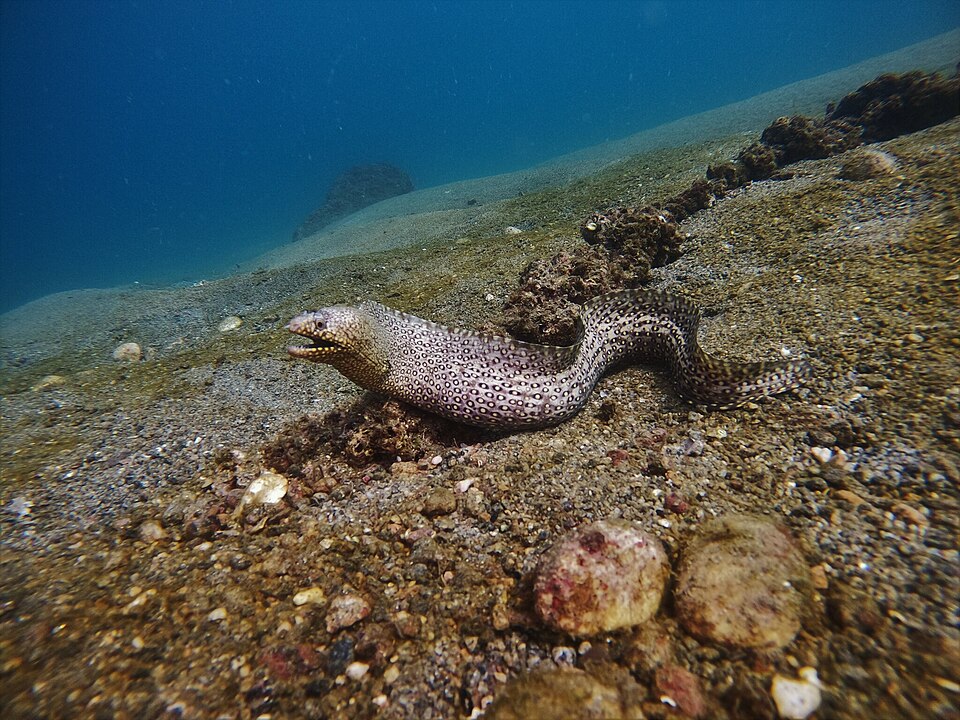
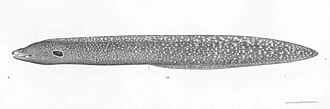
The body is eel-shaped and narrows towards the tail; its depth at mid-length goes about 13 times into the total length; the head, up to the gill opening, is close to one seventh of the length [5]. Head and jaws are strongly flattened from side to side, the jaws are slender, equal in length and pointed, and the gape reaches as far behind the eye as it extends in front of it [5]. The teeth are flattened, very sharp and slightly curved backwards; it carries two tubular openings above the eyes and two more at the tip of the snout [5].
The dorsal fin is thick and fleshy and hard to tell apart from the body at its front end, and the vent lies a little ahead of mid-length [5]. According to Darwin's notes, the larger specimen was a deep purplish brown with round yellow spots, which Jenyns described as mostly small; the smaller one was a reddish purple brown, with pale spots and bluish eyes [5].
As for size, a recent regional checklist gives up to 63 cm total length [2]; FishBase gives a maximum of 61 cm and a usual size of 35 cm [3].
Distribution and habitat
It ranges across the eastern Pacific, from Bahía Magdalena in southern Baja California to the Lobos de Afuera islands in Peru, including the Gulf of California, the Galapagos and other offshore islands [2]. From the Colombian Pacific, the reference fish collection of the Universidad del Valle, in Cali, holds specimens of the species under 5 catalogue numbers [6].
It is a bottom fish recorded from the intertidal zone to 27 m depth [2]; FishBase describes it as reef-associated, between 5 and 25 m [3]. On Gorgona Island, Colombia, it turned up in tide pools in a 2006 survey, at only one of the three sites studied [7]. In Colima, on the Mexican Pacific coast, it was found in 2014 on a coral patch about 2.5 m deep on average [8].
Biology
It is usually seen in shallow water; it spends the day hidden in rock crevices and comes out to feed mostly at night [3]. One of the two original specimens, 13 and a half inches long, was caught in tide pools on Chatham Island in the Galapagos, and the other, 20 inches and 6 lines long, on Charles Island [5].
Like other morays, it keeps opening and closing its mouth: this is how it moves water over the gills, not a threat [3].
Ecology
It is a predator: it feeds mainly on crustaceans and fishes [3], and a study of Galapagos fishes classed it as a piscivore [9].
In the tide pools of Gorgona Island it was considered an accidental visitor rather than a resident, and it had already appeared in collections made at the same sites in 1993 [7].
Conservation
The IUCN Red List assessed it in 2007 and classes it globally as Least Concern [4].
Between September 2015 and April 2016, at the height of the 2015-2016 El Niño, sea surface temperature around the Galapagos ran 2.5 to 4.0 °C above normal, and a new illness that opened ulcers in the skin turned up in reef fishes; in all, 18 species were seen affected [9]. Muraena lentiginosa was one of them: the first diseased individual of the species was seen at Roca Cousins on 19 January 2016 [9].
Health, toxicological and chemical relevance
Not medical advice. For a sting, a poisoning or an allergy, seek medical care.
FishBase lists it as harmless to people, and notes that its habit of constantly opening and closing its mouth is part of breathing, not a sign of attack [3].
Where to see it in Peru
In Peru, its presence at the Lobos de Afuera islands, off the northern coast, was confirmed with environmental DNA: in November 2018, 9 water samples were taken at 3 sites around the islands [10]. DNA of the species showed up in 2 of the 3 genetic assays used; the species was already in the historical records for the islands, but not in the baseline visual surveys used for comparison [10].
The islands lie about 32 nautical miles offshore, belong to the Guano Islands, Isles and Capes National Reserve, and their distance and rugged seabed make them hard to reach [10].
References (10)
- WoRMS Editorial Board (2026). Muraena lentiginosa Jenyns, 1842. World Register of Marine Species. https://www.marinespecies.org/aphia.php?p=taxdetails&id=271900 (accessed 2026-10-20)
- Love, M.S., Bizzarro, J.J., Cornthwaite, A.M. et al. (2021). Checklist of marine and estuarine fishes from the Alaska–Yukon Border, Beaufort Sea, to Cabo San Lucas, Mexico. Zootaxa, 1-285. doi:10.11646/zootaxa.5053.1.1 (accessed 2026-10-20)
- Froese, R., Pauly, D. (2026). Muraena lentiginosa Jenyns, 1842. Jewel moray. FishBase. https://www.fishbase.se/summary/Muraena-lentiginosa.html (accessed 2026-10-20)
- McCosker, J., Lea, B. (2007). Muraena lentiginosa: McCosker, J. and Lea, B. The IUCN Red List of Threatened Species 2010: e.T183921A8200163. doi:10.2305/IUCN.UK.2010-3.RLTS.T183921A8200163.en (accessed 2026-10-20)
- Jenyns, L. (1842). Fish. Part 4 of The zoology of the voyage of H.M.S. Beagle. Smith, Elder and Co., London (ed. C. Darwin); transcripción de Darwin Online, 143-144. https://darwin-online.org.uk/converted/published/1838_Zoology_F8/1842_Zoology_F8.17.html (accessed 2026-10-20)
- Tavera, J., Beltrán-León, B.S., Polanco F, A. et al. (2026). Voucher-verified checklist of Colombian Pacific marine fishes with emphasis on material deposited in Colombian museums. ZooKeys, 337-387. doi:10.3897/zookeys.1272.141461 (accessed 2026-10-20)
- Castellanos-Galindo, G.A., Giraldo, A., Zapata, F.A. (2014). Tidepool fish assemblages of Gorgona Island, Colombian Pacific coast: a local and regional comparison. Revista de Biología Tropical, 373-390. doi:10.15517/rbt.v62i0.16362 (accessed 2026-10-20)
- Cadena-Estrada, A., Ortega-Ortiz, C.D., Liñán-Cabello, M.A. (2019). Cryptic fish associated with different substrates in two coastal reef communities of Colima, Mexico. Latin American Journal of Aquatic Research, 318-330. doi:10.3856/vol47-issue2-fulltext-12 (accessed 2026-10-20)
- Lamb, R.W., Smith, F., Aued, A.W. et al. (2018). El Niño drives a widespread ulcerative skin disease outbreak in Galapagos marine fishes. Scientific Reports. doi:10.1038/s41598-018-34929-z (accessed 2026-10-20)
- Alfaro-Cordova, E., Ortiz-Alvarez, C., Alfaro-Shigueto, J. et al. (2022). What lies beneath? Revealing biodiversity through eDNA analysis in Lobos de Afuera Islands, Peru. Latin American Journal of Aquatic Research, 642-659. doi:10.3856/vol50-issue4-fulltext-2782 (accessed 2026-10-20)
More pictures
Where it has been recorded
- Filled: scientific records, or confirmed by a curator
- Hatched: isolated record
- Dotted outline: no scientific records and no curator's confirmation (an ORKA sighting is not drawn here)
- Cold central sea
Scientific records (1 record)
From openly licensed OBIS and GBIF records (CC0 or CC BY). How each list is built.
Related species
From the same genus (Muraena) and from the same family (Muraenidae).
Hourglass moray
Muraena clepsydra
IUCN status: LC · Least Concern- No openly licensed image yet
Muraena appendiculata
IUCN status: DD · Data Deficient 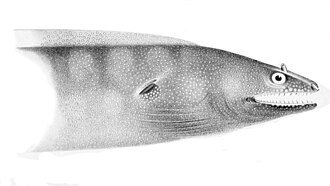
Argus moray
Muraena argus
IUCN status: LC · Least ConcernSpottail moray
Gymnothorax equatorialis
IUCN status: LC · Least Concern
Palenose moray
Echidna nocturna
IUCN status: LC · Least ConcernLow Fin Moray
Gymnothorax porphyreus
IUCN status: LC · Least Concern- No openly licensed image yet
Wrinkled Moray
Gymnothorax angusticeps
IUCN status: LC · Least Concern 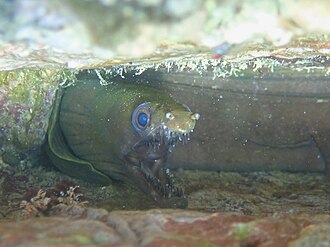
Slenderjaw moray
Enchelycore octaviana
IUCN status: LC · Least Concern
Names and sources
In Spanish
- Morena — Peru; fishbase · main name
- Morena lentejuela — Wikidata
- Morena pinta — Wikidata; WoRMS
In English
- Jewel moray — WoRMS; Wikidata
Classification
Learn more
Conservation status: Least Concern (IUCN Red List, according to Wikidata). Taxonomy: PeRMS / WoRMS (CC BY 4.0).