
Bony fishes · Mugilidae
Grey mullet
Mugil cephalus Linnaeus, 1758
Spanish: Lisa
- Names in Peru
- Lisa · Lisa común · Lisa rayada
- Peruvian Register of Marine Species
- Listed in PeRMS (IMARPE)
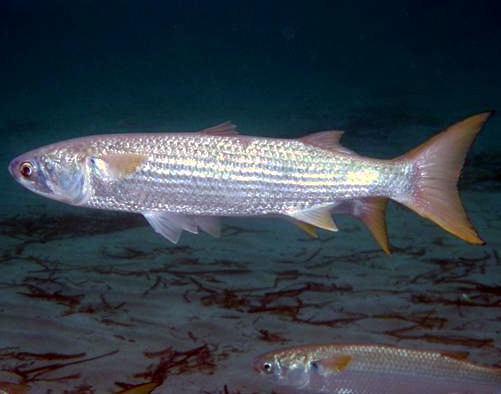
Species account
Summary
Mugil cephalus is a fish of the family Mugilidae, in the order Mugiliformes [1]. It is a euryhaline species that lives in coastal waters, lagoons, bays and estuaries almost worldwide, between latitudes 42° N and 42° S [2]. It spawns offshore and its juveniles settle in estuaries [3]. In Peru it is called «lisa» and it is one of the resources most landed in the La Libertad region [4]. Its global category on the IUCN Red List is Least Concern [5].
Distribution and habitat
It is a euryhaline fish, meaning it tolerates very different salinities, and it ranges worldwide in coastal waters, lagoons, bays and estuaries between 42° N and 42° S [2]. In the eastern Pacific, the literature cited by the La Libertad diet study extends it from southern California to Valdivia, in Chile [4].
Juveniles occupy coastal ponds, lagoons and estuaries, and sometimes the adjoining river catchments [6]. Otolith analysis of fish from Taiwan indicated that, after the juvenile stage, most moved between the estuary and the open sea and that only a few, under 2 years old, may have entered freshwater [3].
Biology
In Taiwan, otoliths indicate that the mullet generally spawns offshore and that newly recruited juveniles are found in estuaries [3]. The earliest larvae drift passively with currents and, once past the flexion stage, move toward the coast [6].
There they live in the surf zone in schools of early juveniles. After about 1 month at sea, the fry colonise ponds, lagoons, estuaries and sometimes adjoining river catchments, and adults return to the sea, where their dispersal varies widely, from 32 to 700 km [6].
According to Gómez et al. (1995), as reported by Atoche et al., spawning occurs mainly in spring; according to González (2001), the season with most maturing fish in 1999-2000 depended on the area: spring at Chimbote and summer at Huacho and Pisco [7]. The commercial sizes recorded by Gómez et al. (1995) ranged from 13 to 60 cm total length [7].
Ecology
The lisa is a plankton feeder, with a preference for cyclopoid copepods [7]. In a sample of stomachs from fish 25 to 45 cm long, taken in 2016 in the La Libertad region, 32 prey were identified: benthic and pelagic diatoms, dinoflagellates, copepods and other plankton prey [4]. By number, pelagic diatoms dominated, at 73.1 %, but by wet biomass copepods dominated, at 80.6 % [4].
Among the prey, the order Cyclopoida supplied 72.3 % of the wet biomass; it was followed by Coscinodiscus at 10.5 %, Calanus at 7.6 %, Helicostomella at 4.4 % and barnacle larvae at 1.4 % [4]. Consumption of diatoms and copepods changed with the month, and pelagic diatoms weighed most from October to December [4]. By contrast, no statistical differences were found between sizes, that is, no change of diet with growth was seen within that range [4].
In Taiwan, the otoliths of 30 adults and 10 juveniles indicated that, after the juvenile stage, most moved between the estuary and the open sea, and that the spawning fish were mostly of that type [3].
Conservation
Its global category on the IUCN Red List is Least Concern [5].
In La Libertad, between 2010 and 2017 lisas caught with curtain nets measured 20 to 45 cm total length, with annual mean sizes of 30.1 to 36.7 cm. The share of fish below the 37 cm minimum size set by R. M. 209-2001-PE was 29.8 % in 2017 and reached 99.9 % in 2010, always above the maximum tolerance of 10 % [7]. The authors recommend a curtain-net mesh of at least 88.9 mm (3.5 inches), and observed that the sizes caught grew with the mesh [7].
Outside Peru, in Taiwan the landings of the species fell from 6865 t in 1980 to 159 t in 2008, a decline suggested to be due to overfishing and global warming [2]. In addition, Mugil cephalus appears to be a complex of cryptic species: 3 of them were identified in the northwest Pacific [2].
Health, toxicological and chemical relevance
Not medical advice. For a sting, a poisoning or an allergy, seek medical care.
In a small sample of 3 fish bought at a market in Villa María del Triunfo, in Lima, microplastics were found in the stomach, along with phytoplankton and zooplankton; with so few fish, how common this is cannot be known [8].
Human relevance
The species' commercial value has risen with demand for its roe, which, salted and dried, is a delicacy and whose price leads fishers in many parts of the world to liken it to gold [6].
In La Libertad, the lisa, the suco and the lorna are the main demersal and coastal species of the artisanal fishery; they have the largest landings and good acceptance for direct human consumption [7]. In 2016 the lisa was caught with curtain nets of 3 to 4.5 inch mesh, set from wooden boats with 2 to 4 t of hold capacity [4]. It is also taken with purse seines and gillnets [7].
A 2019 study describes it as eaten along the whole Peruvian coast and common in Lima markets [8].
Where to see it in Peru
In Peru it is known mainly from artisanal fishing. Between 2010 and 2017 fishery monitoring covered the La Libertad coast, from Punta Chérrepe to the Santa River, with 5 landing centres: the ports of Pacasmayo, Malabrigo and Salaverry and the coves of Huanchaco and Morín [7]. The stomachs analysed in 2016 came from those same places, from 15 fishing grounds [4]. The data of both studies come from fishing; neither describes places to observe it underwater [7].
References (8)
- WoRMS Editorial Board (2026). Mugil cephalus Linnaeus, 1758. World Register of Marine Species. https://www.marinespecies.org/aphia.php?p=taxdetails&id=126983 (accessed 2026-10-25)
- Shen, K.-N., Jamandre, B.W., Hsu, C.-C. et al. (2011). Plio-Pleistocene sea level and temperature fluctuations in the northwestern Pacific promoted speciation in the globally-distributed flathead mullet Mugil cephalus. BMC Evolutionary Biology, 83. doi:10.1186/1471-2148-11-83 (accessed 2026-10-25)
- Chang, C.W., Iizuka, Y., Tzeng, W.N. (2004). Migratory environmental history of the grey mullet Mugil cephalus as revealed by otolith Sr:Ca ratios. Marine Ecology Progress Series, 277-288. doi:10.3354/meps269277 (accessed 2026-10-25)
- Villanueva Gómez, B., Atoche Suclupe, D., Culquichicón Malpica, Z. (2021). COMPOSITION AND ABUNDANCE OFMugil cephalus“LISA”, LA LIBERTAD REGION-PERU, 2016. REBIOL, 68-74. doi:10.17268/rebiol.2021.41.01.07 (accessed 2026-10-25)
- Camara, K.D., Carpenter, K.E., Djiman, R. et al. (2022). Mugil cephalus: Camara, K.D., Carpenter, K.E., Djiman, R., Nunoo, F., Sagna, A., Sidibé, A, Sylla, M., de Morais, L., Jelks, H., Tolan, J., Vega-Cendejas, M., Espinosa-Perez, H., Chao, L., Moretzsohn, F., Sparks, J.S. & Ford, M. The IUCN Red List of Threatened Species 2024-2. doi:10.2305/IUCN.UK.2024-2.RLTS.T135567A155662225.EN (accessed 2026-10-25)
- Cossu, P., Mura, L., Scarpa, F. et al. (2021). Genetic patterns in Mugil cephalus and implications for fisheries and aquaculture management. Scientific Reports, 2887. doi:10.1038/s41598-021-82515-7 (accessed 2026-10-25)
- Atoche Suclupe, D., Buitrón Díaz, B., Paredes Paredes, J. (2020). Incidencia de juveniles de Mugil cephalus Linnaeus, 1758, Paralonchurus peruanus (Steindachner, 1875) y Sciaena deliciosa (Tschudi, 1846) en la región La Libertad, 2010-2017. Boletín del Instituto del Mar del Perú 35(1), IMARPE, 106-115. https://revistas.imarpe.gob.pe/index.php/boletin/article/download/294/280/547 (accessed 2026-10-25)
- Santos, J., Ortiz Correa, Y., Aranda Baca, K. et al. (2019). Microplásticos en contenido estomacal de la “lisa” Mugil cephalus, Lima -Perú. Revista de Investigación Ciencia, Tecnología y Desarrollo. doi:10.17162/rictd.v5i2.885 (accessed 2026-10-25)
More pictures
Where it has been recorded
- Filled: scientific records, or confirmed by a curator
- Hatched: isolated record
- Dotted outline: no scientific records and no curator's confirmation (an ORKA sighting is not drawn here)
- Tropical northern sea
Scientific records (5 records)
- Tropical–cold transition zone
Scientific records (7 records)
- Cold central sea
Scientific records (26 records)
- Cold southern sea
Scientific records (31 records)
From openly licensed OBIS and GBIF records (CC0 or CC BY). How each list is built.
Related species
From the same genus (Mugil) and from the same family (Mugilidae).
Names and sources
In Spanish
- Lisa — Peru; SERFOR (2019). Plan Nacional de Conservación de las Tortugas Marinas en el Perú 2019-2029, p. 77 of the PDF; Wikidata · main name
- Albur — Wikidata
- Cabezudo — Wikidata
- Cachamba — Wikidata
- Cap Pla — Wikidata
- Capitán — Wikidata
- Capiton — Wikidata
- Céfalo — Wikidata
- Galupe — Wikidata
- Ilissa Lobarrera — Wikidata
- Lebranche — Wikidata
- Lisa Cabezuda — Wikidata
- Lisa común — Peru; fishbase; Wikidata
- Lisa Pardete — Wikidata
- Lisa rayada — Peru; fishbase; Wikidata; WoRMS
- Lissa Amaria — Wikidata
- Liza Cabezona — Wikidata
- Lizarra — Wikidata
- Lizza — Wikidata
- Machu — Wikidata
- Machuto — Wikidata
- Mugil — Wikidata
- Mugil Común — Wikidata
- Mujol — Wikidata; WoRMS
- Mule — Wikidata
- Muxo — Wikidata
- Pardete — Wikidata; WoRMS
- Pordete — Wikidata
In English
- Grey mullet — WoRMS; Wikidata
- Black Mullet — Wikidata
- Black True Mullet — Wikidata
- Bright Mullet — Wikidata
- Bully Mullet — Wikidata
- Callifaver Mullet — Wikidata
- Common Grey Mullet — Wikidata
- Common Mullet — Wikidata
Learn more
Conservation status: Least Concern (IUCN Red List, according to Wikidata). Taxonomy: PeRMS / WoRMS (CC BY 4.0).