
Sharks, rays and chimaeras · Mobulidae
Smoothtail mobula
Mobula thurstoni (Lloyd, 1908)
Spanish: Chupasangre
- Names in Peru
- Chupasangre · Diablo · Manta
- Peruvian Register of Marine Species
- Listed in PeRMS (IMARPE)
Species account
Summary
Mobula thurstoni is a devil ray of the family Mobulidae, in the order Myliobatiformes [1]. In Peru it is known as «chupasangre», «diablo» or «manta», and its disc reaches about 220 cm across [2]. It is a filter feeder that in the Gulf of California eats almost nothing but one small crustacean, the euphausiid Nyctiphanes simplex [3],[4]. The IUCN classifies it as Critically Endangered [5]. Since September 2024 it has been forbidden to catch, land or sell it anywhere along the Peruvian coast [6].
Etymology
Lloyd described it in 1908 under the name Dicerobatis thurstoni; Mobula lucasana, described by Beebe and Tee-Van in 1938, is now a synonym [1]. The revision of the genus published in 1987 treated that Gulf of California name as a junior synonym of Mobula thurstoni [3]. In 2017 a genetic analysis of the whole family placed the mantas inside Mobula and left Mobulidae with a single genus and 8 nominal species [7]. Mobula thurstoni remains the accepted name today [1].
Identification and similar species
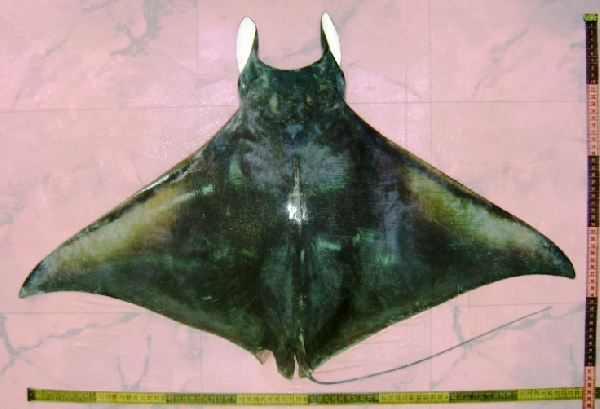
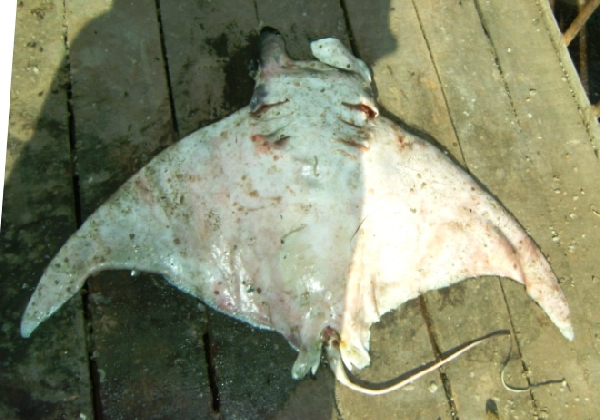
Like every Mobula, it has its mouth on the underside of the head and tooth bands in both jaws, unlike the mantas, whose mouth is subterminal [3]. Its own features are the lack of a spine at the base of the tail, skin that feels smooth, a tail base flattened from above and the front edge of each pectoral fin bent in a double curve; the surface of the teeth is rugose [3].
The back is dark blue to black and the tip of the dorsal fin is white; the belly is white, with a dark greenish patch near the rear edge of each pectoral fin and a pattern of dark and silvery areas on the outer half of the pectorals [3]. In the animals filmed in French Polynesia in 2023 the observers also recognised a thick black band across the head, from eye to eye, grey shading on the curve of the front edge of the pectorals, seen from below, and a tail somewhat longer than the disc width [8].
In the Gulf of California adults exceed 180 cm across; the largest specimen, a female the fishers had already begun to fillet, had a calculated width of 180.1 cm, and the largest male measured 177 cm and weighed 53 kg [3]. At sea, aboard the boats of northern Peru, it is hard to tell from Mobula munkiana, so the data taken on board were analysed only to genus [9].
Similar species
- Mobula munkiana: It is smaller, barely over 100 cm across, with a straight or barely convex front edge to the pectorals, a tail base compressed from the sides, smooth-surfaced teeth and a mauve-grey back [3].
- Mobula mobular: It has a spine at the base of a very long tail, with rows of white tubercles, rough skin and reaches about 250 cm across; older papers call it Mobula japanica, now a synonym of Mobula mobular [3],[7].
Distribution and habitat
It lives in tropical seas around the world, between about 38° N and 34° S; in the eastern Pacific it is recorded from the Gulf of California to Chile, and it is regarded as pelagic, in the top 100 m [2]. It is considered a mainly oceanic species; its presence is confirmed off Mexico, Ecuador, West Africa and Southeast Asia, in the Indian Ocean and in the equatorial Atlantic off Brazil, and in 2023 it was recorded for the first time in the Marquesas Islands, in French Polynesia [8].
In the southern Gulf of California it was seen at the surface of coastal waters, often a few hundred metres from land and sometimes as far as 6 km out, occasionally over depths of more than 500 m, although it was most abundant over the shelf; in nets it was always taken in the shallowest part, usually at less than 100 m [3]. In Peru it appears in the updated checklist of the country's chondrichthyans [10].
Biology
In a 4-year study in the southern Gulf of California, between 1981 and 1984, it was the most frequent devil ray: 58 % of the 262 mobulids examined [3]. 81 males, 69 females and 3 specimens of undetermined sex were caught, and the overall ratio was 1.18 males per female [3]. Males begin to mature at around 150 cm disc width, when the claspers grow quickly [3].
Females also seem to mature from about 150 cm, and only the left ovary is functional [3]. It is viviparous and the mother feeds the embryo, which grows to be vastly larger than the mature egg; the 2 largest females carried a single embryo each, and none of the 55 adult females checked between March and June was pregnant, while the 4 examined in October all were, every embryo at the same stage [3]. A near-term embryo measured 63 cm and weighed 3.4 kg, and the author estimates that they are born at 65 to 85 cm across and about 4.5 kg [3].
From those fragmentary data the author proposed that gestation lasts one year and that each female gives birth to one young every 2 years or more, in midsummer and close to that area [3]. In February 2023 a courtship was filmed in the Marquesas Islands in which 6 males chased a female that bore fresh mating wounds on one pectoral fin [8].
Ecology
Its diet is highly specialised: of 139 stomachs from the Gulf of California, 81 were empty, and in the 57 analysed the euphausiid Nyctiphanes simplex made up 97.9 % of the index of relative importance, followed far behind by a mysid of the genus Mysidium [3]. Mysids dominated from December to March and euphausiids in the warm months; rays under 130 cm ate both, and larger ones ate euphausiids only [3]. A later study with stable carbon and nitrogen isotopes, carried out over 11 months in the southwestern Gulf, confirmed that its main prey is Nyctiphanes simplex and placed it as a second-level consumer [4].
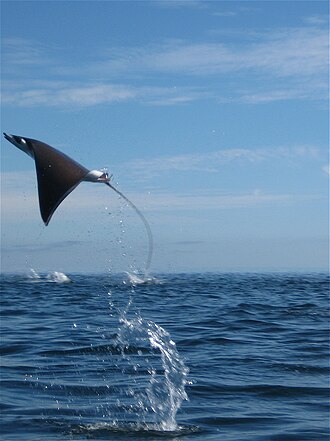
In that area its abundance tracks that of its prey: it arrived in spring, peaked in June and became scarce from July, and the area served it for feeding, mating and nursing young [3]. At the surface it went alone or in small groups of 2 to 6, and it leapt out of the water in repeated somersaults [3]. Remoras of 2 species were occasionally found on large specimens, and several parasitic copepods on the skin, gills and olfactory organs [3].
Conservation
The IUCN classifies it as Critically Endangered [5]. The Convention on Migratory Species has listed it in its Appendices I and II since 2014 [11], and it is in CITES Appendix II, which regulates its international trade [2]. In Peru, Ministerial Resolution N.° 000362-2024-PRODUCE, published on 8 September 2024, added it to the ban that already protected the giant manta: it may not be taken with any gear, nor landed, transported, held, processed or sold; if caught by accident it must be returned alive to the sea and may not be marketed or eaten, and IMARPE must study its populations [6].
Since 2014 the 5 mobulid species of Peru have been part of the National Action Plan for Elasmobranch Conservation, known as PAN-Tiburón [9]. Between January 2015 and February 2016, 44 specimens of this species landed by the gillnet fleet were counted at Zorritos, against 1927 of Mobula mobular, recorded there as Mobula japanica; the 56 specimens measured had a mean width of 142.2 cm, below the 178 cm that the authors take as its size at maturity [9].
In the Gulf of California, 72 % of the specimens caught were immature, under 150 cm across, and the author warned that fishing for devil rays could grow as sharks declined [3]. In several parts of the world it is the mobulid that most often reaches port, yet its ecology remains poorly studied, and there are signs that many individuals die after being released from nets [8].
Health, toxicological and chemical relevance
Not medical advice. For a sting, a poisoning or an allergy, seek medical care.
FishBase regards it as harmless to people [2].
Human relevance
In the southern Gulf of California, in the 1980s, mobulids were caught with nets and harpoons, and their meat, cut from the pectoral fins, was eaten and used as shark bait [3]. In the early morning, when these rays paused at the surface with their fin tips out of the water, fishers approached and harpooned them [3]. From March to July 1983 about 20 boats worked the area [3].
In northern Peru, in 2015 and 2016, mobulid meat sold for 2.5 to 4 soles per kilo, dearer when white than when grey; meat from Zorritos went mainly to Chiclayo, meat from San José was sold in local markets, and the authors also learned of a trade in that meat between Peru and Ecuador [9]. Since 2024 that sale has been forbidden for this species [6].
Where to see it in Peru
The published records for Peru come from small-scale fishing: between January 2015 and February 2016, 44 specimens were counted landed at Zorritos and, between September 2015 and January 2016, 1 at San José, two small-scale gillnet ports in the north of the country [9]. The country's chondrichthyan checklist includes it on the basis of the 2001 catalogue of the marine fishes of Peru [10].
Old records should be read with caution: many records of Mobula lucasana, this species' synonym, from Central and South America belong, according to the 1988 review, to other Mobula species [3].
References (11)
- WoRMS Editorial Board (2026). Mobula thurstoni (Lloyd, 1908). World Register of Marine Species. https://www.marinespecies.org/aphia.php?p=taxdetails&id=217430 (accessed 2026-10-20)
- Froese, R., Pauly, D. (2026). Mobula thurstoni, Bentfin devil ray. FishBase. https://www.fishbase.se/summary/2588 (accessed 2026-10-20)
- Notarbartolo-di-Sciara, G. (1988). Natural history of the rays of the genus Mobula in the Gulf of California. Fishery Bulletin 86(1), NOAA National Marine Fisheries Service, 45-66. https://spo.nmfs.noaa.gov/sites/default/files/pdf-content/1988/861/notar.pdf (accessed 2026-10-20)
- Sampson, L., Galván-Magaña, F., De Silva-Dávila, R. et al. (2010). Diet and trophic position of the devil rays Mobula thurstoni and Mobula japanica as inferred from stable isotope analysis. Journal of the Marine Biological Association of the United Kingdom, 969-976. doi:10.1017/S0025315410000548 (accessed 2026-10-20)
- Jabado, R.W., Marshall, A., Stevens, G. et al. (2025). Mobula thurstoni: Jabado, R.W., Marshall, A., Stevens, G., Laglbauer, B., Barros, N., D’Costa, N., Carter, R., De Bruyne, G., Doherty, P., Fernando, D., Metcalfe, K., Mvomo Minko, Y., Rambahiniarison, J. & Rohner, C.A. The IUCN Red List of Threatened Species 2025: e.T60200A279078290. doi:10.2305/IUCN.UK.2025-2.RLTS.T60200A279078290.en (accessed 2026-10-20)
- Ministerio de la Producción (2024). Resolución Ministerial N.° 000362-2024-PRODUCE: incorporan nuevas especies dentro de los alcances de la Resolución Ministerial N.° 441-2015-PRODUCE. El Peruano, Normas Legales (08-09-2024). https://busquedas.elperuano.pe/dispositivo/NL/2322814-1 (accessed 2026-10-20)
- White, W.T., Corrigan, S., Yang, L. et al. (2017). Phylogeny of the manta and devilrays (Chondrichthyes: mobulidae), with an updated taxonomic arrangement for the family. Zoological Journal of the Linnean Society, 50-75. doi:10.1093/zoolinnean/zlx018 (accessed 2026-10-20)
- Carpentier, A.S., Buray, N., Berthe, C. et al. (2025). First records of Spinetail Devil Ray, Mobula mobular (Bonnaterre, 1788), and Bentfin Devil Ray, M. thurstoni (Lloyd, 1908) (Myliobatiformes, Mobulidae), in French Polynesia. Check List, 1099-1107. doi:10.15560/21.6.1099 (accessed 2026-10-20)
- Alfaro-Cordova, E., Del Solar, A., Alfaro-Shigueto, J. et al. (2017). Captures of manta and devil rays by small-scale gillnet fisheries in northern Peru. Fisheries Research, 28-36. doi:10.1016/j.fishres.2017.06.012 (accessed 2026-10-20)
- Cornejo, R., Vélez-Zuazo, X., González-Pestana, A. et al. (2015). An updated checklist of Chondrichthyes from the southeast Pacific off Peru. Check List, 1809. doi:10.15560/11.6.1809 (accessed 2026-10-20)
- Convention on the Conservation of Migratory Species of Wild Animals (2026). Mobula thurstoni. CMS, species page. https://www.cms.int/species/mobula-thurstoni (accessed 2026-10-20)
More pictures
If you come across it
Protected or threatened species. Watch it without touching, feeding, chasing or taking it, and keep the recommended viewing distances.
Where it has been recorded
- Filled: scientific records, or confirmed by a curator
- Hatched: isolated record
- Dotted outline: no scientific records and no curator's confirmation (an ORKA sighting is not drawn here)
- Tropical northern sea
Scientific records (1 record)
From openly licensed OBIS and GBIF records (CC0 or CC BY). How each list is built.
Related species
From the same genus (Mobula).

Names and sources
In Spanish
- Chupasangre — Peru; fishbase; Wikidata · main name
- Chupa Sangre — Wikidata
- Diablo — Peru; fishbase
- Diablo Chupasangre — Wikidata
- Diablo Manta — Wikidata
- Manta — Peru; fishbase
- Manta Diablo — Wikidata
- Manta doblada — WoRMS
- Manta Raya — Wikidata
- Muciélago — Wikidata
In English
- Smoothtail mobula — WoRMS; Wikidata
- Bentfin Devil Ray — Wikidata
- Lesser Devil Ray — Wikidata
- Smoothtail Devil Ray — Wikidata
- Thurton’s Devil Ray — Wikidata
Classification
Learn more
Conservation status: Critically Endangered (IUCN Red List, according to Wikidata). Taxonomy: PeRMS / WoRMS (CC BY 4.0).