
Sharks, rays and chimaeras · Mobulidae
Pygmy devil ray
Mobula munkiana Notarbartolo-di-Sciara, 1987
Spanish: Manta chica
- Peruvian Register of Marine Species
- Listed in PeRMS (IMARPE)

Species account
Summary
Mobula munkiana is a small mobulid ray of the tropical eastern Pacific, described by Notarbartolo-di-Sciara in 1987 and accepted today in the family Mobulidae [1]. Its range runs from the Baja California peninsula, in Mexico, to Peru, including the Galapagos Islands [2]. It forms very large aggregations and the IUCN classifies it as Vulnerable [3].
Identification and similar species
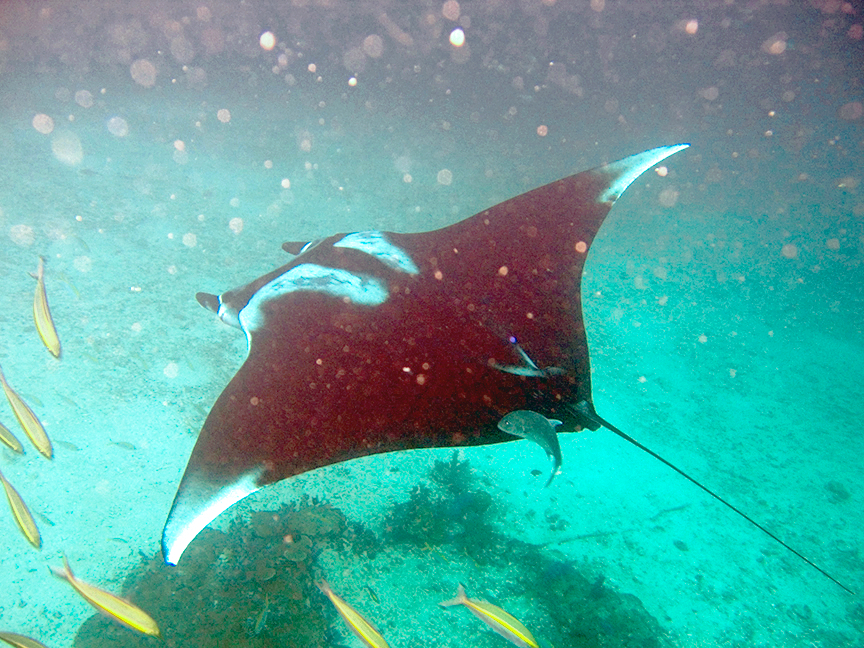
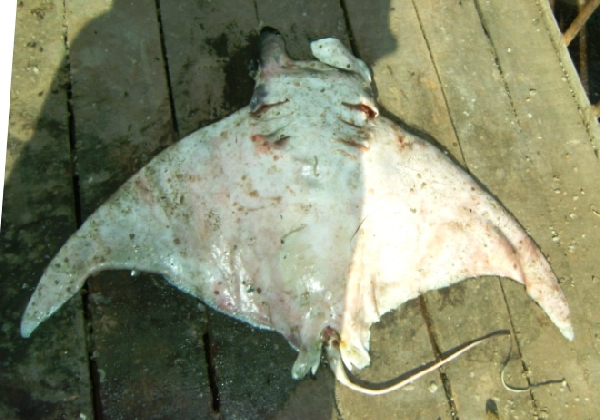
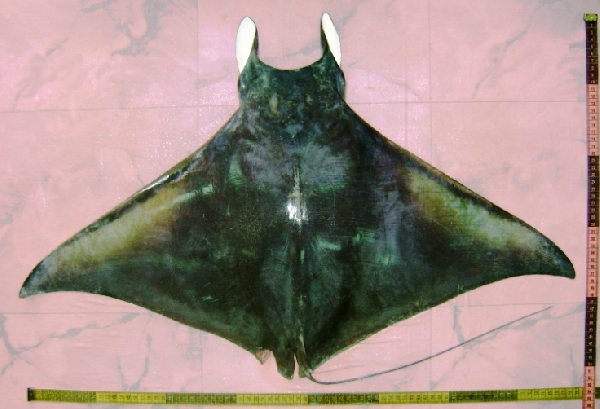
It reaches the smallest adult size in the genus Mobula [2]; a disc width of up to 112 cm has been given, and males are treated as juveniles below roughly 87 cm of disc width [4],[2]. Newborns in the bay of Ensenada Grande measured 49.5 to 56 cm of disc width and were recognised by the umbilical scar below the gill slits; juveniles measured 49 to 85 cm [4].
On the Costa Rican coast juveniles were spotted from the shore by their uniform dark, violet-toned colour and by the fin tips cutting the surface as they swam. When feeding they unfurl the cephalic lobes, which from above look like round white patches [2]. Immature males have claspers that are neither calcified nor rotated, whereas adults carry them fully developed [4].
Distribution and habitat
The species is endemic to the tropical eastern Pacific and extends from the Baja California peninsula to Peru, the Galapagos included [2]. It lives in neritic and coastal waters [4].
Juveniles use shallow bays: in Ensenada Grande, in the Espiritu Santo archipelago, newborns were caught at 2–5 m depth and adults at more than 15 m in the same bay [4]. At Punta Descartes, in northwest Costa Rica, juveniles fed in the surf zone at less than 50 cm depth, and some entered water only 20 cm deep [2]. In the southern Gulf of California, reproductive events of three mobulid species, this one included, were recorded between 4 m and 6.3 km from the coast [5].
Biology
Like the other mobulids, it bears a single pup per gestation [4]. In Ensenada Grande near-term females and courtship were seen between April and June, pointing to a pupping period from April to June; a gestation of 10 to 12 months has been reported for another pygmy mobulid of similar size, and the authors assume this species is the same [4].
Reproductive behaviour of Mobula munkiana was recorded in 208 events in the southern Gulf of California, in 2017 and 2021–2022, from March to August and peaking in May [5]. The authors also describe a courtship vortex and individuals leaping over one another as behaviours not described before for the species [5].
It feeds on zooplankton: in the Gulf of California it takes mostly mysids and, second, the euphausiid Nyctiphanes simplex [4]. In Costa Rica, the stomach of a juvenile found dead was full of mysids, and these were most abundant right in the surf zone [2].
Ecology
Aggregations of thousands of individuals are characteristic of the species, and are attributed in part to mating [4]. Juveniles feed in groups of 2 to 10 that swim parallel to the beach behind the waves and turn shoreward as a wave approaches, with the cephalic lobes unfurled [2].
In Ensenada Grande, 84 % of the 95 tagged individuals were newborns or juveniles, and newborns and juveniles were only caught with others of the same stage, which indicates size segregation [4]. With acoustic telemetry, young animals stayed up to 145 days in a row inside the bay, and 98.6 % of validated detections happened there, so the authors consider it a nursery area [4].
At Punta Descartes the male to female ratio among 12 juveniles was 3 to 1, whereas in Ensenada Grande it was 1 to 1 [2],[4]. Adults in the Gulf of California do separate by sex on maturing [2].
Conservation
The IUCN classifies Mobula munkiana as Vulnerable globally [3]. Mobulids have among the lowest fecundities of any elasmobranch, with a single pup per litter, which makes them very vulnerable to human impact [4].
Targeted fisheries for mobulid rays are concentrated mainly in Mexico, Peru and Ecuador, for their meat or for gill plates for the Asian market; in the Pacific off Costa Rica bycatch is linked to tuna purse-seine nets [2]. In Mexico the species has national protection, although illegal targeted fishing persists in several parts of the Gulf of California [4]. Costa Rica bans by decree all fishing, onboard retention, landing and sale of mobulids [2].
In the southern Gulf of California, the authors of that work single out two localities, La Ventana and Ensenada de Muertos, as key places for the reproduction of these rays [5].
Health, toxicological and chemical relevance
Not medical advice. For a sting, a poisoning or an allergy, seek medical care.
In a study of a single pregnant female and her embryo, 13 trace elements were measured in muscle and liver. Arsenic appeared at high concentrations in the tissues of both, and cadmium, vanadium, uranium and silver were high in the mother’s liver but low in the embryo [6]. One animal allows no conclusions about the population, and these sources give no data on toxins or on risks from eating it [6].
Human relevance
Mobulid rays are caught for their meat and for their gill plates, which are sold in the Asian traditional-medicine market [2]. In the bay of Ensenada Grande, fishers and tour operators have known a stable aggregation since 2013, and recreational-dive photographs from 2013 to 2016 indicate that sightings of newborns and juveniles are common every year between September and December [4].
References (6)
- WoRMS Editorial Board (2026). Mobula munkiana Notarbartolo-di-Sciara, 1987. World Register of Marine Species. https://www.marinespecies.org/aphia.php?p=taxdetails&id=271482 (accessed 2026-10-25)
- Porsiel, N., Hernández, S., Cordier, D. (2021). The devil is coming: Feeding behavior of juvenile Munk’s devil rays (Mobula munkiana) in very shallow waters of Punta Descartes, Costa Rica. Revista de Biología Tropical 69(S2), S256-S266. doi:10.15517/rbt.v69isuppl.2.48744 (accessed 2026-10-25)
- Marshall, A., Barreto, R., Carlson, J. et al. (2018). Mobula munkiana: Marshall, A., Barreto, R., Carlson, J., Fernando, D., Fordham, S., Francis, M.P., Herman, K., Jabado, R.W., Liu, K.M., Rigby, C.L. & Romanov, E. The IUCN Red List of Threatened Species. doi:10.2305/IUCN.UK.2022-1.RLTS.T60198A214407880.en (accessed 2026-10-25)
- Palacios, M.D., Hoyos-Padilla, E.M., Trejo-Ramírez, A. (2021). Description of first nursery area for a pygmy devil ray species (Mobula munkiana) in the Gulf of California, Mexico. Scientific Reports 11: 132. doi:10.1038/s41598-020-80506-8 (accessed 2026-10-25)
- Palacios, M.D., Trejo-Ramírez, A., Velázquez-Hernández, S. (2023). Reproductive behavior, seasonality, and distribution of three devil ray species (Mobula mobular, M. thurstoni, and M. munkiana) in the Southern Gulf of California, Mexico. Marine Biology 171: 12. doi:10.1007/s00227-023-04314-0 (accessed 2026-10-25)
- Baró-Camarasa, I., Marmolejo-Rodríguez, A.J., Cobelo-García, A. (2021). Essential and non-essential trace element concentrations in muscle and liver of a pregnant Munk’s pygmy devil ray (Mobula munkiana) and its embryo. Environmental Science and Pollution Research 29, 61623-61629. doi:10.1007/s11356-021-17390-w (accessed 2026-10-25)
More pictures
If you come across it
Protected or threatened species. Watch it without touching, feeding, chasing or taking it, and keep the recommended viewing distances.
Related species
From the same genus (Mobula).

Names and sources
In Spanish
- Manta chica — WoRMS · main name
- Diabolo Manta — Wikidata
- Manta Raya — Wikidata
- Manta Violácea — Wikidata
- Tortilla — Wikidata
In English
- Pygmy devil ray — WoRMS; Wikidata
- Manta De Monk — Wikidata
- Munk’s Devil Ray — Wikidata
- Smoothtail mobula — Wikidata
Classification
Learn more
Conservation status: Vulnerable (IUCN Red List, according to Wikidata). Taxonomy: PeRMS / WoRMS (CC BY 4.0).