
Bony fishes · Merlucciidae
Hake
Merluccius gayi (Guichenot, 1848)
Spanish: Merluza
- Names in Peru
- Merluza · Huaycuya · Merlango · Peje-palo · Pescada · Pescadilla
- Peruvian Register of Marine Species
- Listed in PeRMS (IMARPE)
Species account
Summary
Merluccius gayi is a hake of the southeastern Pacific with two populations, one off Peru and one off Chile, about 1300 km apart; the Peruvian one is treated as the subspecies Merluccius gayi peruanus [1]. In Peru it lives near the bottom on the continental shelf, mostly in the north, and its range shifts with El Niño [2].
It is a predator that eats mostly fish, plus cephalopods and crustaceans, and the most frequent fish in its diet is hake itself [3]. It is the most abundant species in Peru's bottom-trawl fishery [4], a fishery the government closed completely in 2002 [5]. The IUCN Red List classifies it as Data Deficient [6].
Etymology
Guichenot described it in 1848 as Merlus gayi, in Claude Gay's work on the physical and political history of Chile, from material taken on the Chilean coast; in 1954 Ginsburg split off the Peruvian population as a subspecies, with specimens from Paita and Callao as its type locality [1]. The accepted name today is Merluccius gayi, in the family Merlucciidae and the order Gadiformes [7].
The FAO catalogue records the local names «merluza», «huaycuya», «merlango», «peje palo», «pescada» and «pescadilla» in Peru [1].
Identification and similar species
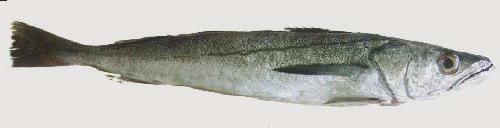
It is an elongated fish with a large head, which takes up between 26 and 33.5 % of the standard length and lacks scales on several areas, such as the lower part of the cheek and the preopercle [1]. It has two dorsal fins: the first short, with 10 to 13 rays, and the second long, with 34 to 42; the pectoral fins always reach past the start of the anal fin and the tail margin is usually concave [1].
The upper body is greyish black, especially on the head and fins; an orange horizontal stripe runs along the middle of the flanks and the belly is whitish [1]. The first gill arch carries 17 to 25 gill rakers, which, like their base, bear small black pigment spots [1]. That pigment is one of the features that separate it from other hakes of the eastern Pacific [1].
The Peruvian and Chilean populations differ little in shape and in counts of fin rays and vertebrae, and the FAO catalogue accepts the two subspecies with reservations [1]. A protein study comparing 25 hake from Talcahuano with 25 from Paita found a genetic identity of 0.873, which according to its authors means the two populations became isolated some 0.9 to 2 million years ago, in the Pleistocene [8].
Similar species
- Merluccius angustimanus: The Panama hake, found from Colombia to the Gulf of California, has no black pigment spots on its gill rakers or their base, and its head fits between 2.9 and 3.3 times into the standard length [1].
Distribution and habitat
The Peruvian subspecies is recorded between Punta Pariñas (4°40'S) and Tambo de Mora (13°56'S), with the largest concentrations between 6° and 9°S, while the Chilean one lives between Chañaral (26°21'S) and the Chonos Archipelago (45°10'S) [1]. Under normal conditions its main range runs from 3° to 10°S and it is most abundant between 100 and 200 m deep [2].
In Peru its habitat is set by the southern branch of the Cromwell Current, a flow of warmer, better-oxygenated water running north to south between 100 and 500 m deep; its southern edge reaches 12° to 14°S in summer and autumn, falls back to 6° to 8°S in winter and spring, and during El Niño can go beyond 18°S [1]. The species tolerates temperatures of 10 to 22 °C and oxygen-poor water [1].
After the 1991-1993 El Niño, large old hake all but vanished from the usual fishing grounds, which filled with young small hake, until then typical of areas further south; within a few months of 1992 the mean length in the catch fell by 8 cm [5]. During the 1997-1998 El Niño it reached 18°S, and between 2016 and 2017, coinciding with the 2015-2016 El Niño and then the 2017 Coastal El Niño, it turned up in the artisanal catch off Quilca, Arequipa (16°42'S) [2].
Biology
In the Peruvian population males reach 68 cm and females 115 cm, although most do not exceed 50 cm [1]. Small fish predominate in the south of the range and large ones in the north [3].
According to the FAO catalogue, males mature at 27.3 cm and females at 29.9 cm; females release their eggs in batches, and those of 40 to 70 cm produce between 78,000 and 174,000 oocytes [1]. It spawns all year round, with a peak in August and September and a smaller one in summer [1].
Under fishing pressure and environmental change, hake began to mature ever smaller and younger, until fish only 1 year old and 19 cm long were reproducing, although hake up to 14 years old have been observed [5].
Ecology
An analysis of 2836 stomachs from hake caught by trawlers off Paita between 1995 and 1997 showed that fish made up 87 % of the food by weight, cephalopods 10.4 % and crustaceans 2.6 % [3]. Hake itself was the most important prey among the fish, at 40.6 %, followed by anchovies at 24.1 %, almost all Peruvian anchoveta; in 1997, an El Niño year, the diet became more varied [3].
Hake under 30 cm eat mostly crustaceans, especially euphausiids, and larger ones switch to sardine, anchoveta and other fish; from 50 cm on, cannibalism is common and is held responsible for 30 % of the species' natural mortality [1]. Besides fishing and the environment, the possible causes put forward for its decline include predation by the jumbo squid, Dosidicus gigas, and cannibalism [5].
In hake from the Ventanilla fish terminal, Callao, in January and February 2014, 15 parasite species were found, among them monogeneans, copepods, digeneans, tapeworms, nematodes such as Anisakis simplex, and acanthocephalans [4].
Conservation
The IUCN Red List classifies Merluccius gayi as Data Deficient [6].
In Peru, coastal and distant-water trawler fleets fished it intensively from 1970 and exported almost the whole catch; the fishery collapsed in 1980 [1]. The species' highest total catch, in 1978, exceeded 380,000 t, more than 300,000 of them Peruvian, and in 1983 the Peruvian catch fell to just over 5000 t [1].
In the 1990s the abundance of young hake on the fishing grounds was taken as a sign of a healthy stock: the fleet grew and catches reached very high levels in 1996, while total abundance was falling [5]. In 2002 the government imposed a total, open-ended ban and formed a technical commission to monitor and rebuild the stock; fishing reopened in 2004 after 20 months shut, but at the close of 2005 the stock had still not regained its abundance or its age structure, and hake aged 4 or more were scarce [5].
Health, toxicological and chemical relevance
Not medical advice. For a sting, a poisoning or an allergy, seek medical care.
Anisakis larvae can pass to people who eat raw or undercooked fish, as in ceviche or sushi, or cold-smoked, salted or pickled fish [9]. In hake bought at the Grau fish terminal in Ayacucho between July and December 2023, larvae of Anisakis simplex and Anisakis physeteris were found in 8 % of the fish, always in the peritoneal cavity [9].
Parasites of the genus Kudoa soften and liquefy the muscle of the marine fish they infect; in hake, Kudoa peruviana forms cysts in the muscle [10]. It was present in 59.67 % of 62 hake from the central coast obtained in January and February 2014 at the Ventanilla terminal, Callao, more often in females and in larger fish [10].
Human relevance
It is the most abundant and most valuable species in Peru's bottom-trawl fishery [4]. In the north of the country it has supported the main trawl fishery since the 1950s, which brings in foreign currency and jobs [2], and it makes up about 80 % of demersal fish landings on the Peruvian coast [3].
It is sold mainly frozen, although in the past it was also turned into fishmeal when it was caught in the nets of pelagic fisheries [1]. It is a modestly priced fish that also reaches the Andes: landings of 28 and 30 t were recorded in Huamanga, Ayacucho, in 2016 and 2017 [9].
Where to see it in Peru
It lives near the bottom, with its largest concentrations off northern Peru, between 6° and 9°S [1], mostly at depths of 100 to 200 m [2]. A study of its diet used fish caught aboard industrial trawlers off Paita between 1995 and 1997 [3].
With El Niño it can appear much further south: in April and September 2016 fish of 16 to 19 cm were caught off Quilca, Arequipa, one of them less than 0.5 nautical miles from the coast, and in July 2017 a gillnet set at about 45 m brought up 56 hake of 26 to 34 cm [2].
References (10)
- Lloris, D., Matallanas, J., Oliver, P. (2005). Hakes of the world (Family Merlucciidae). An annotated and illustrated catalogue of hake species known to date. FAO Species Catalogue for Fishery Purposes No. 2. FAO, Rome, 17, 28-30. https://www.fao.org/4/y4876e/y4876e00.htm (accessed 2026-10-20)
- Barriga R., E., Campos, S., Ramos, E. et al. (2022). Distribución de merluza peruana (Merluccius gayi peruanus) frente al litoral sur de Perú durante El Niño 2015-2016 y El Niño Costero 2017. Boletín Instituto del Mar del Perú, 534-540. doi:10.53554/boletin.v36i2.352 (accessed 2026-10-20)
- Orrego A., H., Mendo, J. (2012). Variación interanual de la dieta de la merluza Merluccius gayi peruanus (Guitchenot) en la costa peruana. Ecología Aplicada, 103-116. doi:10.21704/rea.v11i1-2.430 (accessed 2026-10-20)
- Chero, J., Cruces, C., Iannacone, J. et al. (2014). Índices parasitológicos de la merluza peruana Merluccius gayi peruanus (Ginsburg, 1954) (Perciformes: Merlucciidae) adquiridos del terminal pesquero de Ventanilla, Callao, Perú. Neotropical Helminthology, 141-162. doi:10.24039/rnh201481907 (accessed 2026-10-20)
- Guevara-Carrasco, R., Lleonart, J. (2008). Dynamics and fishery of the Peruvian hake: Between nature and man. Journal of Marine Systems, 249-259. doi:10.1016/j.jmarsys.2007.02.030 (accessed 2026-10-20)
- Iwamoto, T., Eschmeyer, W., Alvarado, J. et al. (2008). Merluccius gayi: Iwamoto, T., Eschmeyer, W., Alvarado, J. & Bussing, W. The IUCN Red List of Threatened Species 2010: e.T183527A8128809. doi:10.2305/IUCN.UK.2010-3.RLTS.T183527A8128809.en (accessed 2026-10-20)
- WoRMS Editorial Board (2026). Merluccius gayi (Guichenot, 1848). World Register of Marine Species. https://www.marinespecies.org/aphia.php?p=taxdetails&id=293628 (accessed 2026-10-20)
- Hernández, C.E., Galleguillos, R., Oyarzún, C. (2000). Diferenciación genética de Merluccius gayi gayi y Merluccius gayi peruanus (Pisces, Merlucciidae) y antecedentes paleogeográficos de su área de distribución. Revista Chilena de Historia Natural. doi:10.4067/S0716-078X2000000100003 (accessed 2026-10-20)
- Julio Cesar Soto Palacios (2024). Prevalencia de Anisakis spp. en merluza (Merluccius gayi peruanus), Ayacucho 2023. Investigación, 21-27. doi:10.51440/unsch.revistainvestigacion.31.1.2024.678 (accessed 2026-10-20)
- Chero, J., Cruces, C., Iannacone, J. et al. (2015). Prevalencia de infección por Kudoa peruviana (Mateo, 1972) (Myxosporea: Kudoidae) en la musculatura somática de la merluza peruana Merluccius gayi peruanus (Ginsburg, 1954) (Perciformes: Merlucciidae) de la costa central del Perú. Neotropical Helminthology, 73-85. doi:10.24039/rnh201591781 (accessed 2026-10-20)
More pictures
Photo: Nelson Balcar · CC BY 4.0 · GBIF (iNaturalist research-grade observations) Photo: Scott Hamilton · CC BY-SA 4.0 · GBIF (vía GBIF)Museum specimen (colours may differ from the living animal)
Where it has been recorded
- Filled: scientific records, or confirmed by a curator
- Hatched: isolated record
- Dotted outline: no scientific records and no curator's confirmation (an ORKA sighting is not drawn here)
- Tropical–cold transition zone
Scientific records (7 records)
- Cold central sea
Scientific records (3802 records)
- Cold southern sea
Scientific records (2 records)
From openly licensed OBIS and GBIF records (CC0 or CC BY). How each list is built.
Related species
From the same genus (Merluccius).
Names and sources
In Spanish
- Merluza — Peru; fishbase; WoRMS · main name
- Huaycuya — Peru; fishbase
- Maltona — WoRMS
- Merlango — Peru; fishbase; WoRMS
- Merluza chilen — WoRMS
- Merluza común — WoRMS
- Merluza común chilena — WoRMS
- Merluza del Pacifico sur — WoRMS
- Peje-palo — Peru; fishbase; WoRMS
- Pescada — Peru; fishbase; WoRMS
- Pescadilla — Peru; fishbase; WoRMS
In English
- Hake — WoRMS
- Chilean whiting — WoRMS
- English hake — WoRMS
- Pacific hake — WoRMS
- Peruvian hake — WoRMS
- Peruvian whiting — WoRMS
- Silver hake — WoRMS
- South Pacific hake — WoRMS
Learn more
Conservation status: Data Deficient (IUCN Red List, according to Wikidata). Taxonomy: PeRMS / WoRMS (CC BY 4.0).