
Bony fishes · Melanocetidae
Humpback anglerfish
Melanocetus johnsonii Günther, 1864
Spanish: Negro
- Peruvian Register of Marine Species
- Listed in PeRMS (IMARPE)
Species account
Summary
Melanocetus johnsonii is a deep-sea anglerfish of the family Melanocetidae, in the order Lophiiformes [1]. Günther described it in 1864 in a note on a pediculate fish from the sea of Madeira [1]. It lives in the deep water column, between about 100 and 1500 m in most records, and is known from tropical to temperate parts of all oceans [2]. Females reach about 18 cm in total length, and the dwarf males do not exceed 2.9 cm [2]. Its global IUCN Red List category is Least Concern [3].
Identification and similar species
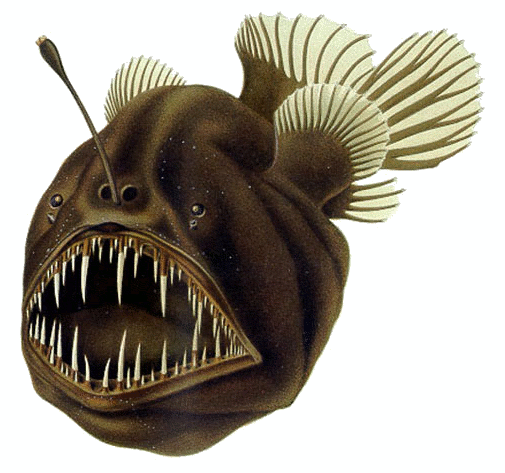
The body is short and/or deep. There is a single dorsal spine, modified into the fishing rod, with 13 to 17 soft rays in the dorsal fin and 3 to 5 in the anal fin, and no anal spines [2]. The skin bears minute spinules over most of the body, and the lure, or esca, has flattened crests [2].
The feature that matters most for telling the species of the genus apart is the lure. In Melanocetus johnsonii the esca has anterior and posterior crests (after Pietsch, cited by Orlov and colleagues) and a black pigmented area on top [4]. The rod length ranges from 26 to 55 % of standard length according to Bertelsen, and from 32.4 to 60.8 % according to Pietsch and Van Duzer; the esca width ranges from 4.3 to 9.2 % of standard length according to Bertelsen [4].
Females reach about 18 cm in total length [2]. A specimen from the Ross Sea measured 157 mm in total length and 133 mm in standard length, and weighed 290 g [4]. Males are much smaller, up to 2.9 cm [2].
Similar species
- Melanocetus murrayi: It has a shorter rod, 23 to 38 % of standard length, and a narrower esca, 1.4 to 3.8 % (Bertelsen's figures); it is also widely distributed, and its COI genetic distance from Melanocetus johnsonii is 0.0363 [4].
- Melanocetus rossi: Its esca has a central crest but no black pigment on top; it was described from a single Ross Sea specimen, and Pietsch suggested it may be a synonym of Melanocetus johnsonii, although Orlov and colleagues consider synonymising them premature [4].
- Melanocetus polyactis: Its esca has a black top, as in Melanocetus johnsonii, but no crests; it is known only from the eastern tropical Pacific [4].
Distribution and habitat
According to FishBase, it lives in tropical to temperate waters of all oceans, roughly between 50° N and 50° S [2]. Orlov and colleagues give a southern limit of 52° S and a northern limit of 66° N for the species [4]. WoRMS reports it as known from seamounts and knolls, and notes a record at 2091 m deep in Canadian Atlantic waters [1].
It is a water-column species, meso- and bathypelagic according to FishBase: it has been recorded between 100 and 4500 m, though 100 to 1500 m is usual [2]. A Ross Sea specimen, found in the stomach of an Antarctic toothfish caught at 1243-1355 m near 75° S, extended the southern limit of the species by 23° of latitude, more than 1000 nautical miles, although the authors caution that the toothfish may have swum some distance before it was caught [4].
Biology
It can catch and swallow prey larger than itself [2]. Reproduction data indicate that it is oviparous, with planktonic larvae living mostly in the upper 100 m; the eggs are believed to be carried in floating gelatinous rafts [2].
The size difference between the sexes is very large: females reach 18 cm and males 2.9 cm, and the males are dwarfed and non-parasitic [2]. The identity of the Antarctic specimen was confirmed with the mitochondrial cytochrome oxidase I gene: its genetic distance from 4 other specimens of Melanocetus johnsonii was 0.0015 [4].
Ecology
Its estimated trophic level is 4.1, calculated from recorded food items [2]. It is also prey: the Ross Sea specimen was found almost fresh in the stomach of an Antarctic toothfish 138 cm long and weighing 28 kg [4].
Four species of Melanocetus have been recorded in the eastern tropical Pacific, and in the Gulf of Mexico two of them (Melanocetus johnsonii and Melanocetus murrayi) are commonly taken in the same trawls, so it can live alongside close relatives [4].
Conservation
Health, toxicological and chemical relevance
Not medical advice. For a sting, a poisoning or an allergy, seek medical care.
No danger to people is known: FishBase rates it as harmless [2].
Human relevance
References (4)
- WoRMS Editorial Board (2026). Melanocetus johnsonii Günther, 1864. World Register of Marine Species. https://www.marinespecies.org/aphia.php?p=taxdetails&id=126556 (accessed 2026-10-25)
- Froese, R., Pauly, D. (2026). Melanocetus johnsonii, Humpback anglerfish. FishBase. https://www.fishbase.se/summary/Melanocetus-johnsonii.html (accessed 2026-10-25)
- IUCN (2013). Melanocetus johnsonii: Arnold, R. The IUCN Red List of Threatened Species. doi:10.2305/IUCN.UK.2015-4.RLTS.T18127840A21911455.en (accessed 2026-10-25)
- Orlov, A.M., Orlova, S.Y., Volkov, A.A. et al. (2015). First record of humpback anglerfish (Melanocetus johnsonii) (Melanocetidae) in Antarctic waters. Polar Research 34, 25356. doi:10.3402/polar.v34.25356 (accessed 2026-10-25)
More pictures
Where it has been recorded
- Filled: scientific records, or confirmed by a curator
- Hatched: isolated record
- Dotted outline: no scientific records and no curator's confirmation (an ORKA sighting is not drawn here)
- Cold central sea
Scientific records (10 records)
- Cold southern sea
Scientific records (4 records)
From openly licensed OBIS and GBIF records (CC0 or CC BY). How each list is built.
Related species
From the same genus (Melanocetus).
Names and sources
In Spanish
- Negro — Wikidata · main name
In English
- Humpback anglerfish — WoRMS; Wikidata
- Blackdevil — Wikidata
- Humpback Blackdevil — Wikidata
Classification
Learn more
Conservation status: Least Concern (IUCN Red List, according to Wikidata). Taxonomy: PeRMS / WoRMS (CC BY 4.0).