
Bony fishes · Megalopidae
Tarpon
Megalops atlanticus Valenciennes, 1847
Spanish: Sábalo
- Peruvian Register of Marine Species
- Listed in PeRMS (IMARPE)
Species account
Summary
The Atlantic tarpon, Megalops atlanticus, is a large, laterally compressed, silvery fish native to the Atlantic Ocean that is presumed to have crossed the Panama Canal about 80 years ago and has since spread through the tropical eastern Pacific [1]. A specimen of 129 cm and 18 kg, caught in July 2024 at Bonanza, Tumbes, is the first published record of the species for Peru [1].
Its global IUCN Red List category is Vulnerable [2].
Identification and similar species
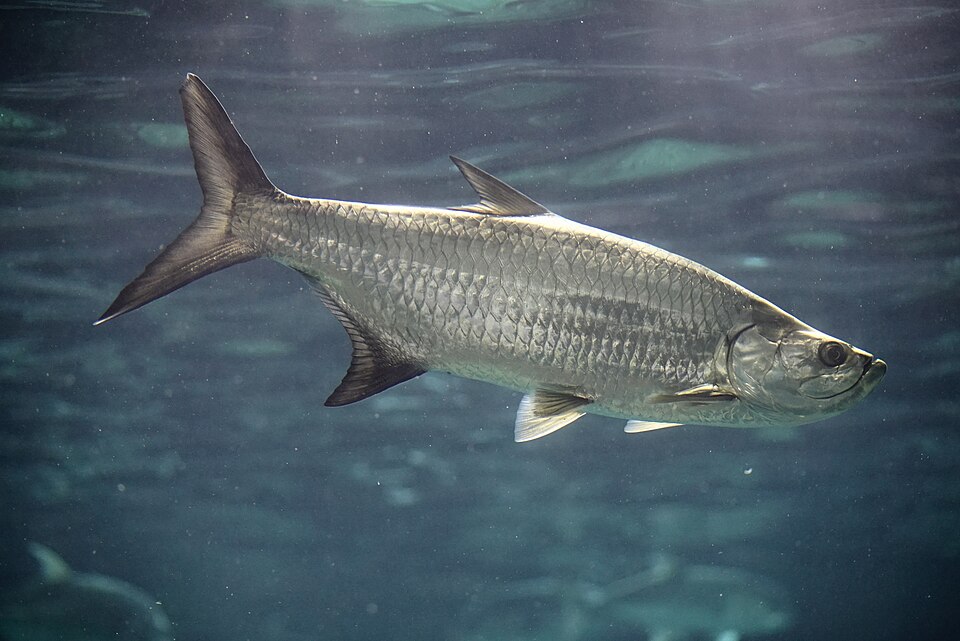
The body is elongated and strongly compressed, the head short and deep, the eyes large, and the mouth large and oblique, opening upward, with a projecting lower jaw. The base of the anal fin is much longer than that of the dorsal fin, the pelvic fins sit on the belly, and the tail fin is large and deeply forked [1].
An elongated bony plate lies between the lower jaws; the teeth are small and simple, found on the jaws, the roof of the mouth, the tongue and the base of the gill arches. The fins have no spines, there is a single dorsal fin with 13 to 21 rays whose last ray is filamentous, the lateral line is complete, and the scales are large and smooth [1].
In life it is bright silver with a dark back and grey fins; the anal fin is white with a grey edge [1]. In the Colombian Pacific, Neira and Acero describe 32 to 36 gill rakers on the lower part of the first arch and 37 to 42 large scales along the lateral line, and give a maximum size of 197 cm and 44 kg [3].
Similar species
- Megalops cyprinoides: It lives in the Indo-Pacific, does not exceed 60 cm and has proportionally larger eyes; there are no records of it in the eastern Pacific [1].
Distribution and habitat
In the western Atlantic it ranges from Nova Scotia (Canada) to southern Brazil, including the Gulf of Mexico and the Caribbean, where the largest populations are found; in the eastern Atlantic it occurs from Mauritania to Angola, with exceptional records in Portugal, Spain, the Azores and the Atlantic coast of France [1].
In the eastern Pacific it extends from Guatemala to the mouth of the Mira River in southern Colombia, and the Tumbes record extends it more than 500 km farther south [1]. Specimens were already on the Pacific side of the Panama Canal in the 1930s, and the two El Salvador records, from 2017 and 2018, lie about 1100 km from the nearest earlier record, at Coiba Island, Panama [4].
It is a euryhaline species, living in marine, estuarine and continental environments [4],[1]. It can ascend rivers; in the Atlantic it reaches Lake Nicaragua after a 195 km journey through fresh water along the San Juan River [1]. The Peruvian specimen was caught over a sandy bottom, about 10 m from the shore [1].
Biology
Megalops is the only known genus of air-breathing marine fishes [5]. In a study of juvenile Atlantic tarpon from Texas, fish under 15 cm took more air when oxygen in the water fell, that is, they are facultative air breathers; in fish over 30 cm exhausting exercise did not increase air breathing, and plasma pH recovered by 4 h, although that group had only 2 fish [5].
Adults make seasonal migrations of thousands of kilometres that cross national boundaries [1]. In the Pacific, small juveniles have been found far from the canal entrance, which suggests the species may be reproducing there [1]. Of 6 specimens examined in the Colombian Pacific, 5 were males and 1 a female, all at gonadal maturity stage III [3].
Ecology
In the Colombian Pacific, fishers catch tarpon with live bait, often Opisthonema libertate, and say they see it most between April and May, when that herring migrates [3].
Its effect on eastern Pacific ecosystems is still uncertain: no decline of other fishes in the region has been attributed to its presence [4], but its presence could alter the composition of local ecosystems and its authors ask for monitoring of its catches [1].
Conservation
The IUCN classifies it as Vulnerable worldwide [2]. According to Hooker, citing the assessment, it has declined significantly since the 1970s, attributed to commercial and subsistence capture, water quality and habitat degradation [1].
In the tropical eastern Pacific no category has been set for the species, and it is not listed in any CITES appendix [4].
Human relevance
In the Colombian Pacific, of 50 fishers interviewed, 65 % use tarpon for their own consumption, 20 % for handicrafts, 7 % for sale and 8 % for sport fishing; its scales are made into lamps, necklaces and bracelets [3]. It is caught with hand line, spear, gillnet and rod [3].
In its native range it supports subsistence, commercial and recreational fisheries, and is a highly prized sport fish in the Caribbean and the Gulf of Mexico [1]. The Tumbes specimen was not preserved: local residents ate it [1].
Where to see it in Peru
No source describes a place to see tarpon in Peru. The only published record is one specimen caught on 2 July 2024 with a curtain net of 16 cm mesh at Bonanza, Tumbes, and its author recommends monitoring local catches to learn its relative abundance [1].
References (5)
- Hooker, Y. (2025). First record of the Atlantic tarpon Megalops atlanticus (Elopiformes: Megalopidae) in the Southeast Pacific, Peru. Boletín del Instituto del Mar del Perú 40(1), e430. doi:10.53554/boletin.v40i1.430 (accessed 2026-10-25)
- Adams, A., Guindon, K., Horodysky, A. et al. (2018). Megalops atlanticus: Adams, A., Guindon, K., Horodysky, A., MacDonald, T., McBride, R., Shenker, J. & Ward, R. The IUCN Red List of Threatened Species 2019: e.T191823A174796143. doi:10.2305/IUCN.UK.2019-2.RLTS.T191823A174796143.en (accessed 2026-10-25)
- Neira, A., Acero P, A. (2016). Megalops atlanticus (Megalopidae), un nuevo pez en el océano Pacífico; información sobre su importancia pesquera. Revista MVZ Córdoba 21(3), 5525-5534. doi:10.21897/rmvz.826 (accessed 2026-10-25)
- Barraza, J.E. (2018). New distribution record of Megalops atlanticus Valenciennes, 1847 (Elopiformes, Megalopidae) in El Salvador, Eastern Pacific Ocean. Check List 14(5), 933-935. doi:10.15560/14.5.933 (accessed 2026-10-25)
- Martin, L., Dichiera, A.M., Esbaugh, A.J. (2025). The role of air breathing in exhaustive exercise recovery in Atlantic tarpon (Megalops atlanticus). Conservation Physiology 13(1), coaf089. doi:10.1093/conphys/coaf089 (accessed 2026-10-25)
More pictures
If you come across it
Protected or threatened species. Watch it without touching, feeding, chasing or taking it, and keep the recommended viewing distances.
Names and sources
In Spanish
- Sábalo — WoRMS; Wikidata · main name
In English
- Tarpon — WoRMS; Wikidata
- Atlantic tarpon — Wikidata
Learn more
Conservation status: Vulnerable (IUCN Red List, according to Wikidata). Taxonomy: PeRMS / WoRMS (CC BY 4.0).