
Jellyfish, hydroids and comb jellies · Geryoniidae
Liriope tetraphylla
Liriope tetraphylla (Chamisso & Eysenhardt, 1821)
- Peruvian Register of Marine Species
- Listed in PeRMS (IMARPE)

Species account
Summary
Liriope tetraphylla is a small planktonic jellyfish, under 2 cm across, that is holoplanktonic and is known from the three great oceans and the Mediterranean [1]. It was described in 1821 as Geryonia tetraphylla, with the Indian Ocean as its type locality [2]. Off Mejillones bay in northern Chile it was collected mostly in the top 50 m of the water column [3].
Identification and similar species
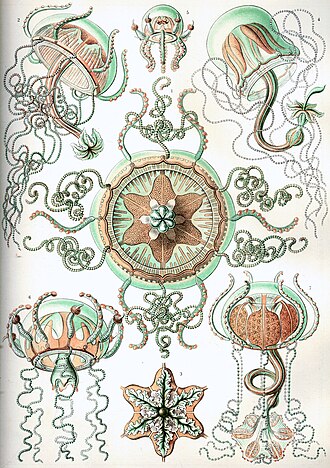
The bell is hemispherical and measures between 0.25 and 17.5 mm across; the jelly is thin and thickens only at the apex [1]. A long gastric peduncle hangs from the small stomach: in adults it can be one to three times the height of the bell [1]. The mouth has four lips, and the four flattened, circular to leaf-shaped gonads cover almost the whole underside of the bell [1].
It carries four long, hollow perradial tentacles with rings of stinging cells, and four short, solid interradial ones that may be lost as it grows; eight statocysts with concretions sit at the tentacle bases [1]. Young medusae under 2 mm have no peduncle and show only the interradial tentacles [1]. The general shape, the tentacle arrangement and the long peduncle are enough to recognise it at any stage, although gonad shape, canal number and size vary a great deal [1].
Distribution and habitat
It is known from the three great oceans and the Mediterranean, most abundant within the 20 °C isotherm, and it is absent from polar regions [1]. WoRMS lists it as circum(sub)tropical [2]. In the southeastern Pacific it has been recorded as an oceanic inhabitant of the Humboldt Current in Chile [1], whereas in the western Atlantic it is usually considered a coastal, euryhaline species [1].
Off Mejillones bay in northern Chile, between October 2000 and October 2001, it was collected from 0 to 100 m, concentrated in the top 50 m and only occasionally down to 200 m [3]. There the oxygen minimum layer, at only 20–50 m depth, limited the vertical distribution of the gelatinous carnivores to the well-oxygenated surface layers [3].
Biology
It is a hydromedusa (trachymedusa) with no known polyp stage: WoRMS notes that only the medusa exists and that development is direct, although that note is flagged as unreviewed [2]. Its diet has not been studied in detail, but herbivorous crustaceans, chaetognaths and fish eggs and larvae have been found in its manubrium, which suggests it preys at several trophic levels [1].
Genetic analyses hint that cryptic species may hide under this name, based on divergences in mitochondrial 16S and nuclear SSU sequences, and the genus is for now treated as having a single species [1].
Ecology
In the northern Humboldt Current it is one of the most abundant hydromedusae of the gelatinous macroplankton (off Mejillones), alongside Aglaura hemistoma, Cunina peregrina, Obelia spp. and Solmundella bitentaculata [3]. Off Mejillones its relative density ranged from 187 to 568 individuals per 100 m3 over the four cruises, by day and night, without the sharp spring and summer increase shown by other medusae [3]. In winter, when almost all medusae were scarce, it and Obelia spp. were the exceptions [3].
Its pattern relative to the coast changed with the season: in spring 2000 it increased from the coast towards the ocean, and in summer it decreased along that same gradient [3]. At the oceanic station, where the abundance of gelatinous carnivores fell sharply, oceanic species, this one among them, predominated [3]. In the southwestern Atlantic, by contrast, it reaches densities of up to 1000 organisms per m3 off estuaries in southern Brazil [1].
Health, toxicological and chemical relevance
Not medical advice. For a sting, a poisoning or an allergy, seek medical care.
On beaches of southern Uruguay and northern Argentina, swarms of this jellyfish irritate bathers' skin, with densities reaching 4.7 × 10^6 organisms per m3 [1]. A dermatological report described paresthesias (tingling) at mucocutaneous junctions and skin folds, leading to chafing and excoriations, caused by several stages of the species; the cases occur in the summer season, among people bathing close to shore in water 1 to 3 m deep [4].
References (4)
- Nagata, R.M., Nogueira Júnior, M., Haddad, M.A. (2014). Faunistic survey of Hydromedusae (Cnidaria, Medusozoa) from the coast of Paraná State, Southern Brazil. Zootaxa 3768(3), 315-316. doi:10.11646/zootaxa.3768.3.3 (accessed 2026-10-25)
- WoRMS Editorial Board (2026). Liriope tetraphylla (Chamisso & Eysenhardt, 1821). World Register of Marine Species. https://www.marinespecies.org/aphia.php?p=taxdetails&id=117568 (accessed 2026-10-25)
- Palma, S., Apablaza, P. (2004). Abundancia estacional y distribución vertical del zooplancton gelatinoso carnívoro en una área de surgencia en el norte del Sistema de la Corriente de Humboldt. Investigaciones Marinas 32(1), 49-70. doi:10.4067/S0717-71782004000100005 (accessed 2026-10-25)
- Mianzan, H., Sorarrain, D., Burnett, J.W. et al. (2000). Mucocutaneous Junctional and Flexural Paresthesias Caused by the Holoplanktonic Trachymedusa Liriope tetraphylla. Dermatology 201(1), 46-48. doi:10.1159/000018429 (accessed 2026-10-25)
More pictures
Where it has been recorded
- Filled: scientific records, or confirmed by a curator
- Hatched: isolated record
- Dotted outline: no scientific records and no curator's confirmation (an ORKA sighting is not drawn here)
- Tropical–cold transition zone
Scientific records (1 record)
- Cold central sea
Scientific records (4 records)
- Cold southern sea
Scientific records (2 records)
From openly licensed OBIS and GBIF records (CC0 or CC BY). How each list is built.
Related species
From the same family.
Names and sources
Learn more
Conservation status: no data (IUCN). Taxonomy: PeRMS / WoRMS (CC BY 4.0).