
Seabirds · Laridae
Kelp gull
Larus dominicanus Lichtenstein, 1823
Spanish: Gaviota dominicana
- Names in Peru
- Gaviota dominicana
- Peruvian Register of Marine Species
- Listed in PeRMS (IMARPE)
Species account
Summary
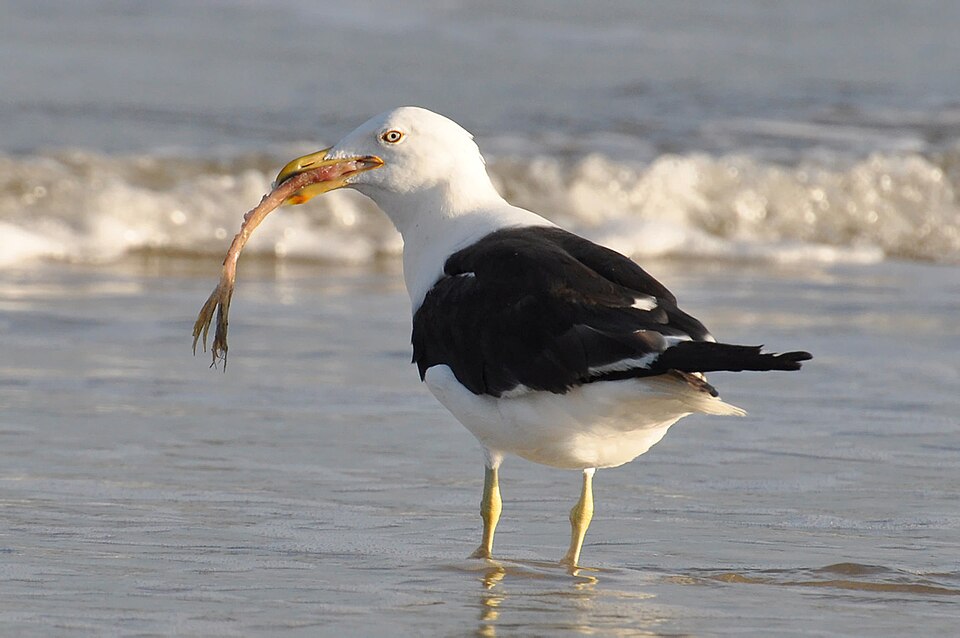
Larus dominicanus is a gull of the family Laridae described by Lichtenstein in 1823 [1]. In Peru it is called «gaviota dominicana» [2]. It is the dominant large gull of the Southern Hemisphere: a bulky bird with blackish upperparts and pale yellowish-green legs, abundant in southern South America and found along both coasts of the continent up to Ecuador and Brazil; it eats a very wide range of animals and makes use of rubbish dumps [3]. On the Pacific coast it breeds as far north as Piura [4]. The IUCN Red List classifies it as Least Concern in its 2018 assessment [5].
Identification and similar species
It is easy to recognise by its large size, its very dark black upperparts and its pale yellowish-green legs [3].
Similar species
- Larus belcheri: A gull of the Humboldt Current whose adult keeps a black tail band throughout life and has a yellow bill with a large red tip; in winter even the adult acquires a well-defined brownish hood [6].
Distribution and habitat
5 subspecies are recognised: the nominate dominicanus on the coasts of southern South America, the Falklands, South Georgia, southern Australia, Tasmania and New Zealand; austrinus in Antarctica and its islands; judithae on subantarctic islands of the Indian Ocean; vetula in southern Africa, from Namibia to KwaZulu-Natal; and melisandae in south-western and southern Madagascar [3].
In South America it breeds from Chilean Tierra del Fuego to Rio de Janeiro on the Atlantic side and to Piura on the Pacific side [4]. In northern Peru it forms colonies on islands such as Foca, Lobos de Tierra and Lobos de Afuera [7], and at sea it was recorded in a seabird census carried out in July 2010 off La Libertad, Áncash and northern Lima [8].
Biology
On Lobos de Tierra, Foca and Lobos de Afuera, islands studied between November and December 2004, laying seemed to begin at the same time on all 3 islands, around the third week of October, and most nests held 3 eggs [7]. Each nest used the material available on its island, mostly seaweed and feathers and, on Foca, sapote leaves as well; the birds chose high, wind-swept spots sheltered by rocks, fissures or steps in the ground, on rock, gravel, cobbles or shell beds, on terrain ranging from slopes under 15° to cliffs [7].
It can also nest in towns: between 2012 and 2013, in an urban area of Coquimbo, Chile, 13 nests made mostly of straw were counted on house roofs and fuel tanks; the birds built them during the first half of November, and the chicks probably hatched around mid-December [9]. What best explained where the birds nested was closeness to the neighbouring nest, consistent with colonial habits, and the author considers it probably the first documented nest on a wholly artificial surface [9].
The breeding population of the South American coasts is estimated at no fewer than 160,000 pairs, at least 106,000 of them in Argentina, and colonies holding over 1,000 pairs are rare [4].
Ecology
In northern Peru its colonies shared space with other animals: on Foca, with the South American sea lion (Otaria flavescens) and the Humboldt penguin (Spheniscus humboldti); on Lobos de Tierra, with the blue-footed booby (Sula nebouxii); and on Lobos de Afuera, with that same sea lion and booby and with the Peruvian pelican (Pelecanus thagus); on all 3 islands it often ate eggs and stole food from blue-footed boobies [7].
At Coquimbo, in northern Chile, during the 2002-2003 breeding season, gulls living near fishing ports fed mostly there, whereas those breeding on islands relied mainly on intertidal organisms; breeders ate more energy-rich fish than non-breeders, and fishery waste proved to be an important food source [10].
In 3 protected areas of Chubut, Argentina, pellets from the 1994 and 1995 breeding seasons revealed at least 38 prey species, including at least 8 fishes and 11 crustaceans as well as molluscs and polychaetes, confirming it as a generalist and opportunistic species [11].
Conservation
The IUCN Red List classifies it as Least Concern [5]. In Peru it appears on the species list of the Master Plan of Los Manglares de Tumbes National Sanctuary 2023-2027 with no threat category under D.S. 004-2014-MINAGRI [2].
A review of South America's coastal populations found trends that varied by sector: only in Argentina were there marked increases and new colonies, and it found no solid evidence that the breeding range is expanding [4]. The authors attribute growth in some areas to food provided by people, such as fishery discards and urban refuse, and recommend continued population monitoring because of possible conflicts with people [4].
Health, toxicological and chemical relevance
Not medical advice. For a sting, a poisoning or an allergy, seek medical care.
At Puerto Deseado, in Argentine Patagonia, 100 gulls caught at the fishery dump over one year, in 1995 and 1996, were sampled and at least 10 species of bacteria from 8 genera were found, among them Salmonella of serotype Typhimurium, present for most of the year and the riskiest for livestock and people; given the gull's abundance and its movements between the dump, the town and the colonies, the authors consider it a likely carrier of pathogens [12].
In Chile, the livers of adults from an urban colony at Coquimbo and from a wild islet held on average 9.72 micrograms of cadmium per gram of dry weight, 194% of the level considered toxic though within the usual range for seabirds; fledglings from the islet held 1.54 and those from the town were below the detection limit, and the authors put the islet figure down to the parents there stealing food and eating the eggs and chicks of other seabirds [13].
It hosts many parasites: a review of 59 publications gathered 62 described helminth species from this gull and added 11 parasites from Talcahuano, Chile, 10 of them new for the country [14]. At the same locality 1,177 lice of 4 species were collected from 124 gulls, the most numerous being Saemundssonia lari [15].
Human relevance
It benefits from fishery discards and urban refuse, so its growth in some areas can create conflicts with people that justify monitoring its populations [4].
At Coquimbo, Chile, it nests on house roofs and fuel storage tanks in the middle of the city [9].
In the July 2010 seabird census off Peru's north-central coast, 56.25% of the kelp gulls observed approached the vessel, as did most of the Laridae species recorded; the study used that approach to assess the birds' possible interaction with fisheries [8].
Where to see it in Peru
Between November and December 2004 its colonies were studied on Foca, Lobos de Tierra and Lobos de Afuera, islands off northern Peru [7].
In the San Fernando National Reserve, in Ica, a survey of 12 beaches between June 2018 and May 2019 recorded it in all 4 seasons, though always in far smaller numbers than Larus belcheri [16].
On Pozo Lizas beach, in the province of Ilo, it was seen in March 2009, June 2012 and May 2015 [17]. It is also on the bird list of Los Manglares de Tumbes National Sanctuary [2].
References (17)
- WoRMS Editorial Board (2026). Larus dominicanus Lichtenstein, 1823. World Register of Marine Species. https://www.marinespecies.org/aphia.php?p=taxdetails&id=212624 (accessed 2026-10-20)
- Servicio Nacional de Áreas Naturales Protegidas por el Estado (2023). Plan Maestro del Santuario Nacional Los Manglares de Tumbes 2023-2027. SERNANP, RP N.° 064-2023-SERNANP. https://cdn.www.gob.pe/uploads/document/file/4137567/RESOLUCION%20PRESIDENCIAL%20N%20064-2023-SERNANP.pdf.pdf (accessed 2026-10-20)
- Burger, J., Gochfeld, M., Garcia, E. et al. (2025). Kelp Gull (Larus dominicanus). Birds of the World, version 1.2. doi:10.2173/bow.kelgul.01.2 (accessed 2026-10-20)
- Yorio, P., Branco, J.O., Lenzi, J. et al. (2016). Distribution and Trends in Kelp Gull (Larus dominicanus) Coastal Breeding Populations in South America. Waterbirds, 114-135. doi:10.1675/063.039.sp103 (accessed 2026-10-20)
- BirdLife International (2018). Larus dominicanus: BirdLife International. The IUCN Red List of Threatened Species 2018: e.T22694329A132542863. doi:10.2305/IUCN.UK.2018-2.RLTS.T22694329A132542863.en (accessed 2026-10-20)
- Burger, J., Gochfeld, M., Kirwan, G.M. et al. (2024). Belcher's Gull (Larus belcheri). Birds of the World, version 1.1. doi:10.2173/bow.belgul.01.1 (accessed 2026-10-20)
- Figueroa, J. (2010). Aspectos de la biología reproductiva de la gaviota dominicana Larus dominicanus (Charadriiformes, Laridae) en tres islas del norte del Perú. The Biologist (Lima), 189-211. doi:10.24039/rtb201082512 (accessed 2026-10-20)
- Figueroa, J., Suazo, E. (2012). Distribución de las aves marinas frente a la costa norte-centro del Perú en el invierno de 2010 y su interacción potencial con la pesquería. The Biologist (Lima), 41-71. doi:10.24039/rtb2012101461 (accessed 2026-10-20)
- Chávez-Villavicencio, C. (2014). Aproximación a la selección de sitios de nidificación de la gaviota dominicana (Larus dominicanus Lichtenstein 1823) en un área urbana de la Región de Coquimbo (Chile) y un nuevo sustrato de nidificación. The Biologist (Lima), 33-44. doi:10.24039/rtb2014121384 (accessed 2026-10-20)
- Ludynia, K., Garthe, S., Luna-Jorquera, G. (2005). Seasonal and Regional Variation in the Diet of the Kelp Gull in Northern Chile. Waterbirds, 359-365. doi:10.1675/1524-4695(2005)028[0359:SARVIT]2.0.CO;2 (accessed 2026-10-20)
- Yorio, P., Bertellotti, M. (2002). Espectro trófico de la Gaviota Cocinera (Larus dominicanus) en tres áreas protegidas de Chubut, Argentina. El Hornero, 91-95. doi:10.56178/eh.v17i2.875 (accessed 2026-10-20)
- Frere, E., Gandini, P., Martinez Peck, R. (2000). Gaviota Cocinera (Larus dominicanus) como vector potencial de patógenos, en la costa patagónica. El Hornero, 93-97. doi:10.56178/eh.v15i2.924 (accessed 2026-10-20)
- Cortés, M., Luna-Jorquera, G. (2011). Efecto de la edad y la localidad en la concentración de cadmio y cobre en el hígado de la gaviota dominicana Larus dominicanus. Revista de Biología Marina y Oceanografía, 287-292. doi:10.4067/S0718-19572011000200020 (accessed 2026-10-20)
- Cerda, F., López, J., Ortega, R. et al. (2009). Checklist of the helminths of the kelp gull, Larus dominicanus (Aves: Laridae), with new records from Chile. Zootaxa. doi:10.11646/zootaxa.2297.1.3 (accessed 2026-10-20)
- González-Acuña, D., Corvalán, F., Barrientos, C. et al. (2011). Community structure of lice (Insecta: Phthiraptera) from two sympatric gull species: kelp gull (Larus dominicanus) and Franklin's Gull (Larus pipixcan) in Talcahuano, Chile. Neotropical Entomology, 300-304. doi:10.1590/S1519-566X2011000300002 (accessed 2026-10-20)
- Meza, M.A., Llapapasca Lloclla, M., Romero, C. (2021). Avifauna de algunas playas de la Reserva Nacional de San Fernando (RNSF) Ica – Perú. Junio 2018 - Mayo 2019. Boletín Instituto del Mar del Perú, 29-43. doi:10.53554/boletin.v36i1.317 (accessed 2026-10-20)
- Pizarro-Neyra, J. (2015). Avifauna de playa Pozo Lizas, provincia de Ilo, sur del Perú. The Biologist (Lima), 429-436. doi:10.24039/rtb20151321558 (accessed 2026-10-20)
More pictures
Where it has been recorded
- Filled: scientific records, or confirmed by a curator
- Hatched: isolated record
- Dotted outline: no scientific records and no curator's confirmation (an ORKA sighting is not drawn here)
- Tropical northern sea
Scientific records (166 records)
- Tropical–cold transition zone
Scientific records (1133 records)
- Cold central sea
Scientific records (9233 records)
- Cold southern sea
Scientific records (12152 records)
From openly licensed OBIS and GBIF records (CC0 or CC BY). How each list is built.
Related species
From the same genus (Larus) and from the same family (Laridae).

Belcher's gull
Larus belcheri
IUCN status: LC · Least ConcernFranklin's gull
Larus pipixcan
IUCN status: LC · Least ConcernSwallow-tailed gull
Creagrus furcatus
IUCN status: LC · Least Concern
Inca tern
Larosterna inca
IUCN status: NT · Near ThreatenedProtected in PeruLeucophaeus modestus
IUCN status: Not evaluated
South American tern
Sterna hirundinacea
IUCN status: LC · Least ConcernProtected in Peru
Common tern
Sterna hirundo
IUCN status: LC · Least Concern
Arctic tern
Sterna paradisaea
IUCN status: LC · Least Concern
Names and sources
In Spanish
- Gaviota dominicana — Peru; SERNANP (2023). Plan Maestro del Santuario Nacional Los Manglares de Tumbes 2023-2027. RP N.° 064-2023-SERNANP, p. 139 of the PDF · main name
- Gaviota cocinera — Wikidata
In English
- Kelp gull — WoRMS; Wikidata
- Dominican gull — WoRMS
- Southern Black-backed Gull — Wikidata; WoRMS
Classification
Learn more
Conservation status: Least Concern (IUCN Red List, according to Wikidata). Taxonomy: PeRMS / WoRMS (CC BY 4.0).