
Bony fishes · Scombridae
Skipjack tuna
Katsuwonus pelamis (Linnaeus, 1758)
Spanish: Barrilete
- Names in Peru
- Barrilete
- Peruvian Register of Marine Species
- Listed in PeRMS (IMARPE)
Species account
Summary
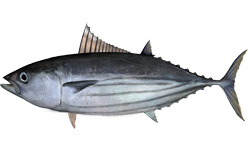
Katsuwonus pelamis is a small tuna of the family Scombridae, in the order Scombriformes [1]. It lives in tropical and warm-temperate waters of every ocean and is recognised by the dark bands running along its silvery belly [2]. In Peru it is called «barrilete» and purse seines take it along with other surface tunas [3]. Its global category on the IUCN Red List is Least Concern [4].
Etymology
Linnaeus described it in 1758 as Scomber pelamis, and the FAO catalogue credits the genus Katsuwonus to Kishinouye, with a reference dated 1915 and Thynnus pelamis as type species by monotypy [2]. The list of synonyms shows that the species passed through Thynnus, Orcynus, Euthynnus and Gymnosarda before settling in Katsuwonus [2]. For Peru, the catalogue records the name «barrilete» [2].
Identification and similar species
The body is elongate, spindle-shaped and rounded, with small conical teeth set in a single row and 53 to 63 gill rakers on the first gill arch [2]. There are two dorsal fins separated by a small gap: the first carries 14 to 16 spines, the second is followed by 7 to 9 finlets and the anal fin is followed by 7 or 8 [2]. The pectoral fins are short, with 26 or 27 rays; the body has no scales except on the corselet and the lateral line, and there is no swim bladder [2].
The back is dark purplish blue and the lower sides and belly are silvery, with 4 to 6 very conspicuous dark longitudinal bands that on a live fish may look like broken lines of blotches [2]. It reaches about 108 cm fork length and 32.5 to 34.5 kg in weight; 80 cm and 8 to 10 kg are usual [2].
In Peru the name alone does not settle the identification: the tuna fishery management plan uses «barrilete» both for this species and for Auxis rochei [3].
Similar species
- Euthynnus lineatus: Euthynnus lineatus, which lives in the tropical eastern Pacific as far south as northern Peru, has 33 to 39 gill rakers instead of 53 to 63, and its iridescent blue back carries black markings in 3 to 5 continuous horizontal stripes; the belly may have few marks or none, whereas Katsuwonus pelamis shows 4 to 6 dark bands [2].
Distribution and habitat
It is cosmopolitan in tropical and warm-temperate waters and is absent from the Black Sea [2]. It is an epipelagic, oceanic species: adults live roughly inside the 15 °C isotherm, with an overall temperature range of 14.7 to 30 °C, and larvae are mostly restricted to surface waters of at least 25 °C [2]. By day it occupies the water from the surface down to about 260 m, and at night it stays near the surface [2].
Its aggregations tend to be associated with convergences, boundaries between cold and warm water masses, upwellings and other hydrographic discontinuities [2]. In the eastern Pacific it is thought to originate in equatorial waters, with pre-recruits of up to 35 cm fork length splitting into a group that migrates north to Baja California and another that enters the fishing grounds of Central and South America; both later return to the equatorial spawning areas [2]. In Peruvian jurisdictional waters, the 1997 management plan acknowledges that tunas occur in concentrations exploited by national and foreign vessels [3].
Biology
It spawns in batches throughout the year in equatorial waters, and from spring to early autumn in subtropical waters; the spawning season shortens as the distance from the equator grows [2]. Fecundity rises with size but varies widely: females of 41 to 87 cm fork length produce between 80000 and 2000000 eggs per season [2].
It matures at about 45 cm fork length [2]. With no reliable method for determining age, estimates of longevity range at least between 8 and 12 years [2].
It forms schools at the surface, often associated with birds, drifting objects, sharks, whales or other tunas, and the groups may jump, feed or churn the water to foam [2]. Fish under 45 cm made nightly trips of 25 to 106 km away from a bank and came back in the morning, while the large ones moved about more independently [2].
Ecology
It eats fishes, crustaceans and molluscs; although carangids and triggerfishes are part of its diet in every ocean, the great variety of prey points to an opportunist that takes whatever food is available [2]. The 1984 synthesis counted 80 or more fish families in its stomachs and recorded juveniles of the same species among the prey, that is, cannibalism [5].
Feeding activity peaks early in the morning and in the late afternoon, cannibalism is common and its main predators are other tunas and billfishes [2]. Euthynnus lineatus often forms mixed-species schools with Thunnus albacares and with Katsuwonus pelamis [2].
Conservation
Its global category on the IUCN Red List is Least Concern [4].
A comparison of Atlantic and Pacific samples found no genetic differentiation between the two oceans, something the authors link to its very large population size [6]. A study with 1373 neutral loci in 222 individuals from the tropical western and central Pacific supported a single population in that region, although its authors recommend widening the study area before drawing global conclusions [7].
In Peru, the 1997 fishery management plan sets as an objective the rational and sustained use of the stocks of tunas and related species, both in jurisdictional waters and on the high seas [3].
Health, toxicological and chemical relevance
Not medical advice. For a sting, a poisoning or an allergy, seek medical care.
Skipjack is sold fresh, frozen and canned [2]. Tunas are among the fish with a lot of free histidine in their tissues; if they are exposed to high temperatures during or after capture, bacteria convert it into histamine, the cause of scombroid poisoning [8]. That exposure is defined there, generally, as more than 25 °C for more than 6 hours, or for longer at lower temperatures [8]. The FAO and WHO assessment set 50 mg of histamine as the no-observed-adverse-effect level, equivalent to 200 mg/kg in a 250 g serving, and noted that good hygiene practices and HACCP achieve less than 15 mg/kg [8].
Human relevance
It supplies about 40 % of the world's tuna catch, and between 1978 and 1981 the annual world catch ranged from 697760 to 796034 t [2]. The 1984 synthesis notes that the world catch rose from 320000 t in 1969 to 699000 t in 1979, and that of the western central Pacific from 41500 to 316000 t [5].
It is caught at the surface mainly with purse seines and with pole and live bait, and incidentally with longlines; floating objects and aggregation devices have become much more important [2]. It is sold fresh, frozen and canned, and in Japan also dried, as katsuobushi [2].
In the eastern Pacific skipjack was exploited between 1981 and 1995 with a mean annual catch of 81000 t, in a range of 49000 to 139000 t, and 108000 t was estimated for 1996; that year the region's main tunas totalled 418000 t, of which 26 % was skipjack [3]. In Peruvian waters tuna was exploited with purse seines and, in recent years, with longlines, the latter mostly by the foreign fleet for bigeye tuna [3].
Where to see it in Peru
What the literature says about Peru concerns fishing rather than direct observation. According to the 1997 fishery management plan, tunas occur in Peruvian jurisdictional waters in concentrations that have been exploited by national and foreign vessels, and purse seines are used for surface tunas such as the skipjack [3].
References (8)
- WoRMS Editorial Board (2026). Katsuwonus pelamis (Linnaeus, 1758). World Register of Marine Species. https://www.marinespecies.org/aphia.php?p=taxdetails&id=127018 (accessed 2026-10-25)
- Collette, B.B., Nauen, C.E. (1983). FAO species catalogue. Vol. 2. Scombrids of the world. An annotated and illustrated catalogue of tunas, mackerels, bonitos and related species known to date. FAO Fisheries Synopsis No. 125, Vol. 2. FAO, Rome, 43-44. https://www.fao.org/4/ac478e/ac478e00.htm (accessed 2026-10-25)
- Ministerio de Pesquería del Perú (1997). Aprueban Plan de Ordenamiento Pesquero del Atún y Especies Afines (Resolución Ministerial N° 1550-97-PE). El Peruano, 11 October 1997. https://faolex.fao.org/docs/pdf/per11258.pdf (accessed 2026-10-25)
- Collette, B.B., Boustany, A., Fox, W. et al. (2021). Katsuwonus pelamis: Collette, B.B., Boustany, A., Fox, W., Graves, J., Juan Jorda, M. & Restrepo, V. The IUCN Red List of Threatened Species 2021: e.T170310A46644566. doi:10.2305/IUCN.UK.2021-2.RLTS.T170310A46644566.en (accessed 2026-10-25)
- Matsumoto, W.M., Skillman, R.A., Dizon, A.E. (1984). Synopsis of biological data on skipjack tuna, Katsuwonus pelamis. NOAA Technical Report NMFS Circular 451 (FAO Fisheries Synopsis No. 136). https://repository.library.noaa.gov/view/noaa/5555 (accessed 2026-10-25)
- Ely, B., Viñas, J., Alvarado Bremer, J.R. et al. (2005). Consequences of the historical demography on the global population structure of two highly migratory cosmopolitan marine fishes: the yellowfin tuna (Thunnus albacares) and the skipjack tuna (Katsuwonus pelamis). BMC Evolutionary Biology, 19. doi:10.1186/1471-2148-5-19 (accessed 2026-10-25)
- Anderson, G., Lal, M., Stockwell, B. et al. (2020). No Population Genetic Structure of Skipjack Tuna (Katsuwonus pelamis) in the Tropical Western and Central Pacific Assessed Using Single Nucleotide Polymorphisms. Frontiers in Marine Science, 570760. doi:10.3389/fmars.2020.570760 (accessed 2026-10-25)
- Food and Agriculture Organization of the United Nations, World Health Organization (2013). Public health risks of histamine and other biogenic amines from fish and fishery products. FAO/WHO Expert Meeting highlights, July 2013. https://fao.org/fileadmin/user_upload/agns/news_events/HistamineHighlightFINAL.pdf (accessed 2026-10-25)
More pictures
Where it has been recorded
- Filled: scientific records, or confirmed by a curator
- Hatched: isolated record
- Dotted outline: no scientific records and no curator's confirmation (an ORKA sighting is not drawn here)
- Cold central sea
Scientific records (2 records)
- Cold southern sea
Scientific records (4 records)
From openly licensed OBIS and GBIF records (CC0 or CC BY). How each list is built.
Related species
From the same family.

Black skipjack
Euthynnus lineatus
IUCN status: LC · Least Concern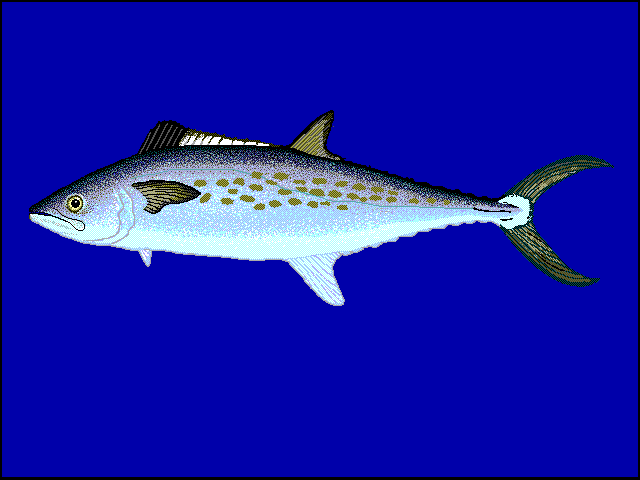
Pacific sierra
Scomberomorus sierra
IUCN status: LC · Least Concern
Little tunny
Euthynnus alletteratus
IUCN status: LC · Least Concern
Pacific bonito
Sarda chiliensis
IUCN status: LC · Least Concern
Chub mackerel
Scomber japonicus
IUCN status: LC · Least Concern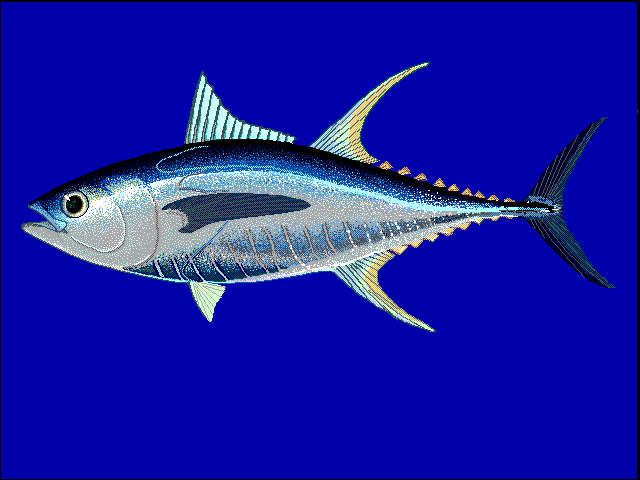
Yellowfin tuna
Thunnus albacares
IUCN status: LC · Least Concern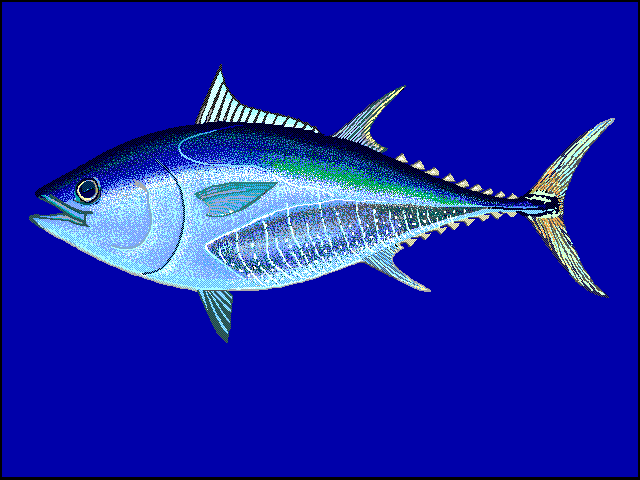
Atlantic bluefin tuna
Thunnus thynnus
IUCN status: LC · Least Concern
Wahoo
Acanthocybium solandri
IUCN status: LC · Least Concern
Names and sources
In Spanish
- Barrilete — Peru; fishbase; Wikidata · main name
- Atún — Wikidata
- Atún De Altura — Wikidata
- Barrilete Listado — Wikidata; WoRMS
- Bonita — Wikidata
- Bonito — Wikidata
- Bonito De Altura — Wikidata
- Bonito De Veintre Rayado — Wikidata
- Bonito Del Sur — Wikidata
- Bonito Listado — Wikidata
- Bonito Oceánico — Wikidata
- Bonitol — Wikidata
- Cachorreta — Wikidata
- Cachureta — Wikidata
- Cachurreta — Wikidata
- Descargamento — Wikidata
- Lampo — Wikidata
- Listado — Wikidata; WoRMS
- Llampua — Wikidata
- Merma — Wikidata
- Palomida — Wikidata
- Picosa — Wikidata
- Rayada — Wikidata
In English
- Skipjack tuna — WoRMS; Wikidata
- Oceanic Bonito — Wikidata; WoRMS
- Oceanic Skipjack — Wikidata
- Skipjack — Wikidata
- Stripy — Wikidata
Classification
Learn more
Conservation status: Least Concern (IUCN Red List, according to Wikidata). Taxonomy: PeRMS / WoRMS (CC BY 4.0).