
Sharks, rays and chimaeras · Lamnidae
Shortfin mako
Isurus oxyrinchus Rafinesque, 1810
Spanish: Tiburón diamante
- Names in Peru
- Tiburón diamante · Mako · Tiburón bonito
- Peruvian Register of Marine Species
- Listed in PeRMS (IMARPE)
Species account
Summary
Isurus oxyrinchus, the shortfin mako, is a shark of the family Lamnidae, order Lamniformes [1]. In Peru it is called tiburón diamante, the name used in the master plan of the Dorsal de Nasca National Reserve [2]. It lives in temperate and tropical seas worldwide, and in the eastern Pacific it reaches Ecuador, Peru and central Chile [3].
It is a fast open-sea swimmer, partly warm-bodied, that feeds mainly on fishes [3]. In Peru, together with the blue shark, it makes up about 60% of the country's shark landings [2].
Identification and similar species
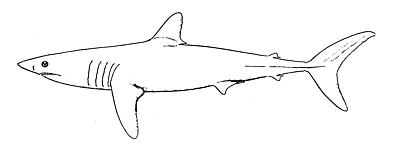
The body is spindle-shaped, the snout long and sharply pointed, and the teeth large and blade-like, without lateral cusplets or serrations. The pectoral fins are narrow at the tip and their front edge is shorter than the head; the first dorsal fin is large, the second dorsal and anal fins are minute, the tail stalk has strong keels with no secondary keels at the base, and the tail fin is crescent-shaped [3].
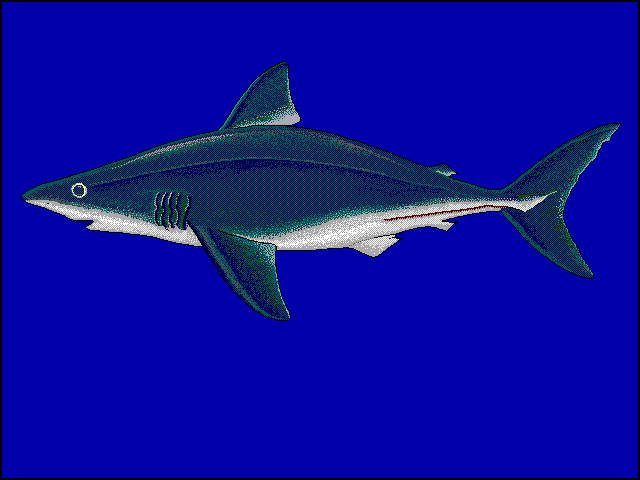
In life it is bright blue or purplish above and white below; the white includes the underside of the snout, and the dark colour of the flanks does not extend down onto the belly. The pelvic fins are dark on the front half and white on the rear half, and the first dorsal fin has a paler centre [3]. It reaches about 396 cm in total length, with an estimated maximum of 408 cm [3].
Similar species
- Carcharodon carcharias: Carcharodon carcharias has huge, flat, triangular, serrated teeth, a dark free tip on the first dorsal fin and a sharply marked boundary between the dark back and the white belly [3].
- Lamna nasus: Lamna nasus has a heavier body, teeth with small lateral cusplets, an abruptly white free tip on the first dorsal fin and short secondary keels at the base of the tail [3].
- Isurus paucus: Isurus paucus has a more slender body, pectoral fins broad at the tip and as long as the head or longer, short secondary keels at the base of the tail and a dusky underside of the head [3].
Distribution and habitat
It is a coastal and oceanic species of all temperate and tropical seas. In the eastern Pacific it is recorded from Washington and California, in the United States, south to Mexico, Costa Rica, Ecuador, Peru and central Chile [3]. The updated checklist of Peruvian chondrichthyans includes it [4], and the master plan of the Dorsal de Nasca National Reserve describes it as a pelagic species of coastal, shelf and high-seas waters, down to 500 m depth [2].
It is epipelagic and seldom enters water colder than 16 °C. It occurs from the surface to at least 500 m, and comes close to shore where the shelf is very narrow. Juveniles in the northeastern Pacific use waters near the surface, above 20 m, at 20 to 21 °C [3].
In the seven main ports analysed, between 1996 and 2010, most landings of this species came from the southern (54%) and central (40%) ports [5].
Biology
It may be the fastest shark and is one of the most active fishes; it leaps out of the water several times its own length [3]. It is endothermic: with heat exchangers in its blood vessels it keeps its swimming muscles between 1 and 10 °C above the water temperature, which helps it swim and see well in cooler water [3].
It is ovoviviparous and practises uterine cannibalism: the embryos feed on eggs. A litter holds 4 to 25 pups, usually 10 to 18, and gestation may last 15 to 18 months within a reproductive cycle of 3 years [3]. Pups are born at 60 to 70 cm [3].
Males mature at 203 to 215 cm and females at 275 to 293 cm, and females seem to mature smaller in the southern hemisphere than in the northwestern Atlantic [3]. From growth rings, maturity would come at 7 or 8 years at the earliest; the oldest known individual had 18 rings at 321 cm, and a maximum age of 45 years is estimated, although studies disagree on how many rings form each year [3].
Ecology
It eats mainly bony fishes, both pelagic and bottom-living, and also small sharks and squids [3]. Off South Africa prey measures 10 to 35% of the shark's length, but in the northwestern Atlantic large adults have been suggested to take prey close to their own size, such as swordfish of 180 kg or more [3]. A 68 kg individual is estimated to eat about 2 kg of prey per day [3].
It has few natural predators. Makos under 2 m have been found in white shark stomachs, and swordfish and sailfish have been seen wounding them with the bill [3].
It is highly migratory. In the northwestern Atlantic 2459 individuals were tagged; 64% were recaptured within 500 km, but 13% travelled more than 1600 km, and one about 4000 km [3]. In Peru, IMARPE lists it among the sharks with a highly migratory status [5].
Conservation
The FAO catalogue of 2002 judged its status to be of moderate concern despite its abundance and wide range. It noted that its fishery was regulated and limited in the United States and New Zealand but not elsewhere, and that international and regional management was needed [3].
In Peru, landings of this species fell by 3.16% a year between 2000 and 2010 [5]. The minimum capture size is 170 cm total length [6], yet IMARPE found that 60.1% (2009) and 88.5% (2010) of what was landed at Pucusana was under the minimum size [5]. In on-board observations of small-scale longliners from Ilo, between 2005 and 2010, the average share of measured makos under that size was 88.6% in the shark season and 98.9% in the dolphinfish season [6].
It is listed under the Convention on Migratory Species [5].
Health, toxicological and chemical relevance
Not medical advice. For a sting, a poisoning or an allergy, seek medical care.
It rarely bites divers or swimmers, and few incidents are well documented. Its speed, teeth and boldness when a feeding stimulus is present call for caution: it should not be speared or provoked, and a diver should back off if it gapes at them, swims in figure eights or makes bluff charges [3].
Incidents with boats are second in number only to those of the white shark; most occurred with individuals being played by sport anglers [3].
Human relevance
According to the FAO catalogue of 2002, it is important to pelagic longline fisheries worldwide, for its relative abundance and high-quality meat. It is eaten fresh, frozen, smoked or dried-salted; oil is extracted from it, the fins are sold and the jaws and teeth are made into ornaments [3]. It is a prize of sport fishing, and the same source mentions mako-watching diving in California, South Africa and the Maldives [3].
In Peru it is caught by small-scale surface longline and gillnet fleets, landing mostly at Paita, Salaverry, Chimbote, Callao, Pucusana, Ilo and Morro Sama; with the blue shark it makes up about 60% of national shark landings [2]. 94% of its landings are caught with longline [5]. In the Ilo observations, 28.4% of the identified sharks were makos [6].
Where to see it in Peru
The Peruvian sources consulted document the species through its capture, not through dive sightings. The master plan of the Dorsal de Nasca National Reserve describes it as pelagic, of coastal, shelf and high-seas waters [2]. In the small-scale longline fishery of Ilo, with data from 2005 to 2010, it was the second most caught shark species, at 28.4% of the identified sharks [6].
References (6)
- WoRMS Editorial Board (2026). Isurus oxyrinchus Rafinesque, 1810. World Register of Marine Species. https://www.marinespecies.org/aphia.php?p=taxdetails&id=105839 (accessed 2026-10-25)
- Servicio Nacional de Áreas Naturales Protegidas por el Estado (SERNANP) (2024). Plan Maestro de la Reserva Nacional Dorsal de Nasca 2024-2029. SERNANP; aprobado por RP N.° 000040-2024-SERNANP. https://cdn.www.gob.pe/uploads/document/file/5997712/5313081-anexo.pdf (accessed 2026-10-25)
- Compagno, L.J.V. (2002). FAO species catalogue for fishery purposes No. 1. Sharks of the world. An annotated and illustrated catalogue of shark species known to date. Volume 2. Bullhead, mackerel and carpet sharks (Heterodontiformes, Lamniformes and Orectolobiformes). FAO Species Catalogue for Fishery Purposes No. 1, Vol. 2. FAO, Rome, 100-101, 110-115, 122. https://www.fao.org/4/x9293e/x9293e00.htm (accessed 2026-10-25)
- Cornejo, R., Vélez-Zuazo, X., González-Pestana, A. et al. (2015). An updated checklist of Chondrichthyes from the southeast Pacific off Peru. Check List, 1809. doi:10.15560/11.6.1809 (accessed 2026-10-25)
- Gonzalez-Pestana, A., Kouri J., C., Velez-Zuazo, X. (2016). Shark fisheries in the Southeast Pacific: A 61-year analysis from Peru. F1000Research, 164. doi:10.12688/f1000research.4412.2 (accessed 2026-10-25)
- Doherty, P.D., Alfaro-Shigueto, J., Hodgson, D.J. et al. (2014). Big catch, little sharks: Insight into Peruvian small-scale longline fisheries. Ecology and Evolution, 2375-2383. doi:10.1002/ece3.1104 (accessed 2026-10-25)
More pictures
Where it has been recorded
- Filled: scientific records, or confirmed by a curator
- Hatched: isolated record
- Dotted outline: no scientific records and no curator's confirmation (an ORKA sighting is not drawn here)
- Cold central sea
Scientific records (14 records)
From openly licensed OBIS and GBIF records (CC0 or CC BY). How each list is built.
Related species
From the same family.

Names and sources
In Spanish
- Tiburón diamante — Peru; SERNANP (2024). Plan Maestro de la Reserva Nacional Dorsal de Nasca 2024-2029. RP N.° 000040-2024-SERNANP, p. 21 of the PDF · main name
- Alecrín — WoRMS
- Dentudo — WoRMS
- Dientuso azul — WoRMS
- Ludia marraco — WoRMS
- Mako — Peru; fishbase; WoRMS
- Marrajo — WoRMS
- Marrajo dientuso — WoRMS
- Marraquet — WoRMS
- Sobratg — WoRMS
- Tiburón — WoRMS
- Tiburón bonito — Peru; fishbase
In English
- Shortfin mako — WoRMS; Wikidata
- Atlantic mako shark — WoRMS
- Blue pointer — WoRMS
- Blue porpoise shark — WoRMS
- Blue shark — WoRMS
- Bonito shark — WoRMS
- Mackerel porbeagle — WoRMS
- Mackerel shark — WoRMS
Classification
Learn more
Conservation status: no data (IUCN). Taxonomy: PeRMS / WoRMS (CC BY 4.0).