
Sharks, rays and chimaeras · Dasyatidae
Hypanus longus
Hypanus longus (Garman, 1880)
Spanish: Raya látigo
- Names in Peru
- Raya látigo
- Peruvian Register of Marine Species
- Listed in PeRMS (IMARPE)
Species account
Summary
Hypanus longus is a stingray of the family Dasyatidae, order Myliobatiformes [1]. In Peru it is called «raya látigo», and the southernmost record cited in that article is Punta Sal, on the coast of Tumbes [2]. It is a large ray: females over 140 cm in disc width have been measured [3]. Its global IUCN Red List category is Vulnerable [4].
Identification and similar species
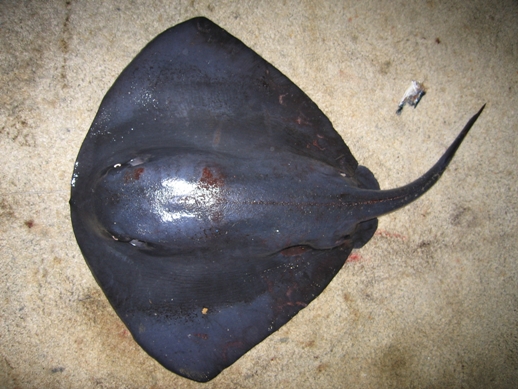
According to the description made from Tumbes specimens, the disc is oval and wider than long, with straight front margins [2]. The tail is thin and its length exceeds two disc lengths; it has a keel on the back and a long, low fold underneath [2]. A central row of blunt spines runs along the back, from the head to near the pectoral girdle [2].
That description, which uses the name Dasyatis for both species, compares it with Hypanus brevis: the distance between the eyes fits about 6 times into the disc width in Hypanus longus and about 5.2 times in the other species [2]. In Oaxaca, Mexico, moreover, most rays are processed on landing, with the axial skeleton removed together with the skin, flesh and viscera, and the resulting product loses the features that separate Hypanus longus from Hypanus dipterurus [3].
The Tumbes specimens measured in Peru had disc widths of 750 and 960 mm, with total lengths of 1640 and 2080 mm; a third one, landed at Puerto Pizarro in 2008, had a disc width of 1230 mm and a total length of 2560 mm [2].
Distribution and habitat
The species is known from the eastern Pacific, from the northern Gulf of California to Puerto López in Ecuador, including the Galápagos Islands; the record from Punta Sal, in Tumbes, extended that limit into Peru [2]. Other authors place it from Bahía Magdalena, in Mexico, to Ecuador, on the continental shelf, from shallow water down to 118 m depth [3].
It lives on soft bottoms, in bays, seagrass meadows, estuaries and the soft part of reefs [3]. In Tumbes it has coastal habits: it spends the day motionless and half-buried in sand, always near rocky reefs [2].
Biology
In a sample of 336 rays landed at Sipacate, on the Pacific coast of Guatemala, between May 2019 and March 2020, females measured 22 to 150 cm in disc width and males 23 to 98 cm; above 113 cm there were only females [5]. The sex ratio was 1 female to 1 male [5]. Females reached maturity at a disc width of 88.2 cm and males at 79.73 cm [5].
On the coast of Oaxaca, Mexico, where 160 specimens were measured, the sizes at maturity were larger: 111 cm in females and 81 cm in males [3]. Pregnant females carried 2 to 3 embryos, most often 2, measuring 30 to 42 cm in disc width, and 40 cm was taken as the size at birth [3]. A female with a disc width of 142 cm and a weight of 82 kg carried 3 full-term embryos [3]. A Peruvian article cites a litter of 1 to 5 pups per birth, taken from an earlier IUCN assessment [2].
The vertebrae made it possible to estimate growth: the theoretical maximum disc width is 167.1 cm and growth is slow, with a constant K of 0.106 per year [3]. With those calculations, males would mature at 3.3 years and females at 7.5 years; the largest female, at 147 cm, would be 17 years old [3]. Natural mortality was estimated at 0.26 per year, that is, an annual survival of 77 % [3].
Conservation
Its global IUCN Red List category is Vulnerable [4]. A Mexican publication explains that the listing became necessary because of low fecundity, late maturity and a generation time of 23 years [3].
In Tumbes, in the 1980s the ray was common and rarely caught because of its low price; later it became highly sought after and, according to that 2009 article, was by then very rare [2]. The author of that record proposed including it in Peru's list of threatened species [2]. In Guatemala it went from incidental catch to a target species of the artisanal fishery [5]; in the Sipacate sample, 65.68 % of the females and 52.10 % of the males were caught below the size at maturity [5].
In Oaxaca, by contrast, the estimated exploitation index was 0.14, and the authors considered the local population underexploited, although they called for more studies because of its slow growth and low fecundity [3].
Human relevance
In Tumbes it is caught by artisanal divers and by fishers with nets [2]. In the 1980s little was fished because little was paid for it; later it became highly sought after [2]. In Guatemala it is the most frequent species in ray landings in two fishing communities on the Pacific coast, making up 47.48 % and 56.66 % of the catch [5]. In Oaxaca its large size and white meat make it preferred on the local market [3].
Where to see it in Peru
Peruvian data are few and old. In 1981 an individual of about 150 cm disc width was seen underwater at Punta Sal, and until 1990 the species was common between Punta Sal and Punta Mero, with several individuals at depths under 5 m [2]. Later records are of animals caught by fishers: two females at Bocapan, Tumbes, in 2001, and one landed at Puerto Pizarro in 2008 [2]. The source warned in 2009 that on the coast of Tumbes it was by then a rare species [2].
References (5)
- Froese, R., Pauly, D. (2026). Hypanus longus (Garman, 1880). World Register of Marine Species. https://www.marinespecies.org/aphia.php?p=taxdetails&id=1042860 (accessed 2026-10-21)
- Hooker, Y. (2011). Nuevos registros de peces costeros tropicales para el Perú. Revista Peruana de Biología, 33-41. doi:10.15381/rpb.v16i1.192 (accessed 2026-10-21)
- Anislado-Tolentino, V., Wakida-Kusunoki, A.T., Rosales-Vázquez, J.I. et al. (2023). Aspectos Biológico Pesqueros de la Raya Arenera, Hypanus Longus (Myliobatiformes: Dasyatidae), Capturada en la Costa de Oaxaca, México. Ciencia Pesquera, 7-20. doi:10.64106/cienciapesquera.v31i2.54 (accessed 2026-10-21)
- Pollom, R., Avalos, C., Bizzarro, J. et al. (2020). Hypanus longus: Pollom, R., Avalos, C., Bizzarro, J., Burgos-Vázquez, M.I., Cevallos, A., Espinoza, M., González, A., Herman, K., Mejía-Falla, P.A., Morales-Saldaña, J.M., Navia, A.F., Pérez Jiménez, J.C. & Sosa-Nishizaki, O. The IUCN Red List of Threatened Species 2020: e.T60157A124445324. doi:10.2305/IUCN.UK.2020-3.RLTS.T60157A124445324.en (accessed 2026-10-21)
- Morales-Aguilar, J.A., Ortíz-Aldana, J.R. (2022). Aspectos reproductivos de la raya látigo Hypanus longus (Garman, 1880) de los desembarques de la pesca artesanal en el Pacífico de Guatemala. Ciencia, Tecnología y Salud, 41-54. doi:10.36829/63cts.v9i1.1082 (accessed 2026-10-21)
More pictures
If you come across it
Protected or threatened species. Watch it without touching, feeding, chasing or taking it, and keep the recommended viewing distances.
Where it has been recorded
- Filled: scientific records, or confirmed by a curator
- Hatched: isolated record
- Dotted outline: no scientific records and no curator's confirmation (an ORKA sighting is not drawn here)
- Tropical northern sea
Scientific records (2 records)
- Tropical–cold transition zone
Scientific records (1 record)
From openly licensed OBIS and GBIF records (CC0 or CC BY). How each list is built.
Related species
From the same genus (Hypanus) and from the same family (Dasyatidae).
Names and sources
In Spanish
- Raya látigo — Peru; fishbase · main name
Classification
Learn more
Conservation status: Vulnerable (IUCN Red List, according to Wikidata). Taxonomy: PeRMS / WoRMS (CC BY 4.0).