
Seabirds · Recurvirostridae
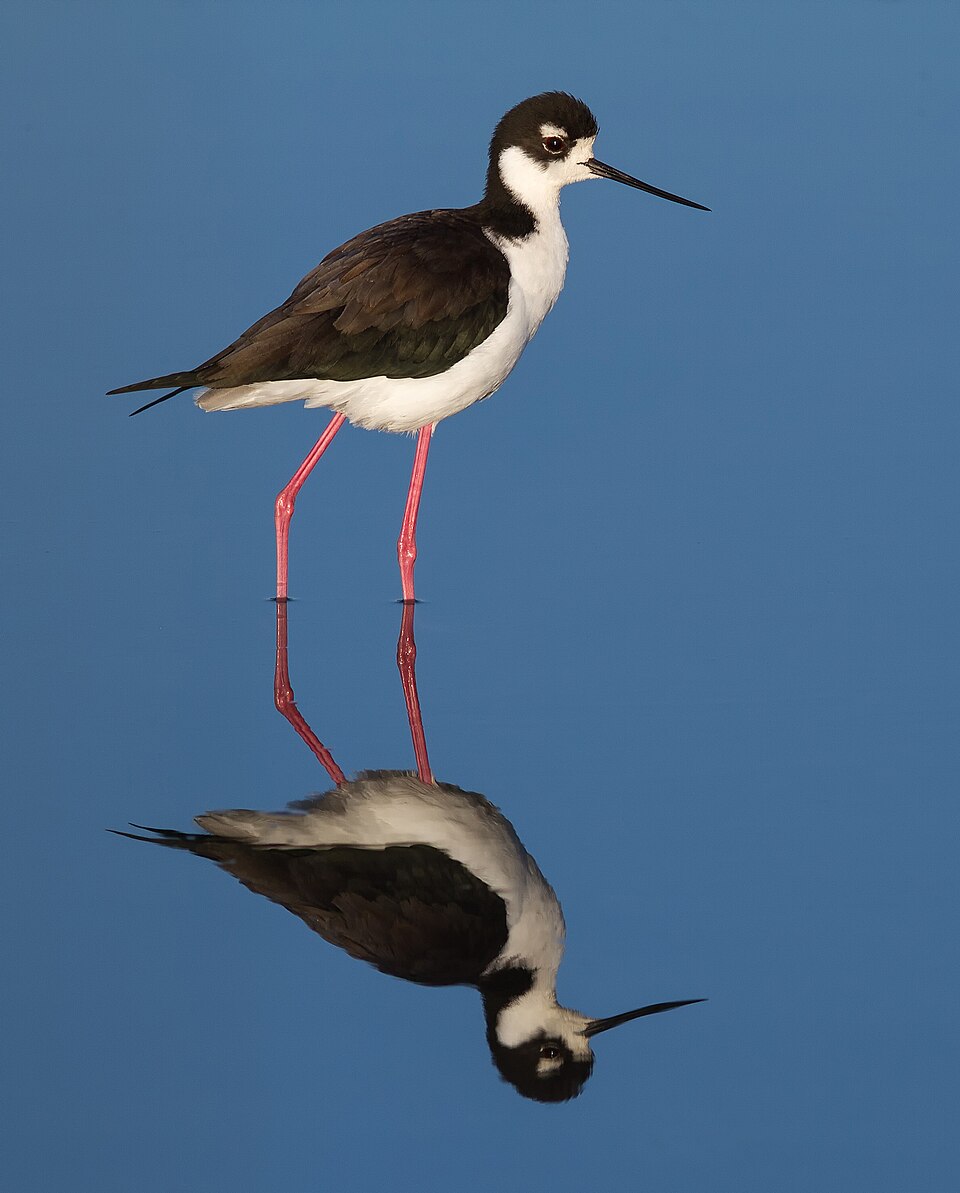
Black-necked stilt
Himantopus mexicanus (Müller, 1776)
Spanish: Tero real
- Peruvian Register of Marine Species
- Not in PeRMS: recorded by OBIS, or by ORKA at our dive sites
Species account
Summary
Himantopus mexicanus is a shorebird of the family Recurvirostridae, described by Müller in 1776 [1]. It breeds from the Atlantic coast of the United States and the western United States, through the Caribbean, Mexico and Central America, to Brazil and Peru [1]. It lives in wetlands, estuaries and other natural or artificial bodies of water [2]. In Peru it has been recorded, among other places, in the Cerro Negro wetlands (La Libertad), in Pantanos de Villa (Lima) and in Los Manglares de Tumbes National Sanctuary [2],[3],[4].
Identification and similar species
Distribution and habitat
It breeds from South Carolina and Florida on the east coast, and from southern Saskatchewan and Oregon in the west, south through the West Indies, Mexico and Central America to Brazil and Peru; in winter it occupies the Gulf States, Texas and central California south to the limit of its breeding range [1]. In the Caribbean it is a resident breeder in the southern Bahamas, the Greater Antilles and the Virgin and Cayman Islands, and is uncommon in the northern Bahamas [5].
In Peru one bird was found in the Cerro Negro wetlands, in Virú province, La Libertad, at 8°26' S [2]. In Lima a nest was recorded at Pantanos de Villa, at 12°12' S, near Laguna Sur, on saltgrass (Distichlis spicata); the authors note that such nests are usually in areas of high salinity and dense vegetation [3].
The introduction of a Peruvian study, drawing on other work, describes it as a widely distributed bird of the Americas that lives in wetlands, estuaries and other natural or artificial bodies of water [2].
Biology
At Pantanos de Villa nest monitoring ran from December 2007 to March 2008 and from December 2008 to February 2009 [3]. Only one nest of this species was followed, near Laguna Sur, from November to December 2007 [3]. It was a platform built at ground level on saltgrass, close to water, with 4 eggs [3]. The authors report that another study places the start of the breeding season at Pantanos de Villa in late October, with chicks in January and February [3].
On the upper Texas coast 356 nests were followed between 21 April and 30 June in 2011 and 2012, in managed freshwater and intermediate wetlands and in rice fields [6].
Ecology
The introduction of a Peruvian study reports that its diet consists mostly of aquatic beetles, bugs and flying-insect larvae and, less often, of snails and small crustaceans [2]. For south-eastern Texas nematodes, cestodes and trematodes have been described in the species, and the authors note that before their work there were no reports of helminths from this species in Peru or South America [2].
In Texas overall nest success was 0.2% and mammal and bird predators caused about 50% of the failures [6].
Conservation
A study of Caribbean shorebirds cites estimates of about 175000 individuals in the North American population and about 38500 residents in the Caribbean [5]. 1% of the North American population equals 1750 birds, but the authors caution that this threshold is not appropriate for the Caribbean population, which is resident [5].
Caribbean sites with many stilts include the Monte Cristi wetlands in the Dominican Republic, with 5480 in a cumulative three-day count in November 2013, and the Cabo Rojo salt ponds in Puerto Rico, with 2425 on one occasion [5].
Health, toxicological and chemical relevance
Not medical advice. For a sting, a poisoning or an allergy, seek medical care.
A stilt found dead on 5 February 2017 in the Cerro Negro wetlands was very thin, with no subcutaneous fat and little pectoral muscle, and its intestine held many cestodes and acanthocephalans [2]. The authors concluded that it died of starvation caused by an intestinal obstruction [2].
9 acanthocephalans of about 8 mm were collected, with the proboscis buried in the mucosa of the small intestine, and were identified as Profilicollis altmani, the first record of this parasite in the species [2]. In Peru its known intermediate host is the mole crab (Emerita analoga), and the authors suggest either that the stilt eats it or that the parasite has another intermediate host [2].
Where to see it in Peru
In Peru the literature places it at Pantanos de Villa, Lima, where a nest was studied in the 2007-2008 season [3], and in the Cerro Negro wetlands, Virú, where in February 2017 a group watching shorebirds found the dead bird [2].
Further north, it appears on the bird list of Los Manglares de Tumbes National Sanctuary [4], for which the master plan states that between 2015 and 2020 the record rose to 158 species [4].
References (6)
- WoRMS Editorial Board (2026). Himantopus mexicanus (Müller, 1776). World Register of Marine Species. https://www.marinespecies.org/aphia.php?p=taxdetails&id=159131 (accessed 2026-10-22)
- Jara, C., Pereda-Sánchez, A., Calvo-Mac, C. (2019). Primer reporte del acantocéfalo Profilicollis altmani en una cigüeñuela de cuello negro Himantopus mexicanus. Revista Peruana de Biología, 157-160. doi:10.15381/rpb.v26i1.15920 (accessed 2026-10-22)
- Amaro, L., Goyoneche, G. (2017). Anidación de aves en el Refugio de Vida Silvestre Los Pantanos de Villa 2007-2009, Lima-Perú. The Biologist (Lima), 155-171. doi:10.24039/rtb2017151151 (accessed 2026-10-22)
- Servicio Nacional de Áreas Naturales Protegidas por el Estado (2023). Plan Maestro del Santuario Nacional Los Manglares de Tumbes 2023-2027. SERNANP, RP N.° 064-2023-SERNANP. https://cdn.www.gob.pe/uploads/document/file/4137567/RESOLUCION%20PRESIDENCIAL%20N%20064-2023-SERNANP.pdf.pdf (accessed 2026-10-22)
- Cañizares, J.R., Reed, J.M. (2020). Identification of priority shorebird conservation areas in the Caribbean. PeerJ, e9831. doi:10.7717/peerj.9831 (accessed 2026-10-22)
- Riecke, T.V., Conway, W.C., Haukos, D.A. et al. (2019). Nest survival of Black-necked Stilts (Himantopus mexicanus) on the upper Texas coast, USA. Waterbirds, 261-271. doi:10.1675/063.042.0302 (accessed 2026-10-22)
More pictures
Where it has been recorded
- Filled: scientific records, or confirmed by a curator
- Hatched: isolated record
- Dotted outline: no scientific records and no curator's confirmation (an ORKA sighting is not drawn here)
- Tropical northern sea
Scientific records (1065 records)
- Tropical–cold transition zone
Scientific records (1765 records)
- Cold central sea
Scientific records (6458 records)
- Cold southern sea
Scientific records (9471 records)
From openly licensed OBIS and GBIF records (CC0 or CC BY). How each list is built.
Names and sources
In Spanish
- Tero real — Wikidata · main name
- Cigüeñuela de Cuello Negro — Wikidata
In English
- Black-necked stilt — WoRMS; Wikidata
- Hawaiian stilt — WoRMS
Classification
Learn more
Conservation status: no data (IUCN). Taxonomy: PeRMS / WoRMS (CC BY 4.0).