
Sharks, rays and chimaeras · Hexanchidae
Sharpnose sevengill shark
Heptranchias perlo (Bonnaterre, 1788)
Spanish: Tiburón de siete agallas
- Names in Peru
- Tiburón de siete agallas
- Peruvian Register of Marine Species
- Listed in PeRMS (IMARPE)

Species account
Summary
Heptranchias perlo is a small, slender shark recognised by its 7 pairs of gill slits, a single dorsal fin and very large eyes [1]. It lives near the bottom on the outer shelf and the upper slope, down to about 1000 m, and is almost worldwide in tropical and temperate seas [1]. In Peru it appears in the updated checklist of the country's cartilaginous fishes [2]; WoRMS places it in the family Hexanchidae, order Hexanchiformes [3].
Identification and similar species
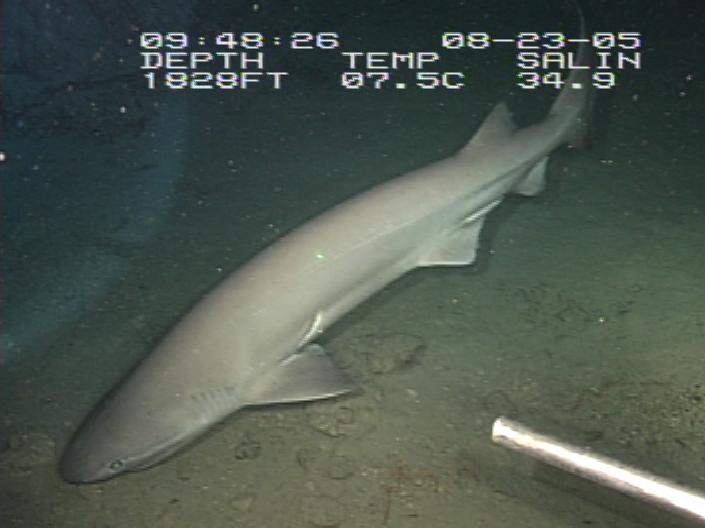
It is a small, slender shark with 7 gill slits, a very narrow head and snout, and very large eyes [1]. It has one dorsal fin, set off from the start of the tail fin by more than 2 times its own base length, and adults have a short lower tail lobe [1]. The lower-jaw teeth are larger than the upper ones, flattened and comb-like, with a long main cusp and several small cusplets and no serrations on the inner edge [1]. It is grey-brown above and pale below; young fish have dark tips on the dorsal fin and the terminal tail lobe, which fade with age [1].
The probable maximum size is 137 cm, and most adults are under 110 cm [1]. In a sample from the central-western Mediterranean, the 31 fish measured between 54.5 and 113.3 cm in total length [4].
Similar species
- Notorynchus cepedianus: Notorynchus cepedianus is the only other shark with 7 pairs of gill slits, but it has a much heavier body, reaches about 2.9 m, has a broad, rounded head, very small eyes and usually many small black spots [1].
- Hexanchus griseus: Hexanchus griseus has 6 pairs of gill slits, a broader head and snout, smaller eyes and lower teeth serrated on the inner edge; it is also much larger [1].
Distribution and habitat
Outside the eastern North Pacific, its range is almost circumglobal in tropical and temperate seas, with a mainly continental distribution [1]. It is chiefly a deepwater species of the outer shelf and upper slope down to 1000 m, although it sometimes occurs in shallow water [1]. Off Sardinia, in the Mediterranean, the 31 fish studied were caught between 336 and 600 m depth, and the authors regard the eleven species they studied, this one included, as rare or occasional in that sea [4].
For Peru, the updated checklist of cartilaginous fishes from the south-east Pacific includes the species, based on the 2001 annotated catalogue of Peruvian marine fishes [2].
Biology
It is ovoviviparous: litters hold 9 to 20 young, about 27 cm long at birth [1]. It apparently swims actively near the bottom and, when caught, is aggressive and quick to bite [1].
In the Sardinian sample, 25 of the 31 fish were females and 6 were males, and only 3 were mature: the 2 largest males, at 90.4 and 95.0 cm, were actively spawning, and the largest female, at 113.3 cm, was regressing [4]. Immature fish were caught in every season, and one active male was smaller than the published size at first maturity [4]. The vertebrae were so poorly calcified that no stain revealed growth bands, so age could not be estimated [4].
Ecology
It feeds on bony fishes, including hake, and on squid [1]. Of the 31 stomachs examined off Sardinia, 13 held food; the main prey were ommastrephid cephalopods such as Todarodes sagittatus, bony fishes, and other elasmobranchs such as Etmopterus spinax and Galeus melastomus [4].
The authors group it with other deepwater sharks that eat large, fast prey, and note that body size, depth range and diet all affect how vulnerable a species is [4].
Conservation
Its global IUCN Red List category is Near Threatened [5].
In Sardinian waters, the authors note that the rare species they studied, this one included, have low or nil commercial value, are not directly targeted and are usually part of the bycatch discarded at sea [4]. In the western Indian Ocean it is taken in bottom trawls and no separate statistics are kept for the species [1].
Health, toxicological and chemical relevance
Not medical advice. For a sting, a poisoning or an allergy, seek medical care.
It is aggressive and quick to bite when caught, but too small to be very dangerous [1].
Human relevance
Where to see it in Peru
The chondrichthyan checklist published in 2015 includes the species for Peru, but only as a presence in the country, with no locality or depth [2]. In the Mediterranean it was caught between 336 and 600 m [4], and FAO describes it as chiefly a deepwater species that sometimes occurs in shallow water [1]. None of the sources consulted says whether it has been seen by divers in Peru [2].
References (5)
- Compagno, L.J.V. (1983). FAO species identification sheets, Fishing Area 51 (W. Indian Ocean): Hexanchidae and Heptranchias perlo. FAO Species Identification Sheets for Fishery Purposes, Fishing Area 51. https://www.fao.org/4/ad468e/ad468eOZ.pdf (accessed 2026-10-25)
- Cornejo, R., Vélez-Zuazo, X., González-Pestana, A. et al. (2015). An updated checklist of Chondrichthyes from the southeast Pacific off Peru. Check List, 1809. doi:10.15560/11.6.1809 (accessed 2026-10-25)
- WoRMS Editorial Board (2026). Heptranchias perlo (Bonnaterre, 1788). World Register of Marine Species. https://www.marinespecies.org/aphia.php?p=taxdetails&id=105832 (accessed 2026-10-25)
- Mulas, A., Bellodi, A., Carbonara, P. et al. (2021). Bio-Ecological Features Update on Eleven Rare Cartilaginous Fish in the Central-Western Mediterranean Sea as a Contribution for Their Conservation. Life. doi:10.3390/life11090871 (accessed 2026-10-25)
- Finucci, B., Barnett, A., Bineesh, K.K. et al. (2019). Heptranchias perlo: Finucci, B., Barnett, A., Bineesh, K.K., Cheok, J., Cotton, C.F., Kulka, D.W., Neat, F.C., Rigby, C.L., Tanaka, S. & Walker, T.I. The IUCN Red List of Threatened Species 2019: e.T41823A2956343. doi:10.2305/IUCN.UK.2020-3.RLTS.T41823A2956343.en (accessed 2026-10-25)
More pictures
If you come across it
Protected or threatened species. Watch it without touching, feeding, chasing or taking it, and keep the recommended viewing distances.
Related species
From the same family.

Names and sources
In Spanish
- Tiburón de siete agallas — Peru; fishbase · main name
- Boquidulce — WoRMS
- Tiburón de siete branquias — WoRMS
In English
- Sharpnose sevengill shark — WoRMS; Wikidata
- One-finned Shark — Wikidata
- Perlon Shark — Wikidata
- Sevengill Cow Shark — Wikidata
- Sharpnose seven-gill shark — Wikidata
- Sharpsnouted Sevengill — Wikidata
- Slender Sevengill — Wikidata
Learn more
Conservation status: Near Threatened (IUCN Red List, according to Wikidata). Taxonomy: PeRMS / WoRMS (CC BY 4.0).