
Bony fishes · Anthiadidae
Splittail bass
Hemanthias peruanus (Steindachner, 1875)
Spanish: Doncella
- Names in Peru
- Doncella
- Peruvian Register of Marine Species
- Listed in PeRMS (IMARPE)
Species account
Summary
Hemanthias peruanus is a serranid fish of the anthiadine subfamily, described in 1875 from material collected off Paita in northern Peru [1]. A Peruvian study calls it doncella [2]. It lives in the eastern Pacific, from Mexico to Trujillo, and at the Galápagos [1]. In Ecuador it is caught mostly as bycatch of other artisanal fisheries [3], and the IUCN rates it Least Concern [4].
Identification and similar species
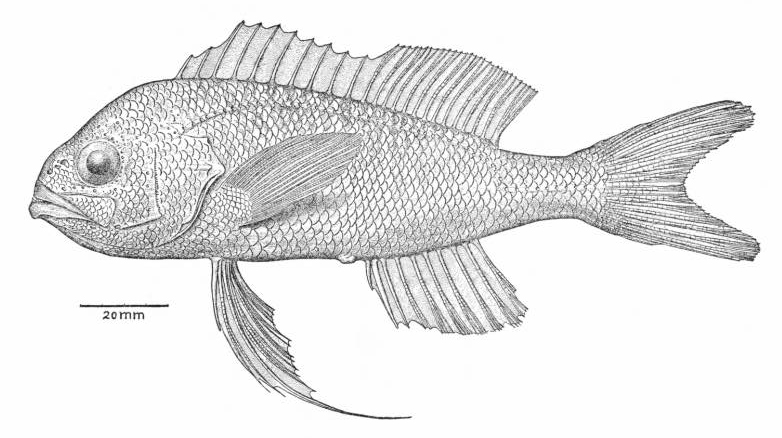
The lectotype, designated in 2012 by Anderson and Heemstra and held under the catalogue number MCZ 10232, measures 248 mm standard length and comes from Paita [1]. The dorsal fin has 10 spines and 13 to 15 soft rays, usually 14; the anal fin has 3 spines and 7 to 9 rays, usually 8 [1].
Other counts from the description are 15 to 19 pectoral rays, 31 to 35 gill rakers in total and 48 to 59 scales along the lateral line, usually 50 to 56 [1]. Fish landed at Manta, Ecuador, measured 19 to 38.1 cm total length, and those examined in Piura reached 40 cm [3]. The largest size on record is 45 cm [5].
Distribution and habitat
Its range runs, according to the review of anthiadines, from Hipólito Bank and Cabo Lobos in Mexico to Trujillo in Peru, and includes the Galápagos Islands [1]. FishBase extends it as far as northern Chile [5].
FishBase gives a depth range of 20 to 120 m in tropical waters [5]. An Ecuadorian study describes it on rocky and sandy bottoms down to 300 m, citing earlier works [3]. The two depth figures disagree, and neither comes from a measurement made in Peru [5],[3].
Biology
In 349 fish landed at Manta between October 2022 and October 2023, mean size was 25.5 cm total length and weight ranged from 50 to 361 g; the length-weight exponent was 2.73, meaning it grows more in length than in girth [3]. Ages estimated from otolith rings ran from 2 to 7 years [3].
The von Bertalanffy model fitted better than the Gompertz and logistic ones, with an asymptotic length of 43.29 cm and a growth constant of 0.21 per year [3]. The length at which half the fish were mature was estimated at 20.48 cm total length [3]. The authors did not validate that each band pair in the otolith is annual and assume it from what is known of other serranids [3].
Sex change is suspected (protogynous hermaphroditism), though this study did not confirm it: the ratio was 1 male to 5 females, and the authors recall that hermaphroditism had already been reported for the genus and for this species [3].
Ecology
In Piura, 75 doncellas bought at the port of Cabo Blanco were examined, and 65.33 % harboured at least one metazoan parasite [2]. Ectoparasites dominated, with 3 monogenean species and 1 isopod, against 2 trematodes, 1 cestode and 1 acanthocephalan [2]. Neither fish length nor sex was related to the parasite indices [2].
Sources disagree on its diet: FishBase describes it as a plankton feeder with a trophic level of 3.4, while an Ecuadorian study treats it as a mid-level predator of crustaceans and small fish [5],[3]. FishBase adds that it forms schools [5].
Conservation
The IUCN assessed the species in 2008 and places it in the global category of Least Concern [4].
The authors of the Manta study note that a fish that changes sex and is caught by size can lose its largest individuals selectively, and they call for minimum catch sizes [3]. The maturity length of 20.48 cm fell below the mean catch size of 25.5 cm in that sample [3].
Human relevance
FishBase rates it as of minor commercial interest [5]. At Manta it is not targeted: it belongs to the fauna associated with the hake fishery and is taken by artisanal fishing [3].
For Peru, the Piura parasitological study obtained its fish at a fishing port, which suggests they are marketed on the northern coast, but it gives no landing figures [2].
Where to see it in Peru
References (5)
- Anderson, W.D., Jr. (2018). Annotated checklist of anthiadine fishes (Percoidei: Serranidae). Zootaxa 4475(1), 14. doi:10.11646/zootaxa.4475.1.1 (accessed 2026-10-25)
- Minaya-Angoma, D., Alvariño-Flores, L., Urbano-Cueva, D. et al. (2021). Estructura comunitaria de metazoos parásitos en la doncella Hemanthias peruanus (Serranidae) del norte de Perú. Revista MVZ Córdoba 26(3), e2125. doi:10.21897/rmvz.2125 (accessed 2026-10-25)
- Macias-Palma, L., Pinela-Zamora, D., Mendoza-Nieto, K. (2026). Estimación de la Edad, Crecimiento y Madurez Sexual de Hemanthias peruanus (Steindachner, 1875) Capturada en las Costas de Manabí, Ecuador. Biotecnia 28, e2642. doi:10.18633/biotecnia.v28.2642 (accessed 2026-10-25)
- Smith-Vaniz, B., Robertson, R., Dominici-Arosemena, A. et al. (2008). Hemanthias peruanus: Smith-Vaniz, B, Robertson, R., Dominici-Arosemena, A., Molina, H., Salas, E. & Guzman-Mora, A.G. The IUCN Red List of Threatened Species 2010: e.T183786A8177055. doi:10.2305/iucn.uk.2010-3.rlts.t183786a8177055.en (accessed 2026-10-25)
- Froese, R., Pauly, D. (2026). Hemanthias peruanus (Steindachner, 1875), Splittail bass. FishBase. https://fishbase.se/summary/3326 (accessed 2026-10-25)
Where it has been recorded
- Filled: scientific records, or confirmed by a curator
- Hatched: isolated record
- Dotted outline: no scientific records and no curator's confirmation (an ORKA sighting is not drawn here)
- Tropical northern sea
Scientific records (1 record)
- Tropical–cold transition zone
Scientific records (1 record)
- Cold central sea
Scientific records (5 records)
From openly licensed OBIS and GBIF records (CC0 or CC BY). How each list is built.
Related species
From the same genus (Hemanthias) and from the same family (Anthiadidae).
Names and sources
In Spanish
- Doncella — Peru; fishbase; Wikidata · main name
- Cabrilla de Perú — Wikidata
- Cabrilla doblecola — Wikidata; WoRMS
- Doncella espinuda — Wikidata
- Doncella serránida — Wikidata
- Mero manchado — Wikidata
- Rabijunco — Wikidata
- Ravijunco — Wikidata
In English
- Splittail bass — WoRMS; Wikidata
- Rose thread-fin bass — Wikidata
Classification
Learn more
Conservation status: Least Concern (IUCN Red List, according to Wikidata). Taxonomy: PeRMS / WoRMS (CC BY 4.0).