
Bony fishes · Labridae
Chameleon wrasse
Halichoeres dispilus (Günther, 1864)
Spanish: Doncella
- Names in Peru
- Doncella · San Pedrano · Sanpedrano · Señorita
- Peruvian Register of Marine Species
- Listed in PeRMS (IMARPE)

Species account
Summary
Halichoeres dispilus is a wrasse, family Labridae, from the tropical eastern Pacific, described by Günther in 1864 [1]. In Peru it is known as «doncella», «señorita», «san pedrano» or «sanpedrano» [2]. It lives over rocky or coral reefs with patches of sand, between 2 and 76 m deep, and grows to about 25 cm total length [2]. The IUCN Red List classes it as Least Concern [3].
Etymology
Identification and similar species
FishBase gives a maximum length of 25 cm total length for the species [2]. The IMARPE photographic catalogue of otoliths, however, figures a specimen labelled «doncella» that measured 32.0 cm total length and whose sagitta, the largest otolith, measured 4.0 mm [4].
Its genetic identity is under study. In a DNA barcoding survey based on the mitochondrial COI gene, among the species analysed, the one closest to the northern Peruvian specimens was Halichoeres notospilus, at a distance of 14.7 %, yet divergence within the species itself reached 2.51 %, above the 2 % threshold the authors use to flag a possible taxonomic split [5]. The delimitation analysis separated 3 lineages: one with individuals from Costa Rica and one from Baja California Sur; another with individuals from the Galápagos, one from Isla Foca and one from central Peru; and a third with individuals from northern and central Peru together with samples from the Pacific coast of Panama [5]. The authors suggest this may be a complex of cryptic species formed by parapatric speciation, a hypothesis that, in their view, needs more genetic markers and sampling across the whole range [5].
In another study, the Galápagos population differed by 3.3 % from the Panama population in its mitochondrial sequence [6]. Its sister species is Halichoeres insularis, an endemic wrasse discovered in the Revillagigedo Archipelago, Mexico, in 1991, from which it differs by 7.6 % in COI [7].
Distribution and habitat
It ranges through the eastern Pacific from the Gulf of California to Bahía Independencia, Peru, including the Galápagos Islands [2]. A study of tropical eastern Pacific wrasses and damselfishes assigned it a range that includes Baja California, the Revillagigedo Islands, Cocos Island, Panama, the Galápagos and mainland Ecuador, spanning about 5192 km, which places it, by the authors' definition, among the region's widespread species [8].
It lives in shallow water over rocky or coral reefs broken up by sandy areas, and has been recorded between 2 and 76 m deep [2].
A DNA barcoding study of rocky-reef fishes from northern Peru, collected at Isla Foca, which the authors place in the transition zone, along the coast between Cabo Blanco and Los Órganos and at Punta Sal in Tumbes, analysed several specimens of the species from northern Peru, one of them from Isla Foca, together with sequences from individuals from central Peru [5]. Further south, at the Lobos de Afuera Islands, its DNA was detected in seawater sampled in November 2018, and the species also appears there in historical reports [9].
Biology
Its planktonic larval stage is long: in 147 specimens aged from the daily rings of their otoliths, the mean duration was 39.4 days, with a minimum of 30 and a maximum of 50 [8].
Its larvae can travel far from shore. A sample taken in open water over the Galápagos Rift held 4 larvae of the species, 9.4 to 13.5 mm standard length, and the DNA sequence obtained from one of them matched the Panama population, about 1000 km away, rather than the Galápagos one [6].
During the breeding season it forms well-defined pairs [2]. When disturbed, and also at night to sleep, it buries itself in the sand [2].
Ecology
It is a solitary fish that eats small invertebrates it finds in the sand; in the Gulf of California, large individuals also take small blennioid fishes [2]. A diet-based model assigns it a trophic level of 3.9 [2].
The authors of the Peruvian genetic study stress that its long pelagic larva is exposed to shifting ocean circulation and that, even without barriers to gene flow, genetic breaks can form within a continuously distributed species [5].
Conservation
The IUCN Red List assesses it as Least Concern, in an assessment from 2007 [3]. FishBase estimates its vulnerability to fishing as low to moderate, 30 out of 100 [2].
The Lobos de Afuera Islands, where its DNA was detected, are a marine protected area within the Guano Islands, Isles and Capes National Reserve [9].
Health, toxicological and chemical relevance
Not medical advice. For a sting, a poisoning or an allergy, seek medical care.
FishBase classes it as harmless to people [2].
Human relevance
It is of minor commercial importance in fisheries, is sold fresh in local markets and is also traded for aquariums [2].
Where to see it in Peru
At the Lobos de Afuera Islands, about 32 nautical miles off the northern coast, its DNA turned up in seawater sampled in November 2018; the authors note that the distance from the coast and the complex seabed limit access to these islands [9].
A study published in 2025 analysed specimens of the species from rocky reefs in northern Peru, one of them from Isla Foca; its sampling covered Isla Foca, the stretch between Cabo Blanco and Los Órganos in Piura, and Punta Sal in Tumbes, under a permit from the Ministry of Production issued in 2020 [5].
References (9)
- WoRMS Editorial Board (2026). Halichoeres dispilus (Günther, 1864). World Register of Marine Species. https://www.marinespecies.org/aphia.php?p=taxdetails&id=275763 (accessed 2026-10-20)
- Froese, R., Pauly, D. (2026). Halichoeres dispilus, Chameleon wrasse. FishBase. https://www.fishbase.se/summary/Halichoeres_dispilus.html (accessed 2026-10-20)
- Allen, G., Robertson, R., Barraza, E. et al. (2007). Halichoeres dispilus: Allen, G., Robertson, R., Barraza, E., Edgar, G., Merlen, G. & Rocha, L. The IUCN Red List of Threatened Species 2010: e.T183822A8183133. doi:10.2305/IUCN.UK.2010-3.RLTS.T183822A8183133.en (accessed 2026-10-20)
- Oré-Villalba, D.O. (2017). Catálogo fotográfico de otolitos de peces marinos y dulceacuícolas del Perú. Boletín Instituto del Mar del Perú 32(2), 136-213. https://revistas.imarpe.gob.pe/index.php/boletin/article/view/63 (accessed 2026-10-20)
- Zavala, E., Britzke, R., Siccha-Ramírez, Z. et al. (2025). DNA barcoding of marine rocky reef fishes from northern Peru suggests a parapatric speciation in the Tropical Eastern Pacific. Ecology and Evolution, e70125. doi:10.1002/ece3.70125 (accessed 2026-10-20)
- Victor, B.C. (2024). Rapid long-distance multispecies transport of shorefish larvae to the oceanic tropical eastern Pacific, revealed by DNA barcodes and otolith aging of larvae captured over the Galapagos Rift. NOAA Professional Paper NMFS 24. doi:10.7755/pp.24.19 (accessed 2026-10-20)
- Victor, B.C., Frable, B.W., Ludt, W.B. (2024). Halichoeres sanchezi n. sp., a new wrasse from the Revillagigedo Archipelago of Mexico, tropical eastern Pacific Ocean (Teleostei: Labridae). PeerJ, e16828. doi:10.7717/peerj.16828 (accessed 2026-10-20)
- Victor, B.C., Wellington, G.M. (2000). Endemism and the pelagic larval duration of reef fishes in the eastern Pacific Ocean. Marine Ecology Progress Series, 241-248. doi:10.3354/meps205241 (accessed 2026-10-20)
- Alfaro-Cordova, E., Ortiz-Alvarez, C., Alfaro-Shigueto, J. et al. (2022). What lies beneath? Revealing biodiversity through eDNA analysis in Lobos de Afuera Islands, Peru. Latin American Journal of Aquatic Research, 642-659. doi:10.3856/vol50-issue4-fulltext-2782 (accessed 2026-10-20)
More pictures
Where it has been recorded
- Filled: scientific records, or confirmed by a curator
- Hatched: isolated record
- Dotted outline: no scientific records and no curator's confirmation (an ORKA sighting is not drawn here)
- Tropical northern sea
Scientific records (4 records)
- Tropical–cold transition zone
Scientific records (5 records)
- Cold central sea
Scientific records (19 records)
- Cold southern sea
Scientific records (1 record)
From openly licensed OBIS and GBIF records (CC0 or CC BY). How each list is built.
Related species
From the same genus (Halichoeres) and from the same family (Labridae).
Banded wrasse
Halichoeres notospilus
IUCN status: LC · Least Concern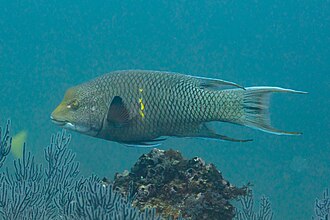
Mexican hogfish
Bodianus diplotaenia
IUCN status: LC · Least ConcernBrown hogfish
Bodianus eclancheri
IUCN status: LC · Least ConcernProtected in PeruBumphead parrotfish
Scarus perrico
IUCN status: LC · Least ConcernProtected in Peru
Loosetooth parrotfish
Nicholsina denticulata
IUCN status: LC · Least ConcernCortez rainbow wrasse
Thalassoma lucasanum
IUCN status: LC · Least Concern- No openly licensed image yet
Bodianus darwini
IUCN status: Not evaluated - No openly licensed image yet
Blackspot wrasse
Decodon melasma
IUCN status: LC · Least Concern
Names and sources
In Spanish
- Doncella — Peru; fishbase; Wikidata · main name
- San Pedrano — Peru; fishbase; Wikidata
- Sanpedrano — Peru; fishbase
- Señorita — Peru; fishbase
- Señorita camaleón — Wikidata; WoRMS
- Vieja camaleón — Wikidata
In English
- Chameleon wrasse — WoRMS; Wikidata
Classification
Learn more
Conservation status: Least Concern (IUCN Red List, according to Wikidata). Taxonomy: PeRMS / WoRMS (CC BY 4.0).