
Crabs, lobsters and shrimps · Grapsidae
Cliff crab
Grapsus grapsus (Linnaeus, 1758)
Spanish: Araña de las rocas
- Names in Peru
- Araña de las rocas · Cangrejo de las rocas
- Peruvian Register of Marine Species
- Listed in PeRMS (IMARPE)

Species account
Summary
Grapsus grapsus is a crab of the family Grapsidae, in the order Decapoda [1]. It is a semi-terrestrial species of rocky shores, common on the central coast of Peru, and its range runs from Baja California to Talcahuano in Chile, taking in the Galápagos and Juan Fernández islands [2]. In Ancón Bay, in Lima, it lives in groups tied to crevices and spends high tide almost motionless on the rock [2].
Identification and similar species
On a granite stretch of shore in Ancón Bay, the moulted shells left behind measured between 0.45 and 7.98 cm in males and between 0.40 and 7.46 cm in females, taken along the cephalothorax [2]. On the islands of Mazatlán Bay, in Mexico, the carapace width of 926 crabs reached 74.5 mm, with a mean of 41.4 mm, and the heaviest weighed 138.2 g [3].
Sex is told by the abdomen, broad in females and narrow in males, and by the pleopods, which are two-branched in females and single-branched in males [3]. Small juveniles have a greenish carapace and large adults a red one, according to what those authors confirmed and what they took from earlier studies [3].
Distribution and habitat
It is a semi-terrestrial species, common on the central coast of Peru, and occurs from Baja California to Talcahuano, including the Galápagos and Juan Fernández islands [2]. The Ancón study area was a 200 m granite shore with massifs, boulders and a small pebble beach, dominated by a mussel community that alternates with algae [2]. On that shore, the author describes the lower mid-littoral, at low tide, as a feeding area and the supra-littoral zone as a resting area [2].
On the Sinaloa islands the crabs were collected in the intertidal on a substrate of rocks, crevices and tide pools [3]. On Belmonte Island, in Brazil's São Pedro and São Paulo archipelago near the equator, they were counted in a booby colony on rock; the authors cite ground temperatures of 33 to 40 °C at midday, measured in April 2001 in that area [4].
Biology
At Ancón, between 1990 and 2001, 312 copulations were seen, with a maximum of 26 in one month; they were most frequent in summer, and only 6 took place in winter, 5 of them during the 1991-1992 and 1997-1998 El Niño events [2]. In courtship, individuals defended the refuges that served as territories; five chases were seen, one of them over 50 m, and on 3 occasions a group of 4 to 5 males cornered a female [2]. Copulation lasts 3 to 3.5 minutes, with the male beneath the female and holding her claws [2].
In 23 copulations (7.4 %) there was cannibalism: 11 attacks caused the death of one individual, 7 of them males, and in the other 12 the attacked animal escaped by dropping a limb [2]. The aggressor was always larger than its victim [2]. Of 8421 moults collected, 418 showed mutilations; 73 % had just one, 20 % two and 6 % three, and males lost claws and second legs more often, while females lost the fourth and third walking legs [2]. Moults were more numerous in summer, as were copulations [2].
Ecology
On the central coast of Peru it feeds on barnacles, mussels, porcelain crabs and other invertebrates, and occasionally scavenges [2]. At Ancón it lives in groups of more than 60 individuals, always larger than 3 cm, that share crevices where they shelter, above all when the surf is heavy; the study area held 5 permanent refuges [2]. At low tide most go out to feed, and at high tide they stay still, beside others of similar size [2].
Its occasional predators at Ancón are the gull Larus belcheri, the sea star Heliaster helianthus and humans [2]. In a booby colony in Brazil about 80 crabs were counted in 300 m² in the morning, about 65 in the afternoon and only 3 at midday, which, in the authors' view, indicates that they avoid the sun [4]. There, of 494 records of handling or feeding, 53 % involved detritus, and the rest feathers, regurgitated fish, dead birds, egg remains and other crabs; they killed a single booby chick in 9 days, one that had been expelled from its nest [4].
Human relevance
Where to see it in Peru
In Peru the species has been studied in Ancón Bay, in Lima, on a 200 m rocky shore called Ensenada del León, between 1990 and 2001 [2]. There the groups occupy crevices and go out to feed at low tide, and at high tide they stay still on the rock [2]. In the Brazilian booby colony, crabs were scarce at midday [4].
References (4)
- DecaNet eds. (2026). Grapsus grapsus (Linnaeus, 1758). World Register of Marine Species. https://www.marinespecies.org/aphia.php?p=taxdetails&id=422188 (accessed 2026-10-25)
- Romero, L. (2003). Comportamiento reproductivo y mutilaciones en el cangrejo de las rocas Grapsus grapsus (Linnaeus, 1758) (Crustacea, Decapoda). Revista Peruana de Biología, 195-202. doi:10.15381/rpb.v10i2.2503 (accessed 2026-10-25)
- Arzola González, J.F. (2018). Size of structure and biometric relationships of the Grapsus grapsus rock crab on the Lobos, Venados, and Pájaros Islands, Sinaloa, Mexico. Hidrobiológica, 31-36. doi:10.24275/uam/izt/dcbs/hidro/2018v28n1/Arzola (accessed 2026-10-25)
- Gianuca, D., Vooren, C.M. (2007). Abundance and behavior of the sally lightfoot crab (Grapsus grapsus) in the colony of the brown booby (Sula leucogaster) in the São Pedro and São Paulo Archipelago. Investigaciones Marinas, 121-125. doi:10.4067/s0717-71782007000200012 (accessed 2026-10-25)
More pictures
Where it has been recorded
- Filled: scientific records, or confirmed by a curator
- Hatched: isolated record
- Dotted outline: no scientific records and no curator's confirmation (an ORKA sighting is not drawn here)
- Tropical northern sea
Scientific records (2 records)
- Tropical–cold transition zone
Scientific records (3 records)
- Cold central sea
Scientific records (10 records)
- Cold southern sea
Scientific records (12 records)
From openly licensed OBIS and GBIF records (CC0 or CC BY). How each list is built.
Related species
From the same family.

Variegate shore crab
Geograpsus lividus
IUCN status: Not evaluatedGoniopsis pulchra
IUCN status: Not evaluated
Leptograpsus variegatus
IUCN status: Not evaluated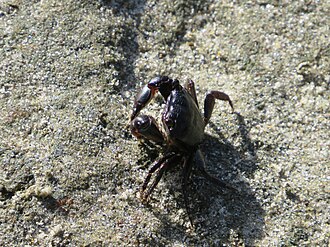
Mottled shore crab
Pachygrapsus transversus
IUCN status: Not evaluated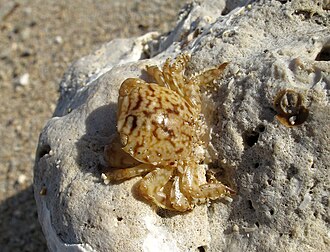
Columbus crab
Planes minutus
IUCN status: Not evaluatedPachygrapsus socius
IUCN status: Not evaluated
Names and sources
In Spanish
- Araña de las rocas — Peru; sealifebase · main name
- Cangrejo de las rocas — Peru; sealifebase
In English
- Cliff crab — WoRMS
- Mottled shore crab — WoRMS
- Sally lightfoot — WoRMS
- Sally lightfoot crab — WoRMS
Classification
Learn more
Conservation status: no data (IUCN). Taxonomy: PeRMS / WoRMS (CC BY 4.0).