
Sharks, rays and chimaeras · Triakidae
Tope
Galeorhinus galeus (Linnaeus, 1758)
Spanish: Tollo cazón
- Names in Peru
- Tollo cazón · Tiburón de aleta
- Peruvian Register of Marine Species
- Listed in PeRMS (IMARPE)
Species account
Summary
Galeorhinus galeus is a shark of the family Triakidae, order Carcharhiniformes, described by Linnaeus in 1758 [1]. In Peru it is called «tollo cazón» and «tiburón de aleta» [2]. It is a slender, long-snouted shark that reaches 195 cm in length and lives in temperate waters of the Atlantic, the Pacific and the southwestern Indian Ocean, including the coasts of Peru and Chile [3]. Its global category on the IUCN Red List is Critically Endangered [4].
Etymology
Linnaeus named it Squalus galeus in 1758 and gave its home as the seas of Europe; no type specimen is known [3]. Blainville coined the name Galeorhinus in 1816, at first as a subgenus of Squalus [3]. Several separate regional species came to be recognised, and for Peru and Chile the name Galeorhinus chilensis was used, based on Pérez Canto's Galeus chilensis of 1886; comparing specimens and descriptions suggested that they probably cannot be told apart, and all were merged under Galeorhinus galeus [3].
Identification and similar species
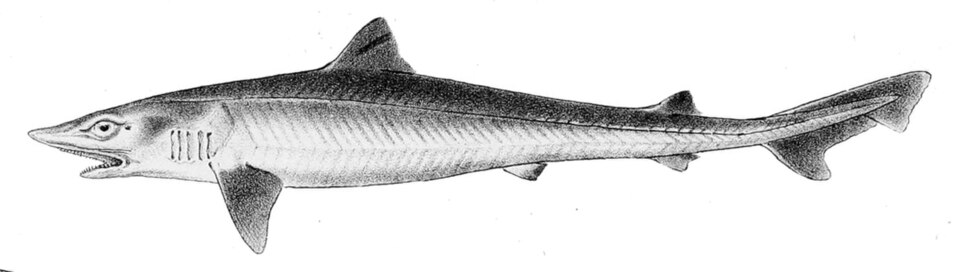
It is a slim shark with a long snout, parabolic when seen from above, and large eyes, horizontally oval, with an internal nictitating lower eyelid [3]. The flaps at the front of the nostrils are no more than tiny points, the mouth forms a broad arch, and the teeth, much alike in both jaws, are flattened blades with a slanting tip and small secondary cusps on the side towards the corner of the mouth [3].
The second dorsal fin is far smaller than the first, under half its height, and roughly matches the anal fin in size [3]. The tail gives it away: the lower lobe is sturdy in young and adults alike, and the terminal lobe is very long, close to half the upper edge of the caudal fin [3].
Females grow larger than males: they mature at about 130 to 185 cm and reach 174 to 195 cm, while males mature at about 120 to 170 cm and reach 155 to 175 cm; pups measure about 30 to 40 cm at birth [3].
Similar species
- Mustelus whitneyi: It is one of the Mustelus species recorded from Peru [5]. In Mustelus the second dorsal is nearly as large as the first, the lower tail lobe is short or missing in adults and the teeth range from broad and blunt to semi-bladelike, not strongly compressed; in Galeorhinus galeus the second dorsal is much smaller and matches the anal fin, the lower tail lobe is long at every age and the teeth are flattened blades [3].
- Triakis maculata: It also lives in Peru [5]. Like Mustelus, it has a second dorsal nearly as large as the first and a lower tail lobe that is short or absent in adults, and its snout is bluntly rounded as well, whereas Galeorhinus galeus has a small second dorsal and a long snout [3].
Distribution and habitat
It occurs in temperate waters over much of the world: in the Atlantic, from Iceland and Norway to South Africa and from southern Brazil to Argentina; in the southwestern Indian Ocean, off South Africa; in the western Pacific, in southern Australia and New Zealand; and in the eastern Pacific, from British Columbia to the Gulf of California, as well as Peru and Chile [3]. Records from tropical waters, such as those off West Africa, still need confirming [3]. The updated list of cartilaginous fishes of the Peruvian sea includes it among the country's sharks [5].
It lives over continental and island shelves, both in midwater and near the seabed: it often ranges far from shore without becoming oceanic, yet also reaches the surf line, shallow bays and submarine canyons, between 2 and 471 m deep [3]. Fish fitted with electronic tags and released in Luce Bay, southwest Scotland, used both shallow and deep water, and some went deeper than 650 m [6].
Sharks from Chile are genetically distinct from those of Australia and New Zealand: mitochondrial DNA and microsatellites both split them into two populations, one Chilean and one in Oceania, and within the latter the data fit a single stock shared by the two countries [7].
Biology
It moves in small groups that make long migrations in the high latitudes of its range; in Europe and the northeastern Pacific, for instance, it heads poleward in summer and towards the equator in winter [3]. It can cover up to 56 km in a day, and one journey of 1600 km at a sustained 16 km a day has been documented [3]. Among fish tagged in UK waters, one mature female was recaptured 3900 km away, and other mature females turned up in the Azores, the Canary Islands and the Mediterranean [6].
In at least some areas the sexes and sizes live partly apart: adult males favour deeper water and females stay closer to shore [3]. In southeastern Australia, pregnant females enter shallow bays and estuaries in late spring and early summer to give birth and then return offshore, while most pups leave those places at the end of summer and come back to them the following spring [3].
It is ovoviviparous and forms no placenta; each litter holds 6 to 52 pups, and the number rises with the mother's size [3]. In Australia males mature after 8 years of age and females after 11, the females give birth for the first time at 12 years or older, and a large female can live 22 years or more [3].
Ecology
In Anegada Bay, a shallow bay on Argentina's Atlantic coast, the shark turns up every year between October and late April, and there it is taken by a recreational hook-and-line fishery [8]. Between 1998 and 2001, 408 sharks from that fishery were examined, with females over 124 cm and males over 119 cm treated as adults [8]. Bony fishes were its main food: in adults a bottom-living fish, Porichthys porosissimus, came first, followed by demersal fishes, above all Cynoscion guatucupa [8].
Juveniles ate more bottom-living invertebrates than adults, especially the octopus Octopus tehuelchus, and adults ate more squid; of the squid eaten by adults, 62 % were Illex argentinus [8]. In summer the adults ate more bottom fishes, and 96 % of those fishes were Porichthys porosissimus [8]. Sharks of every size cut their prey with their teeth, even though these bear only small cusps at the base, and the pieces they ate were larger than the prey they swallowed whole [8].
Across its range it eats a wide variety of bottom and midwater fishes, such as sardines, anchovies, hakes and flatfishes, plus squid, octopus, crabs and other invertebrates, and it hardly ever takes carrion [3]. Its natural enemies are more powerful sharks, such as the white shark, and probably marine mammals [3].
Conservation
Its global category on the IUCN Red List is Critically Endangered [4]. Since 2020 it has been included in Appendix II of the Convention on the Conservation of Migratory Species of Wild Animals [9].
In southern Australia its fishery was managed for 30 years by protecting the nursery areas, yet the population kept falling until the fishery collapsed, because the adults were meanwhile being caught beyond sustainable levels [10].
In Peru, IMARPE counts it among the highly migratory shark species, and it is one of the sharks that fishing catches incidentally and discards at sea [10].
Health, toxicological and chemical relevance
Not medical advice. For a sting, a poisoning or an allergy, seek medical care.
No attacks on people are known, but it bites when taken out of the water and its teeth are large enough to warrant careful handling [3].
It accumulates mercury in its flesh. In southeastern Australia, in a study that called it Galeorhinus australis, muscle from the sharks analysed held between 0.01 and 2.7 ppm wet weight, with an estimated average of 0.90 ppm for the commercial catch landed in Victoria in 1971; most of that mercury was methylmercury and the level rose with the shark's length [11]. These findings led to its fisheries in Australia and New Zealand being restricted, or made them collapse [3].
Human relevance
It is a shark of great fishery interest, above all off Uruguay and Argentina, in California and in southern Australia: its meat is excellent and is eaten fresh, frozen or dried and salted, its fins go into soup and its liver yields an oil very rich in vitamin A [3]. It is caught with gillnets, longlines and trawls, both bottom and midwater, and with hook and line [3].
Off California a large fishery in the thirties and forties reached 4186 t landed in 1939 and then declined through overfishing and because synthetic vitamin A replaced the vitamin from liver oil; in South Africa a similar fishery went through the same boom and bust [3]. It is also a sought-after catch for anglers in the British Isles, South Africa and California [3].
In Peru it is one of the 18 shark species with landing statistics, although it is not among the 6 that made up 98 % of the sharks landed between 1996 and 2010 [10].
Where to see it in Peru
The Peruvian literature knows it mainly through fishing: an analysis of shark landings in Peru between 1950 and 2010 counts it among the species landed and among those caught incidentally and discarded at sea [10]. The country's list of cartilaginous fishes, published in 2015, includes it among the species of the Peruvian sea [5].
References (11)
- WoRMS Editorial Board (2026). Galeorhinus galeus (Linnaeus, 1758). World Register of Marine Species. https://www.marinespecies.org/aphia.php?p=taxdetails&id=105820 (accessed 2026-10-20)
- Froese, R., Pauly, D. (2026). Common names of Galeorhinus galeus. FishBase. https://www.fishbase.se/comnames/CommonNamesList.php?ID=4642&GenusName=Galeorhinus&SpeciesName=galeus&StockCode=4830 (accessed 2026-10-20)
- Compagno, L.J.V. (1984). FAO species catalogue. Vol. 4. Sharks of the world. An annotated and illustrated catalogue of shark species known to date. Part 2: Carcharhiniformes. FAO Fisheries Synopsis No. 125, Vol. 4, Part 2. FAO, Rome, 382-389. https://www.fao.org/4/ad123e/ad123e00.htm (accessed 2026-10-20)
- Walker, T.I., Rigby, C.L., Pacoureau, N. et al. (2020). Galeorhinus galeus: Walker, T.I., Rigby, C.L., Pacoureau, N., Ellis, J., Kulka, D.W., Chiaramonte, G.E. & Herman, K. The IUCN Red List of Threatened Species 2020: e.T39352A2907336. doi:10.2305/IUCN.UK.2020-2.RLTS.T39352A2907336.en (accessed 2026-10-20)
- Cornejo, R., Vélez-Zuazo, X., González-Pestana, A. et al. (2015). An updated checklist of Chondrichthyes from the southeast Pacific off Peru. Check List, 1809. doi:10.15560/11.6.1809 (accessed 2026-10-20)
- Thorburn, J., Neat, F., Burrett, I. et al. (2019). Ontogenetic Variation in Movements and Depth Use, and Evidence of Partial Migration in a Benthopelagic Elasmobranch. Frontiers in Ecology and Evolution, 353. doi:10.3389/fevo.2019.00353 (accessed 2026-10-20)
- Hernández, S., Daley, R., Walker, T. et al. (2015). Demographic history and the South Pacific dispersal barrier for school shark (Galeorhinus galeus) inferred by mitochondrial DNA and microsatellite DNA mark. Fisheries Research, 132-142. doi:10.1016/j.fishres.2015.02.010 (accessed 2026-10-20)
- Lucifora, L.O., García, V.B., Menni, R.C. et al. (2006). Food habits, selectivity, and foraging modes of the school shark Galeorhinus galeus. Marine Ecology Progress Series, 259-270. doi:10.3354/meps315259 (accessed 2026-10-20)
- Convention on the Conservation of Migratory Species of Wild Animals (2026). Galeorhinus galeus. CMS, species page. https://www.cms.int/en/species/galeorhinus-galeus (accessed 2026-10-20)
- Gonzalez-Pestana, A., Kouri J., C., Velez-Zuazo, X. (2016). Shark fisheries in the Southeast Pacific: A 61-year analysis from Peru. F1000Research, 164. doi:10.12688/f1000research.4412.2 (accessed 2026-10-20)
- Walker, T.I. (1976). Effects of species, sex, length and locality on the mercury content of school shark Galeorhinus australis (Macleay) and gummy shark Mustelus antarcticus Guenther from south-eastern Australian waters. Australian Journal of Marine and Freshwater Research, 603-616. doi:10.1071/MF9760603 (accessed 2026-10-20)
More pictures
If you come across it
Protected or threatened species. Watch it without touching, feeding, chasing or taking it, and keep the recommended viewing distances.
Where it has been recorded
- Filled: scientific records, or confirmed by a curator
- Hatched: isolated record
- Dotted outline: no scientific records and no curator's confirmation (an ORKA sighting is not drawn here)
- Cold central sea
Scientific records (6 records)
- Cold southern sea
Scientific records (1 record)
From openly licensed OBIS and GBIF records (CC0 or CC BY). How each list is built.
Related species
From the same family.
Sharptooth smoothhound
Mustelus dorsalis
IUCN status: VU · Vulnerable
Brown smoothhound
Mustelus henlei
IUCN status: LC · Least Concern
Humpback smoothhoun
Mustelus whitneyi
IUCN status: CR · Critically Endangered
Sicklefin smoothhound
Mustelus lunulatus
IUCN status: NT · Near Threatened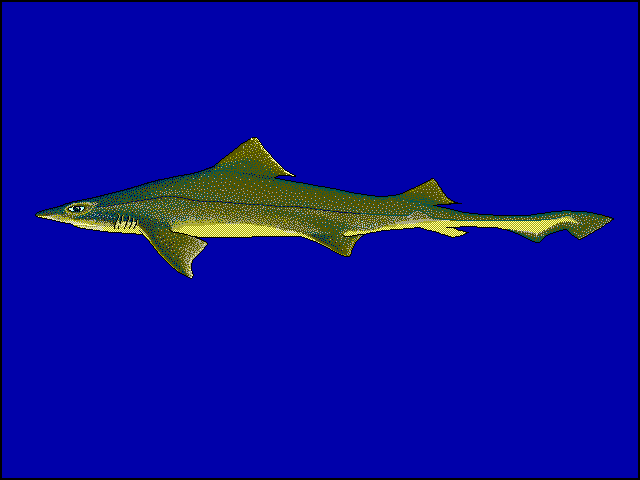
Speckled smooth-hound
Mustelus mento
IUCN status: CR · Critically Endangered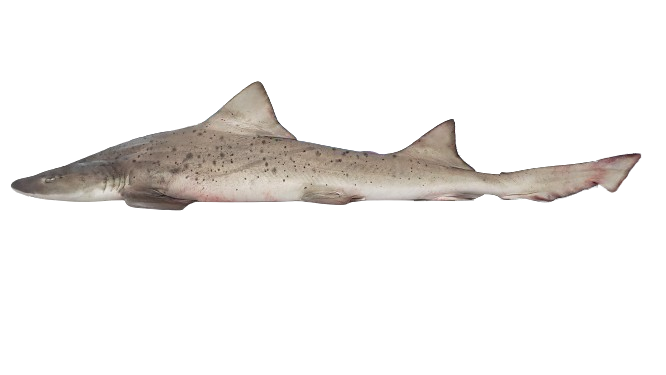
Spotted Houndshark
Triakis maculata
IUCN status: CR · Critically EndangeredTollo
Triakis acutipinna
IUCN status: Not evaluated
Names and sources
In Spanish
- Tollo cazón — Peru; fishbase · main name
- Bosti — Wikidata
- Bostrich — Wikidata
- Ca Marí — Wikidata
- Cacao — Wikidata
- Cassó — Wikidata
- Cazón — Wikidata; WoRMS
- Gat — Wikidata
- Gazón — WoRMS
- Musola — Wikidata
- Musola Carallo — Wikidata
- Pez Calzón — Wikidata
- Pez Peine — Wikidata
- Tiburón aceitoso — WoRMS
- Tiburón de aleta — Peru; fishbase
- Tiburón Trompa De Cristal — Wikidata
- Tiburón Vitamínico — Wikidata
In English
- Tope — WoRMS; Wikidata
- Liver-oil Shark — Wikidata
- Miller’s Dog — Wikidata
- Oil Shark — Wikidata
- Penny Dog — Wikidata
- Rig — Wikidata
- School Shark — Wikidata
- Snapper Shark — Wikidata
Classification
Learn more
Conservation status: Critically Endangered (IUCN Red List, according to Wikidata). Taxonomy: PeRMS / WoRMS (CC BY 4.0).