
Seabirds · Hydrobatidae
White-bellied storm petrel
Fregetta grallaria (Vieillot, 1817)
Spanish: Paíño ventriblanco
- Peruvian Register of Marine Species
- Listed in PeRMS (IMARPE)
Species account
Summary
Fregetta grallaria belongs to the family Hydrobatidae, in the order Procellariiformes [1]. It is a small southern-hemisphere storm-petrel with a white belly, which breeds on remote oceanic islands of the Pacific and the South Atlantic [2]. Its taxonomy remains unresolved: the complex could include up to twice the 4 taxa recognised today, and some forms may deserve recognition of their own [2]. Hundreds of birds have been recorded in the eastern Pacific within 1700 km of the South American coast [3], but IMARPE names proven breeding sites in Peru for only 3 storm-petrel species of other genera [4]. The IUCN rates it Least Concern [5].
Identification and similar species
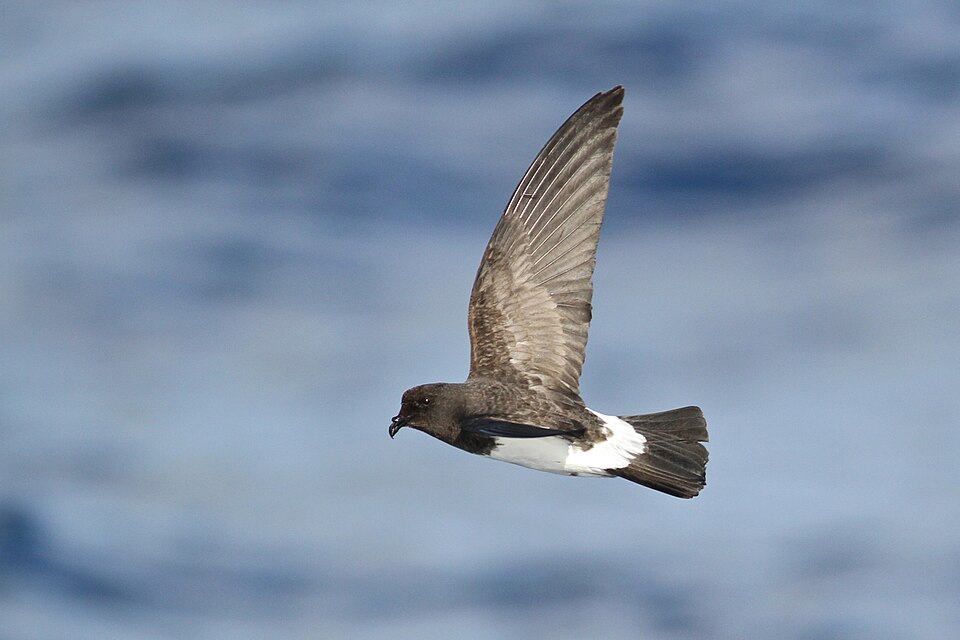
It is a small storm-petrel. A presumed bird of this species seen in the eastern Pacific appeared slightly larger than Oceanites oceanicus, although no other birds were nearby for comparison [3]. That bird appeared to have a dark throat, a square or rounded tail, white underparts and underwing coverts, and white uppertail coverts [3]. It propelled itself with its feet and left small splashes on the water, a feature of Fregetta and related genera [3].
Within the Fregetta grallaria complex, the birds of Rapa are exceptionally large, nearly the size of Nesofregetta fuliginosa when the two are seen side by side, and carry broad white fringes on the scapulars, mantle, rump and several wing coverts [2]. Those fringes alone do not identify them, however, because other populations of the complex also show them, and some birds have fine streaks on the body sides [2].
Plumage alone does not settle identification. A decayed bird found on a beach in Otago, New Zealand, in 1987 was provisionally identified as Fregetta grallaria and the authors later proposed that it was Fregetta tropica, after comparing its measurements: wing 160 mm, culmen 15 mm and tarsus 44 mm [6]. In addition, a small share of the birds breeding on Tristan da Cunha and Gough that are assigned to Fregetta tropica may have an entirely white belly, and their taxonomic status is unclear [3].
Similar species
- Fregetta tropica: Fregetta tropica usually has a black stripe of variable width down the belly, darker and browner upperparts, and longer legs whose feet project beyond the tail [3].
- Nesofregetta fuliginosa: Nesofregetta fuliginosa has a white throat, which gives the look of a dark breast band, a notched tail, a larger size and a different manner of flight [3].
Distribution and habitat
Known breeding sites lie in the Pacific and the South Atlantic. The nominate form breeds on Lord Howe and in the Kermadec Islands, with about 2000 pairs; another population breeds on Rapa and probably on Marotiri; another, a few hundred pairs by nest counts, in the Juan Fernández and Desventuradas islands, although counts at sea indicate that its population is considerably larger; and in the Tristan da Cunha group and on Gough, in the Atlantic, a population nests that, together with Fregetta tropica melanoleuca, adds up to about 61000 pairs [2].
At sea, a tally of observations in the eastern Pacific between 1974 and 1984 recorded at least 20 birds in 4333 hours of observation, between the equator and 12° S and between 86° and 109° W [3]. Another study, with data from 1980 to 1995, collected 7 birds and observed 406 within 1700 km of the South American coast, between 1° N and 36° S, and attributed them to the Juan Fernández form [3].
That form was seen most often over surface waters of 8–15 °C. A bird photographed in 2006 far from there, over 28 °C water and more than 1600 km from any earlier record of the genus in the eastern Pacific, was interpreted as crossing unfavourable habitat [3].
Biology
The Rapa form nests on 5 islets, with 400–1000 pairs in 1990, and probably on Marotiri; strong night-time activity over the cliffs of Rapa itself suggests that it breeds there as well [2].
The taxonomy of the group is unresolved. The Fregetta grallaria complex could include up to twice the 4 taxa recognised today, and birds with differing plumage seen at Rapa might represent seasonal populations or another taxon [2]. A very pale variant from the Desventuradas, with the same broad fringes, was also noted in 2003 in the Humboldt Current, far from those islands, which suggests that it disperses or migrates [2].
Ecology
In the breeding season it forages at least as far as 15 nautical miles from Rapa, often alongside Nesofregetta fuliginosa, and chumming sessions drew hundreds of birds [2]. Near the Juan Fernández Islands, about 600 birds gathered on 8 November 2014 around dripping fish oil between Robinson Crusoe and Alexander Selkirk islands [2].
Off South America, the form attributed to Juan Fernández is associated with cold water, with most sightings at 8–15 °C [3].
Conservation
The IUCN rates Fregetta grallaria as Least Concern [5],[2]. The authors of a study at Rapa note that the typical form of that island, if treated separately, might be considered threatened; they report that it forages in substantial numbers near Rapa and Marotiri but not far beyond them, and that protecting the breeding islets, rocks and adjacent waters is imperative for its survival [2].
In Peru, information on storm-petrels in general is scarce: IMARPE notes that little is known of their biology and that many species of the group sit in threat categories because of this lack of knowledge [4].
Where to see it in Peru
The literature reviewed places Fregetta grallaria at sea rather than on land, and IMARPE lists the genus Fregetta among the four storm-petrel genera cited for Peru, with no proven breeding colony in the country [4]. The sources consulted do not say where or when it can be seen from the Peruvian coast; eastern Pacific records come from within 1700 km of the South American coast [3].
References (6)
- WoRMS Editorial Board (2026). Fregetta grallaria (Vieillot, 1817). World Register of Marine Species. https://www.marinespecies.org/aphia.php?p=taxdetails&id=212695 (accessed 2026-10-25)
- Flood, R.L., Zufelt, K., Bretagnolle, V. et al. (2021). Pelagic birds around Rapa and Marotiri, French Polynesia, October–December 2019, with notes on Rapa Shearwater Puffinus myrtae and Titan Storm Petrel Fregetta [grallaria] titan. Bulletin of the British Ornithologists' Club, 387-411. doi:10.25226/bboc.v141i4.2021.a3 (accessed 2026-10-25)
- Pagen, R., Pyle, P., Ballance, L.T. (2008). A Fregetta storm-petrel off western Mexico. Western Birds, 225-227. doi:10.21199/wb39.4.5 (accessed 2026-10-25)
- Romero, C. (2021). Distribución espacio-temporal de la golondrina de mar de Markham Oceanodroma markhami (Salvin, 1883) y la golondrina de mar acollarada O. hornbyi (Gray, 1854) en Perú. 2019. Boletín del Instituto del Mar del Perú 36(1), 68-84. https://revistas.imarpe.gob.pe/index.php/boletin/article/download/320/305/597 (accessed 2026-10-25)
- BirdLife International (2018). Fregetta grallaria: BirdLife International. The IUCN Red List of Threatened Species. doi:10.2305/IUCN.UK.2018-2.RLTS.T22698465A132649235.en (accessed 2026-10-25)
- Darby, J.T., Schweigman, P. (1993). White-bellied storm petrel revisited. Notornis, 304. doi:10.63172/986765cxpnjw (accessed 2026-10-25)
More pictures
Where it has been recorded
- Filled: scientific records, or confirmed by a curator
- Hatched: isolated record
- Dotted outline: no scientific records and no curator's confirmation (an ORKA sighting is not drawn here)
- Cold southern sea
Scientific records (7 records)
From openly licensed OBIS and GBIF records (CC0 or CC BY). How each list is built.
Related species
From the same family.
Wedge-rumped storm petrel
Oceanodroma tethys
IUCN status: Not evaluated
Elliot's storm petrel
Oceanites gracilis
IUCN status: DD · Data Deficient
Wilson's storm petrel
Oceanites oceanicus
IUCN status: LC · Least Concern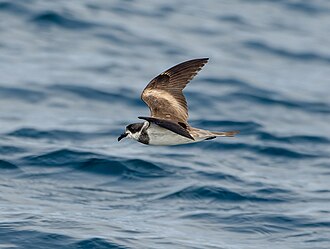
Hornby's storm petrel
Oceanodroma hornbyi
IUCN status: Not evaluatedMarkham's storm petrel
Oceanodroma markhami
IUCN status: Not evaluatedProtected in Peru
Black storm petrel
Oceanodroma melania
IUCN status: Not evaluated
Least storm petrel
Oceanodroma microsoma
IUCN status: Not evaluated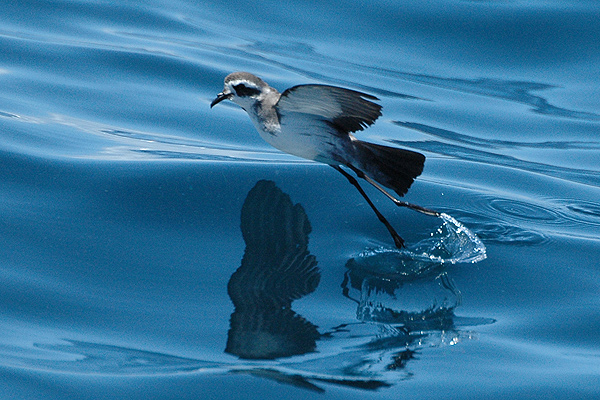
White-faced storm petrel
Pelagodroma marina
IUCN status: LC · Least Concern
Names and sources
In Spanish
- Paíño ventriblanco — Wikidata · main name
- Paíño vientre blanco — Wikidata
In English
- White-bellied storm petrel — WoRMS; Wikidata
Classification
Learn more
Conservation status: Least Concern (IUCN Red List, according to Wikidata). Taxonomy: PeRMS / WoRMS (CC BY 4.0).