
Sea snails · Fissurellidae
Fissurella crassa
Fissurella crassa Lamarck, 1822
- Peruvian Register of Marine Species
- Listed in PeRMS (IMARPE)

Species account
Summary
Fissurella crassa is a medium-sized to large keyhole limpet that lives high on the rocky intertidal shore of the south-eastern Pacific, wedged into crevices in the reef [1]. Its known range runs from Huarmey, Peru (10°06' S), to Punta Pulga on the island of Chiloé, Chile (42°06' S), and WoRMS lists it as an accepted species in the family Fissurellidae [1],[2].
It is common throughout its range and is widely collected as food [1]. At Ilo, in southern Peru, an adult trematode parasite lives in its gonads and damages them [3].
Identification and similar species
The mature shell is 60 to 90 mm long, low to moderately high in profile, elongate-oval in outline, and a uniform caramel brown, sometimes with faint darker rays [1]. The surface is smooth apart from broad, low primary ribs that form undulations at the edge, and the apical opening is very elongate and narrows in the middle, with the rear part much wider and longer than the front [1]. The most characteristic feature is the margin turned upward at every growth stage, together with an interior stained lavender [1].
The animal is too large to fit inside its shell: the cephalic tentacles are brown, the mantle lobe is broad and banded in light and dark, and the sides of the foot carry large, bulbous, white-tipped tubercles, the best developed of any species in the group [1]. Juveniles have strong, pale primary ribs, and the shell darkens at a length of about 7 mm [1]. Most individuals bear a single epibiotic limpet, Scurria parasitica, which erodes the shell surface [1].
Similar species
- Fissurella limbata: Fissurella limbata has a broad, flat margin rather than the upturned margin of Fissurella crassa, and it develops its mantle papillae and foot tubercles far less; it also lives lower on the shore [1].
- Fissurella maxima: Fissurella maxima also has an unusual margin, but in it only the junction between the margin and the inner aragonite layer is rounded, whereas in Fissurella crassa the whole margin turns upward [1].
Distribution and habitat
The northernmost record is Huarmey, Peru (10°06' S), and the southernmost is Punta Pulga, in north-western Chiloé, Chile (42°06' S) [1]. A parasite study gives the same interval, roughly 10° S to 42° S [4]. McLean judged the Galápagos Islands record to be erroneous and rejected the one from the Strait of Magellan, and he noted that the southern limit is uncertain because he did not find it on the eastern side of Chiloé, where there is little surf [1].
It lives in the mid-intertidal zone, in crevices of rocky reefs that are exposed to surf or partly sheltered, and it occurs higher on the shore than the other species of the genus in the region, wedged into narrow crevices at low tide [1]. It is not found below the tide line [1]. The upturned margin may be an adaptation to that cramped position when the animal is exposed to air [1].
Biology
According to a study by Bretos that McLean cites, it feeds on green algae such as Ulva and Enteromorpha [1]. Males and females are separate individuals with no external dimorphism, and sex is recognised by gonad colour: pale yellow to white in males and green in females [5].
In tagging work at Huayquique, in northern Chile, the shell was found to form two growth rings a year, normally one in summer and one in winter, and these serve to estimate age between 1 and 6 years; the largest specimen analysed had a calculated age of 10 years [6]. Growth is fast in early spring and late summer and slower during the rest of the year, so harvestable sizes are reached in 2 to 4 years [1].
Gonad weight varies with the season and with wave exposure: at sheltered sites it was higher in summer and stayed constant in winter, whereas at exposed sites the winter value exceeded the summer one [7]. Individuals from Ilo infected with the trematode Proctoeces lintoni have an altered gonad structure and gamete formation is interrupted, in both males and females [3].
Ecology
The species is active only during nocturnal low tides [8]. Excursions are longer and reach farther from the refuge on spring tides than on neap tides, and the lowest level of the shore is reached only at spring low tides [8]. Each animal combines foraging from a fixed point with freer ranging, with a clear preference for the former, and it seems to find its refuge again by following its own trail [8].
In central Chile this species and Fissurella limbata are heavily collected by shellfishermen, and after about 2.5 years without harvesting on one stretch of coast, densities and size distributions changed compared with the harvested zone [9]. The difference was large on rocky platforms and did not appear on vertical walls, which are harder to reach [9].
The trematode Proctoeces lintoni lives as an adult in the gonads of this limpet, and in the Peruvian population the degree of progenesis was low, a result the authors attribute possibly to parasite-induced mortality rather than to latitude [4]. A related parasite, Proctoeces humboldti, uses a mussel as first host, a limpet as second host and the fish Sicyases sanguineus as definitive host; in a central Chilean sample it was present in 59.5 % of the limpets, with 1 to 32 parasites each [5]. According to a personal communication cited by McLean, during the 1982-1983 El Niño event all large Fissurella species near the shore died in northern Chile; the report does not concern this species alone [1].
Human relevance
McLean describes it as common throughout its range and widely exploited for food [1]. Because its habitat lies high on the shore and is very accessible, large specimens are seldom seen [1].
In central Chile, collection by shellfishermen is intense enough to change the density and size structure of populations [9]. No source was found that quantifies its use as food in Peru; the harvest data cited here are from Chile [9].
Where to see it in Peru
The Peruvian shells that McLean illustrated in 1984 come from Bahía Independencia, in Ica province, and from Miraflores, in Lima province, the latter a juvenile [1]. In 1992 specimens from Ilo, in southern Peru, were studied [3].
McLean describes it wedged in rock crevices at low tide, in the mid-intertidal zone and higher on the shore than the other species of the genus [1]. The specimens cited come from collections and studies, and do not confirm that it can be seen at those places today. The sources consulted do not mention access restrictions at those places [1],[3].
References (9)
- McLean, J.H. (1984). Systematics of Fissurella in the Peruvian and Magellanic faunal provinces (Gastropoda: Prosobranchia). Contributions in Science, 1-70. doi:10.5962/p.226839 (accessed 2026-10-25)
- WoRMS Editorial Board (2026). Fissurella crassa Lamarck, 1822. World Register of Marine Species. https://www.marinespecies.org/aphia.php?p=taxdetails&id=570517 (accessed 2026-10-25)
- Oliva, M.E. (1992). Parasitic castration in Fissurella crassa (Archaeogastropoda) due to an adult Digenea, Proctoeces lintoni (Fellodistomidae). Memórias do Instituto Oswaldo Cruz, 37-42. doi:10.1590/s0074-02761992000100007 (accessed 2026-10-25)
- Oliva, M.E., Huaquin, L.G. (2000). Progenesis in Proctoeces lintoni (Fellodistomidae), a parasite of Fissurella crassa (Archaeogastropoda) in a latitudinal gradient in the Pacific coast of South America. Journal of Parasitology, 768. doi:10.1645/0022-3395(2000)086[0768:piplfa]2.0.co;2 (accessed 2026-10-25)
- García-Huidobro, M.R., Reyes, M., Caro Fuentes, N. et al. (2024). Host-parasite dialogue: fecundity compensation mechanisms of Fissurella crassa. Frontiers in Marine Science. doi:10.3389/fmars.2023.1266405 (accessed 2026-10-25)
- Bretos, M. (1980). Age determination in the keyhole limpet Fissurella crassa Lamarck (Archaeogastropoda: Fissurellidae), based on shell growth rings. The Biological Bulletin, 606-612. doi:10.2307/1540826 (accessed 2026-10-25)
- Pulgar, J., Alvarez, M., Delgadillo, A. et al. (2012). Impact of wave exposure on seasonal morphological and reproductive responses of the intertidal limpet Fissurella crassa (Mollusca: Archaegastropoda). Journal of the Marine Biological Association of the United Kingdom, 1595-1601. doi:10.1017/s0025315412000173 (accessed 2026-10-25)
- Serra, G., Chelazzi, G., Castilla, J.C. (2001). Temporal and spatial activity of the key-hole limpet Fissurella crassa (Mollusca: Gastropoda) in the eastern Pacific. Journal of the Marine Biological Association of the United Kingdom, 485-490. doi:10.1017/s002531540100412x (accessed 2026-10-25)
- Oliva, D., Castilla, J.C. (1986). The Effect of Human Exclusion on the Population Structure of Key-Hole Limpets Fissurella crassa and F. limbata on the Coast of Central Chile. Marine Ecology, 201-217. doi:10.1111/j.1439-0485.1986.tb00158.x (accessed 2026-10-25)
More pictures
Where it has been recorded
- Filled: scientific records, or confirmed by a curator
- Hatched: isolated record
- Dotted outline: no scientific records and no curator's confirmation (an ORKA sighting is not drawn here)
- Cold central sea
Scientific records (5 records)
- Cold southern sea
Scientific records (11 records)
From openly licensed OBIS and GBIF records (CC0 or CC BY). How each list is built.
Related species
From the same genus (Fissurella).
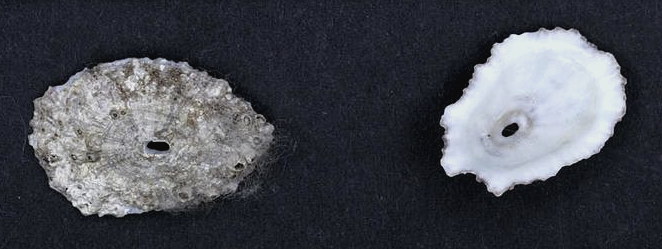
Fissurella microtrema
IUCN status: Not evaluatedFissurella asperella
IUCN status: Not evaluated
Fissurella bridgesii
IUCN status: Not evaluatedFissurella cumingi
Fissurella cumingii
IUCN status: Not evaluated
Fissurella latimarginata
IUCN status: Not evaluated
Fissurella limbata
IUCN status: Not evaluated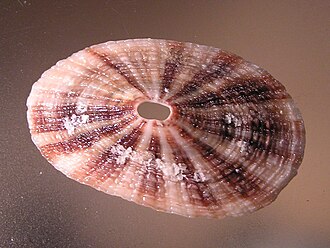
Fissurella maxima
IUCN status: Not evaluated
Fissurella nigra
IUCN status: Not evaluated
Names and sources
Classification
Learn more
Conservation status: no data (IUCN). Taxonomy: PeRMS / WoRMS (CC BY 4.0).