
Crabs, lobsters and shrimps · Eurypodiidae
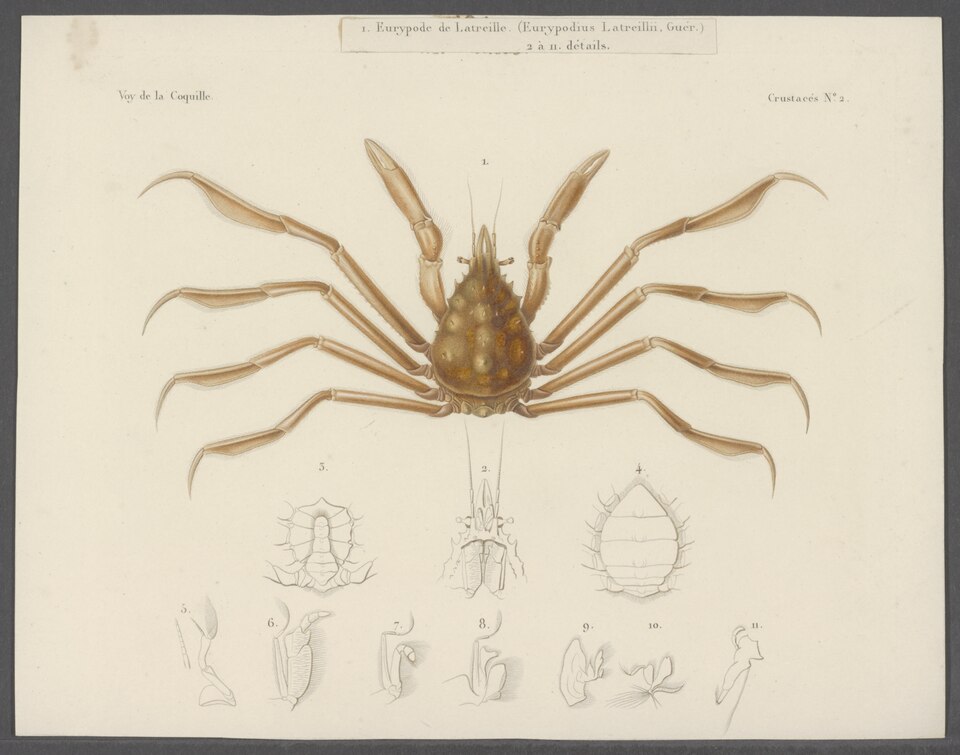
Eurypodius latreillii
Eurypodius latreillii Guérin, 1828
Spanish: Cangrejo
- Names in Peru
- Cangrejo · Cangrejo araña
- Peruvian Register of Marine Species
- Listed in PeRMS (IMARPE)
Species account
Summary
Eurypodius latreillii is a spider crab of the superfamily Majoidea, which the World Register of Marine Species accepts under the authorship of Guérin and the date 1828 and places in the family Eurypodiidae [1]. Its carapace is usually covered with algae, sponges, bryozoans and other organisms living on it [2]. It is known from Peru to the Strait of Magellan, and also in the south-western Atlantic [3]. Almost everything measured about its biology comes from the far south of Chile, from surveys in 1994, and not from Peru [2].
Identification and similar species
It is a spider crab whose carapace is usually host to attached organisms. In specimens from the 1994 trawls in far southern Chile, the carapace frequently carried green and red algae, sponges, bryozoans, foraminiferans, polychaetes of the families Sabellidae and Serpulidae, the molluscs Aulacomya ater and Hiatella solida, ascidians, nematodes, pycnogonids, the decapod Liopetrolisthes patagonicus, amphipods and isopods [2]. Earlier studies cited by those authors had recorded sponges and hydrozoans in Concepción Bay, and bryozoans, sponges and seaweeds in the Magellan region [2]. In English it is called the camouflaged spider crab [4].
Sizes are measured as carapace length. In the 1994 catches, the per-station averages ranged from 24.7 to 38.8 mm in males and from 25.1 to 39.0 mm in females, and the largest male measured 68.5 mm [2]. Egg-bearing females were between 29.0 and 62.9 mm in carapace length and between 21.0 and 42.5 mm in carapace width [3].
The same list of Southern Ocean decapods includes another member of the genus, Eurypodius longirostris, with a maximum recorded depth of 527 m, against 1490 m for Eurypodius latreillii [5]. That source gives no features to tell them apart [5].
Distribution and habitat
It is a widely distributed species of the southern cone of South America. On the Pacific side it ranges from Peru to the Strait of Magellan; on the Atlantic side it has been recorded from the tip of South America to the Gulf of San Matías, in Argentina, as well as the Falkland Islands and Rio de Janeiro, in Brazil [3]. The northern limit known in the Pacific is Independencia Bay, in Peru, and in the Atlantic the Gulf of San Matías [2].
It prefers sandy sediments [3]. SeaLifeBase states that juveniles live on hard bottoms covered with algae, sponges and bryozoans, at shallow depth, and adults on mud or sand bottoms in deeper water; it also gives a depth range of 17 to 1490 m [4]. The maximum value matches that of an analysis of the southern decapod fauna [5]. In the 1994 Agassiz trawl surveys it was caught between 15 and 117 m [2].
Biology
Reproduction was studied in 66 egg-bearing females taken at a single station in the Strait of Magellan, between October and November 1994 [3]. Each female carried between 201 and 15886 eggs (the maximum in their table is 15866), and the number grew with the size of the mother [3]. Newly laid eggs were large for a spider crab, with a mean volume of 0.162 mm3, and their volume increased by 32 % during incubation [3].
The mean number of eggs per clutch fell from 9384 in the first stage of development to 1627 in the last, equivalent to a loss of 83 %; the authors caution that this figure may be biased, because females with nearly ready embryos were somewhat smaller, and that the loss is suggested but not proven [3]. The egg mass at spawning averaged 13 % of the female's body mass [3]. Because egg-bearing females varied so widely in size, they found no support for a terminal moult, and they note that the reproductive biology of spider crabs from temperate South American waters is almost completely unknown [3]. SeaLifeBase records egg-bearing females from December to May [4], whereas the egg-bearing females of the study above were collected in October and November [3].
In the same survey, the ratio of males to females was between 0.21 and 0.39 at the deepest stations, that is, females dominated, and in the Strait of Magellan there were more egg-bearing females towards deep water [2]. The authors note that females have been seen close to shore in the austral spring (a personal communication from another researcher), probably to release larvae in shallow water, and offer this only as a possible explanation [2].
Ecology
In the far south of Chile it was, together with the hermit crab Pagurus comptus, the decapod caught most often in the 1994 survey: 773 specimens at 15 stations [2]. In the strait it made up 19 % of all decapods collected, and the authors therefore consider it a key species of the shallow ecosystems at the southern tip of the Americas [3].
The smallest individuals, under 20 mm, were collected at stations of 15 to 115 m, whereas the largest males and females, averaging about 38 mm, predominated in deep water [2]. The authors think size and distribution may be related to the organisms growing on the carapace, since a large biomass of ascidians and molluscs could affect the crab's mobility, though they did not test this [2].
Where to see it in Peru
The literature consulted places the species from Peru southwards, with Independencia Bay as the northern limit, but its field data come from southern Chile, from Agassiz trawl sampling in 1994, not from diving observations [2]. The sources consulted name no specific Peruvian locality or time of year for seeing it, so this account cannot recommend any [3].
References (5)
- DecaNet eds. (2026). Eurypodius latreillii Guérin, 1828. World Register of Marine Species. https://www.marinespecies.org/aphia.php?p=taxdetails&id=366245 (accessed 2026-10-25)
- Soto, R., Quiroga, E., Vargas, M. et al. (1999). Size structure and sex composition of Eurypodius latreillii Guérin, 1828 (Brachyura) and Pagurus comptus White, 1847 (Anomura) in southern Chile. Scientia Marina 63 (Supl. 1), 339-345. doi:10.3989/scimar.1999.63s1339 (accessed 2026-10-25)
- Navarrete, N., Soto, R., Quiroga, E. et al. (1999). Egg production in Eurypodius latreillei Guérin, 1828 (Decapoda: Majidae) in the Straits of Magellan, southern Chile. Scientia Marina 63 (Supl. 1), 333-337. doi:10.3989/scimar.1999.63s1333 (accessed 2026-10-25)
- Palomares, M.L.D., Pauly, D. (2026). Eurypodius latreillii, Camouflaged spider crab. SeaLifeBase. https://www.sealifebase.se/summary/Eurypodius-latreillii.html (accessed 2026-10-25)
- Gorny, M. (1999). On the biogeography and ecology of the Southern Ocean decapod fauna. Scientia Marina 63 (Supl. 1), 367-382. doi:10.3989/scimar.1999.63s1367 (accessed 2026-10-25)
More pictures
Where it has been recorded
- Filled: scientific records, or confirmed by a curator
- Hatched: isolated record
- Dotted outline: no scientific records and no curator's confirmation (an ORKA sighting is not drawn here)
- Cold southern sea
Scientific records (12 records)
From openly licensed OBIS and GBIF records (CC0 or CC BY). How each list is built.
Names and sources
In Spanish
- Cangrejo — Peru; sealifebase · main name
- Cangrejo araña — Peru; sealifebase
Classification
Learn more
Conservation status: no data (IUCN). Taxonomy: PeRMS / WoRMS (CC BY 4.0).