
Bony fishes · Epinephelidae
Flag cabrilla
Epinephelus labriformis (Jenyns, 1840)
Spanish: Murique
- Names in Peru
- Murique
- Peruvian Register of Marine Species
- Listed in PeRMS (IMARPE)

Species account
Summary
Epinephelus labriformis is a grouper of the family Epinephelidae, described by Jenyns in 1840 as Serranus labriformis [1]. In Peru it is called «murique» [2]. It is a mid-sized grouper, reaching about 50 cm in total length, common on shallow rocky shores of the eastern Pacific between the Gulf of California and Peru, and of some value to local fisheries [3]. All of its males arise from females that change sex, a form of hermaphroditism known as monandric protogyny [4]. The IUCN Red List lists it as Least Concern [5].
Identification and similar species
Its body depth is clearly less than its head length: depth goes 2.7 to 3.1 times into the standard length and the head 2.2 to 2.5 times, with a flat space between the eyes and a rounded, finely serrated preopercle [3]. The dorsal fin has 11 spines and 16 to 18 soft rays, the third or fourth spine being the longest; the anal fin has 3 spines and 8 rays, the pectorals 18 or 19 rays, and the tail is rounded [3]. There are 48 to 51 scales along the lateral line [3].
The ground colour ranges from olive green to reddish brown, sprinkled with irregular white spots; the tip of each dorsal spine carries a bright white mark and the edge of the membrane between spines a white triangle [3]. A small black saddle sits on the caudal peduncle and the inside of the mouth is red; juveniles show black dots on top of the head and median fins that turn reddish towards the tip, with a white rim [3].
Similar species
- Epinephelus analogus: It has 10 dorsal-fin spines instead of 11, and its reddish brown body is covered in dark brown dots with 5 faint oblique dark bars rather than white spots; it also grows larger, to about 75 cm [6],[6].
- Epinephelus clippertonensis: It is easy to recognise by its colouring, although genetically it differs very little from Epinephelus labriformis; its populations are insular, such as the one at Clipperton Atoll, and exchange few genes with mainland populations of Epinephelus labriformis [7].
Distribution and habitat
It lives in the eastern Pacific from the Gulf of California to Peru, including the oceanic islands of Cocos, Revillagigedo and Galápagos, where its type locality lies [3]. Its range spans 31° N to 10° S, and it is found between 1 and 50 m deep [2].
It is a common species of shallow rocky bottoms and is most abundant close to shore, although adults go down to at least 30 m [3]. A genetic study pooling 304 fish of this species and its island relative Epinephelus clippertonensis, taken from across their range, found 49 haplotypes of the mitochondrial cytochrome b gene; according to the authors, the barriers described along the mainland coast do not seem to hold back the spread of these groupers, whose larvae spend a long time in the plankton, whereas gene flow between mainland and island populations is scarce [7].
Biology
At Bahía de Navidad, Jalisco, Mexico, commercial gillnet catches were sampled every month between 1998 and 2008: of 940 fish, 521 were females and 419 males, measuring 20.0 to 40.5 cm in total length and weighing 128 to 1096 g [8]. Females outnumbered males by 1.3 to 1, but males dominated 4 of the 5 largest size classes; the gonadosomatic index and the share of ripe gonads peaked in April and August, so breeding is concentrated in spring and summer [8]. There, half of the females were mature at 29.6 cm and half of the males at 31.3 cm, and the smallest fish caught in the middle of sex change measured 25.6 cm [8].
In Mazatlán Bay, Mexico, histology of 527 fish collected weekly between March 2017 and March 2018 confirmed that it is a monandric protogynous hermaphrodite [4]. No female longer than 27.5 cm turned up; females reached maturity at 17.2 cm and males at 19.42 cm, and sex change took place between 20 and 33.5 cm, at a mean size of 24.7 cm [4]. Among mature adults there were 1.5 females for every male [4].
In the laboratory, from induced spawnings, its eggs proved pelagic, spherical and transparent, with a single oil droplet and a mean diameter of 726.1 µm [9]. At 25 °C they hatched 27 hours after fertilisation, and between 23 and 27 °C the time to hatching shortened as the temperature rose [9].
Ecology
It is a secretive predator: by day it eats mostly small fishes and at night mainly crustaceans [3]. FishBase describes it as solitary and gives it a trophic level of 4.0 [2].
During the 2015 and 2016 El Niño, the sea around Galápagos stayed about 2.5 °C warmer than normal for 6 months, and in that period a previously undescribed ulcerative skin disease appeared, striking 18 bony fish species belonging to 13 families [10]. Epinephelus labriformis, classed as a piscivore, was one of them: the first sick individual was seen on 13 January 2016 at Cuatro Hermanos East [10].
Conservation
The IUCN Red List classifies it globally as Least Concern [5]. FishBase rates its resilience as low, with a minimum population doubling time of 4.5 to 14 years [2].
Its protogynous hermaphroditism, together with breeding concentrated in spring and summer, makes it highly vulnerable to fishing; at Bahía de Navidad, however, catch sizes suggest that the fish taken would already have spawned at least once [8]. Since Mexico has no rules of its own for this species, the Mazatlán study suggests setting a minimum catch size of 24 to 27 cm and a closed season while it spawns, so that the population keeps its capacity to reproduce and the balance between females and males is not upset [4].
As a hypothesis, the authors of the Galápagos study link the 2016 outbreak to the months-long warm water and the shortage of planktonic food that come with the strongest El Niño events, which projections say will grow more frequent with global warming [10].
Human relevance
It has some commercial interest in local fisheries, which take it with hook and line and in traps [3]. At Bahía de Navidad, Mexico, it is exploited commercially and caught with gillnets [8]. FishBase also records it as a game fish [2].
In Peru it is one of the 35 key fishery resources of the tropical eastern Pacific ecosystem off the northern coast, between 3° S and 6° S, whose vulnerability to climate change up to 2055 was assessed by a panel of experts; that region supplies 12 % of the country's annual landings, and the demersal fish group, to which it belongs, came out as the least vulnerable [11].
The description of its embryonic development was framed as a basis for achieving controlled breeding and larval rearing [9].
Where to see it in Peru
In November 2018, environmental DNA analysis of water samples taken at the Lobos de Afuera islands detected Epinephelus labriformis, a species absent from the historical records and baseline studies of those islands [12]. These islands, the farthest from the Peruvian coast at about 32 nautical miles, belong to the Reserva Nacional Sistema de Islas, Islotes y Puntas Guaneras, and the distance from the coast and their complex seabed relief limit access to them [12].
In Peru's tropical north, between 3° S and 6° S, it is regarded as a key fishery resource [11].
References (12)
- WoRMS Editorial Board (2026). Epinephelus labriformis (Jenyns, 1840). World Register of Marine Species. https://www.marinespecies.org/aphia.php?p=taxdetails&id=273858 (accessed 2026-10-20)
- Froese, R., Pauly, D. (2026). Epinephelus labriformis, Starry grouper. FishBase. https://www.fishbase.se/summary/Epinephelus-labriformis.html (accessed 2026-10-20)
- Heemstra, P.C., Randall, J.E. (1993). FAO species catalogue. Vol. 16. Groupers of the world (family Serranidae, subfamily Epinephelinae). An annotated and illustrated catalogue of the grouper, rockcod, hind, coral grouper and lyretail species known to date. FAO Fisheries Synopsis No. 125, Vol. 16. FAO, Rome, 173-174. https://www.fao.org/4/t0540e/t0540e26.pdf (accessed 2026-10-20)
- Sánchez-Cárdenas, R., López-Cardiel, J., Martínez-Brown, J.M. et al. (2026). Reproductive biology of the starry grouper, Epinephelus labriformis (Perciformes: Serranidae): Gonadal development, sex change and sexual pattern. Journal of Fish Biology, 478-493. doi:10.1111/jfb.70397 (accessed 2026-10-20)
- Craig, M.T., Erisman, B. (2016). Epinephelus labriformis: Craig, M.T. & Erisman, B. The IUCN Red List of Threatened Species 2018: e.T132750A100549669. doi:10.2305/IUCN.UK.2018-2.RLTS.T132750A100549669.en (accessed 2026-10-20)
- Heemstra, P.C., Randall, J.E. (1993). FAO species catalogue. Vol. 16. Groupers of the world (family Serranidae, subfamily Epinephelinae). An annotated and illustrated catalogue of the grouper, rockcod, hind, coral grouper and lyretail species known to date. FAO Fisheries Synopsis No. 125, Vol. 16. FAO, Rome, 110-111. https://www.fao.org/4/t0540e/t0540e18.pdf (accessed 2026-10-20)
- Craig, M.T., Hastings, P.A., Pondella, D.J. et al. (2006). Phylogeography of the flag cabrilla Epinephelus labriformis (Serranidae): implications for the biogeography of the Tropical Eastern Pacific and the early stages of speciation in a marine shore fish. Journal of Biogeography, 969-979. doi:10.1111/j.1365-2699.2006.01467.x (accessed 2026-10-20)
- Ruiz-Ramírez, S., Pérez-Segoviano, A.M., Lucano-Ramírez, G. et al. (2019). Reproducción de la cabrilla pinta Epinephelus labriformis en la Bahía de Navidad, Jalisco, México. Revista de Biología Marina y Oceanografía, 335-347. doi:10.22370/rbmo.2018.53.3.1358 (accessed 2026-10-20)
- Torres-Hernández, P., Cebada-Martínez, P., Girón-Cruz, D.A. et al. (2015). Embryonic development of the starry grouper Epinephelus labriformis (Jenyns, 1840) and description of its eleutheroembryo. CICIMAR Oceánides, 27-33. doi:10.37543/oceanides.v30i2.149 (accessed 2026-10-20)
- Lamb, R.W., Smith, F., Aued, A.W. et al. (2018). El Niño drives a widespread ulcerative skin disease outbreak in Galapagos marine fishes. Scientific Reports, 16602. doi:10.1038/s41598-018-34929-z (accessed 2026-10-20)
- Ramos, J.E., Tam, J., Aramayo, V. et al. (2026). Vulnerability of fishery resources to climate change in the Tropical Eastern Pacific Ecosystem off Peru. Scientific Reports, 23567. doi:10.1038/s41598-026-44359-x (accessed 2026-10-20)
- Alfaro-Córdova, E., Ortiz-Alvarez, C., Alfaro-Shigueto, J. et al. (2022). What lies beneath? Revealing biodiversity through eDNA analysis in Lobos de Afuera Islands, Peru. Latin American Journal of Aquatic Research, 642-659. doi:10.3856/vol50-issue4-fulltext-2782 (accessed 2026-10-20)
More pictures
Where it has been recorded
- Filled: scientific records, or confirmed by a curator
- Hatched: isolated record
- Dotted outline: no scientific records and no curator's confirmation (an ORKA sighting is not drawn here)
- Tropical northern sea
Scientific records (3 records)
- Tropical–cold transition zone
Scientific records (3 records)
- Cold central sea
Scientific records (3 records)
From openly licensed OBIS and GBIF records (CC0 or CC BY). How each list is built.
Related species
From the same genus (Epinephelus) and from the same family (Epinephelidae).
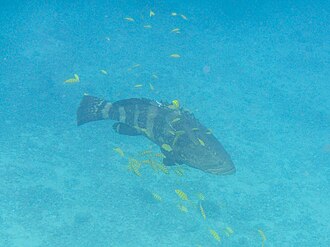
Pacific Goliath Grouper
Epinephelus quinquefasciatus
IUCN status: DD · Data DeficientProtected in Peru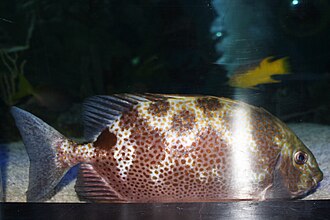
Spotted grouper
Epinephelus analogus
IUCN status: LC · Least Concern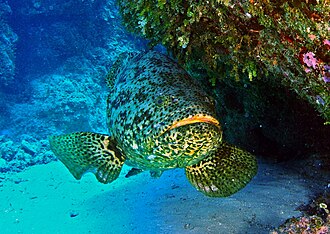
Jewfish
Epinephelus itajara
IUCN status: VU · Vulnerable
Broomtail grouper
Mycteroperca xenarcha
IUCN status: DD · Data Deficient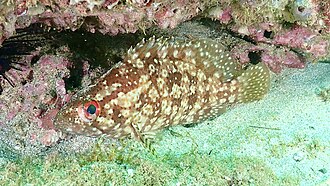
Pacific mutton hamlet
Alphestes immaculatus
IUCN status: LC · Least ConcernRivulated mutton hamlet
Alphestes multiguttatus
IUCN status: LC · Least Concern
Panama graysby
Cephalopholis panamensis
IUCN status: LC · Least Concern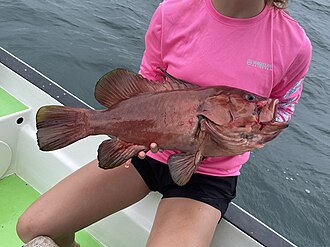
Gulf Coney
Hyporthodus acanthistius
IUCN status: VU · Vulnerable
Names and sources
In Spanish
- Murique — Peru; fishbase; Wikidata · main name
- Cabrilla — Wikidata
- Cabrilla Piedrera — Wikidata; WoRMS
- Cabrilla Pinta — Wikidata
- Murico — Wikidata
In English
- Flag cabrilla — WoRMS; Wikidata
- Grouper — Wikidata
- Red-tipped — Wikidata
- Rock Bass — Wikidata
- Sea Bass — Wikidata
- Starry Grouper — Wikidata
Classification
Learn more
Conservation status: Least Concern (IUCN Red List, according to Wikidata). Taxonomy: PeRMS / WoRMS (CC BY 4.0).