
Octopuses and squids · Ommastrephidae
Humboldt squid
Dosidicus gigas (A. d'Orbigny, 1835)
Spanish: Pota
- Names in Peru
- Pota · Calamar gigante
- Peruvian Register of Marine Species
- Listed in PeRMS (IMARPE)
Species account
Summary
Dosidicus gigas is an oceanic squid of the family Ommastrephidae, in the order Oegopsida [1]. It is one of the largest and most abundant swimming squids in the ocean's surface waters, and it lives only in the eastern Pacific [2]. In Peru it is called «pota» or «calamar gigante», and its fishery is the largest small-scale fishery in the country [3]. On the IUCN Red List it is listed as Data Deficient [4].
Etymology
D'Orbigny described it in 1835 under the name Ommastrephes gigas; the genus Dosidicus, erected by Steenstrup in 1857, has this species as its type species and contains no others [2]. Other names it received later, such as Dosidicus eschrichti or Dosidicus steenstrupi, are treated as synonyms; FAO calls it jumbo flying squid in English and jibia gigante in Spanish [2].
Identification and similar species
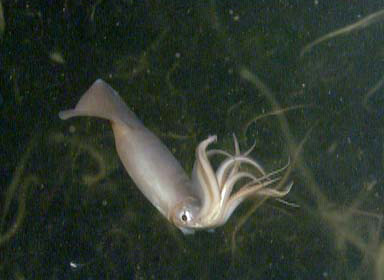
It has a large, sturdy, thick-walled mantle and two muscular diamond-shaped fins whose width averages 56 % of the mantle length [2]. At the base of the funnel there is a deep pit with about 7 skin folds and 4 or 5 pockets at the sides, and in adults the ends of the arms stretch into very fine tips carrying 100 to 200 tiny suckers [2]. Under the skin of the belly, the head and two pairs of arms it has small light organs, which are easy to see in juveniles and become hard to make out in adults [2].
It is a large species: total length approaches 2.5 m, the mantle reaches 1.2 m off Chile and the weight 50 kg, although mantles of 500 to 800 mm and weights of 20 to 30 kg are usual [2]. In Peru, the female with the heaviest oviduct in an IMARPE study had a 920 mm mantle and weighed 31.1 kg [5], and the 954 squids IMARPE examined on its 2015 to 2019 cruises had mantles from 12 to 93.3 cm [6].
Similar species
- Sthenoteuthis oualaniensis: Sthenoteuthis oualaniensis carries a large oval yellow light organ on the front of the back of the mantle from about 140 mm mantle length, its arm tips are not drawn out into filaments and its mantle does not exceed 650 mm [2].
Distribution and habitat
It lives in the eastern Pacific, mainly between 22° N and 22° S, with a limit that roughly follows the 20 °C surface isotherm; in some years its range spreads to much higher latitudes, and it has been confirmed as far as 59° N in Alaska and 53° S, near Tierra del Fuego [2]. Towards the open ocean it may reach about 125° W, and it has been fished 1000 km off the Peruvian coast [2].
It can go below 1000 m: 3 squids tracked with acoustic tags spent most of the day deeper than 250 m, in the oxygen-poor layer, and swam above 200 m at night [2]. Off Peru that layer is more intense and starts shallower than off California, and the squid copes with it by lowering its metabolism and thanks to a blood protein that binds oxygen very well [7]. IMARPE cruises caught it between 3° S and 19° S [6].
Biology
It breeds only once and then dies [5]. The female releases her eggs in several batches, 10 to 14, and can produce 32 million eggs or more, the highest fecundity known among cephalopods; even immature females keep the male's sperm after mating [5]. Its ripe eggs are transparent, amber-coloured and about 1 mm long, and most individuals live about 1 year, although the largest may reach 2 [2].
In Peru, observers on board the fleet that jigged for it measured more than 145000 squids between 1991 and 2007 [5]. In the 1990s mature adults had mantles of about 300 mm, and between the winter of 1999 and the summer of 2001 this rose to over 800 mm in males and about 900 mm in females; they mature at smaller sizes in warm water and at larger sizes in cold water [5]. Breeding is concentrated in the austral spring, and there were about 3 females per male until around 2002 and about 2 afterwards [5].
According to FAO, off Peru it spawns along the whole coast, most intensely from October to January with a second peak in July and August, and mainly between 3° S and 8° S and between 12° S and 17° S [2]. Eggs from Peruvian females fertilised in the laboratory at 18 °C gave 167 young, which hatched after 6 to 9 days [2].
Ecology
It is a voracious predator. In more than 4000 stomachs of squids caught off Peru between 2004 and 2011, the fish Vinciguerria lucetia turned up in 36 %; it ate hardly any anchoveta, which lives very close to the coast in a thin oxygenated surface layer, above a very shallow oxygen minimum zone that seems to keep the squid from reaching it [7]. The way it is fished and its voracity fill the stomachs with pieces of other squids of its kind; even after discarding the fresh pieces, its own species was still the dominant prey by weight [7].
IMARPE analysed 954 stomachs from its 2015 to 2019 cruises and found 51 kinds of prey, among crustaceans, fishes, cephalopods and snails; euphausiids dominated in 2015 and 2016, above all Nyctiphanes simplex in 2016, and Vinciguerria lucetia from 2017 to 2019, and what changed the diet most was the distance from the coast [6]. That study places it as a top predator [6].
It is in turn prey to large animals: in the Humboldt Current the sperm whale feeds almost only on this squid, and it is the main prey of the swordfish throughout its range [2]. When threatened it releases a great deal of ink, which contains substances that confuse its attackers' senses [2]. On IMARPE cruises off Ático, in Arequipa, a juvenile Thalassarche eremita albatross was seen eating a medium-sized squid of this species [3].
Conservation
On the IUCN Red List it is listed as Data Deficient [4].
Its fishery in Peru is governed by the Fishery Management Regulation for the giant squid, approved by Supreme Decree 003-2025-PRODUCE with a precautionary approach, and IMARPE studies it continuously [8]. In 2026 IMARPE reported that its fishery indicators were highly variable and that few biological samples came from the small-scale fleet, so Operation Giant Squid V was authorised, from 23 to 29 August 2026, in which up to 30 boats were to jig at night within 150 nautical miles of the coast [8].
The Management Plan of the Dorsal de Nasca National Reserve notes that the foreign fleet fishing off Peru mainly targets this species, that most of those vessels are Chinese and that Peru requires those using Peruvian ports to carry an additional satellite device [3].
Human relevance
The squid fishery provides many jobs and export earnings, and the species is among the 25 most important in world fishery production [3]. In Peru's exclusive economic zone, total landings rose from almost nothing in 1991 to more than 230000 t in 2006 [5].
It is caught mainly with jigging machines, and the fleet working off Peru is so large that its lights can be seen from satellites; in 2007 catches of the species were close to 700000 t, about 21 % of all squid caught worldwide [2]. Its flesh is eaten fresh and frozen [2].
There are several accounts of large squids of this species attacking people, including at least one death, and divers working at night among feeding squids have suffered deep cuts through their suits [2].
Where to see it in Peru
It is an open-ocean squid known mostly from fisheries: IMARPE cruises catch it with handlines between 3° S and 19° S [6], and the industrial fleet fished it between 2004 and 2011 from near the coast to 605 km offshore [7]. The Dorsal de Nasca National Reserve lies 57 nautical miles off the coast of Ica [3], and in 2022, 7461 t of squid caught inside it were landed by small-scale boats coming mainly from Piura [3].
References (8)
- MolluscaBase eds. (2026). Dosidicus gigas (A. d'Orbigny, 1835). World Register of Marine Species. https://www.marinespecies.org/aphia.php?p=taxdetails&id=342291 (accessed 2026-10-25)
- Jereb, P., Roper, C.F.E. (2010). Cephalopods of the world. An annotated and illustrated catalogue of cephalopod species known to date. Volume 2. Myopsid and Oegopsid Squids. FAO Species Catalogue for Fishery Purposes No. 4, Vol. 2. FAO, Rome, 300-304, 314-315. https://www.fao.org/4/i1920e/i1920e.pdf (accessed 2026-10-25)
- Servicio Nacional de Áreas Naturales Protegidas por el Estado (SERNANP) (2024). Plan Maestro de la Reserva Nacional Dorsal de Nasca 2024-2029. SERNANP; aprobado por RP N.° 000040-2024-SERNANP. https://cdn.www.gob.pe/uploads/document/file/5997712/5313081-anexo.pdf (accessed 2026-10-25)
- Barratt, I., Allcock, L. (2010). Dosidicus gigas: Barratt, I. & Allcock, L. The IUCN Red List of Threatened Species 2014: e.T162959A958088. doi:10.2305/IUCN.UK.2014-1.RLTS.T162959A958088.en (accessed 2026-10-25)
- Tafur, R., Keyl, F., Argüelles, J. (2010). Reproductive biology of jumbo squid Dosidicus gigas in relation to environmental variability of the northern Humboldt Current System. Marine Ecology Progress Series, 127-141. doi:10.3354/meps08386 (accessed 2026-10-25)
- Cisneros, R., Argüelles, J., Tafur, R. (2024). Ecología trófica del calamar gigante Dosidicus gigas en el litoral de Perú durante 2015-2019. Boletín Instituto del Mar del Perú, e412. doi:10.53554/boletin.v39i2.412 (accessed 2026-10-25)
- Alegre, A., Ménard, F., Tafur, R. et al. (2014). Comprehensive Model of Jumbo Squid Dosidicus gigas Trophic Ecology in the Northern Humboldt Current System. PLoS ONE, e85919. doi:10.1371/journal.pone.0085919 (accessed 2026-10-25)
- Ministerio de la Producción (2026). Resolución Ministerial N.° 00269-2026-PRODUCE: autorizan al Instituto del Mar del Perú - IMARPE la ejecución de la Operación Calamar Gigante V. El Peruano (15-08-2026). https://busquedas.elperuano.pe/dispositivo/NL/2543963-1 (accessed 2026-10-25)
More pictures
Where it has been recorded
- Filled: scientific records, or confirmed by a curator
- Hatched: isolated record
- Dotted outline: no scientific records and no curator's confirmation (an ORKA sighting is not drawn here)
- Cold central sea
Scientific records (4 records)
- Cold southern sea
Scientific records (9 records)
From openly licensed OBIS and GBIF records (CC0 or CC BY). How each list is built.
Related species
From the same family.


Names and sources
In Spanish
- Pota — Peru; SERNANP (2024). Plan Maestro de la Reserva Nacional Dorsal de Nasca 2024-2029. RP N.° 000040-2024-SERNANP, p. 18 of the PDF · main name
- Calamar gigante — Peru; SERNANP (2024). Plan Maestro de la Reserva Nacional Dorsal de Nasca 2024-2029. RP N.° 000040-2024-SERNANP, p. 18 of the PDF
In English
- Humboldt squid — WoRMS; Wikidata
- Jumbo Flying Squid — Wikidata; WoRMS
- Jumbo squid — WoRMS
Classification
Learn more
Conservation status: Data Deficient (IUCN Red List, according to Wikidata). Taxonomy: PeRMS / WoRMS (CC BY 4.0).