
Bony fishes · Eleotridae
Pacific fat sleeper
Dormitator latifrons (Richardson, 1844)
Spanish: Puyeki
- Peruvian Register of Marine Species
- Listed in PeRMS (IMARPE)
Species account
Summary
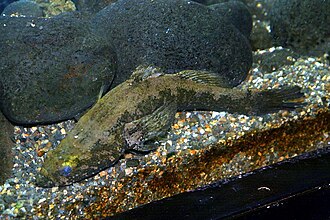
Dormitator latifrons is a fish of the family Eleotridae, order Gobiiformes [1]. It is the only species of its genus on the eastern Pacific coast, where it lives in fresh and brackish water from the Gulf of California to Peru [2]. Adults can reach about 41 cm in total length [3]. Its global category on the IUCN Red List is Least Concern [4].
Etymology
Identification and similar species
The maximum published size is 41 cm total length for males or unsexed fish and 39 cm for females; the maximum published weight is 1.2 kg and the common length is 25 cm [3].
In a sample of 300 fish from Manabí province, Ecuador, farm-raised and wild, mean weight was 173.13 g and mean total length 24.65 cm [6]. Males were taller, longer and wider than females, but the difference was significant only for the length of the head, of the second dorsal fin, of its rays and of the pelvic fin [6]. Farmed fish were larger than wild ones in almost every measurement, which the authors put down to available food, environment and habitat type [6].
Distribution and habitat
In the Pacific the genus ranges from the Gulf of California to Peru, including the Galápagos Islands, and Dormitator latifrons is the only species on the American Pacific coast [2]. A subspecies restricted to the Pacific coast of Mexico has also been described [2].
It lives in freshwater bodies and in brackish water; in Ecuador it is found mainly in the provinces of Manabí, Guayas and Los Ríos [6]. It prefers warm water, from 21 to 30 °C, and tolerates a pH of 6.4 to 9.4 [6].
Genetic analyses of fish from northern Mexico to Ecuador found no geographic structure in the Pacific lineage, whereas in mitochondrial DNA the Atlantic lineage split into 4 clades [2]. The two lineages are estimated to have separated about 1 million years ago [2].
Biology
The genus Dormitator is amphidromous: adults live and breed in fresh water, and after hatching the larvae are carried to the sea, where they spend a variable time before returning to rivers [2].
In a trial with 4 pairs of broodfish, from a fattening farm that is supplied with wild juveniles, females weighed 760 g on average and measured 32 cm total length, and males 808.3 g and 27.3 cm [5]. After spawning was induced with hormone implants, hatching came 7 to 8 h after fertilisation [5]. In captivity the larvae survive only about 7 days after hatching, and this is the main obstacle to farming the species [5].
Ecology
It occupies a low level of the food chain, being a herbivore, and withstands extreme water-quality conditions; it is also gregarious [7]. It can process detritus and pass it on to other trophic levels [6].
Parasites were found in 3 of 4 adult fish from rivers of the Pedernales canton, in Ecuador: larvae of Southwellina in stomach and liver, larvae of Parvitaenia cochlearii in liver and stomach, and adults of Piscicola in gills and liver; the fourth fish, which came from a farm, had none [8]. In a hatchery, 2 species of protozoans of the genus Trichodina caused up to 58 % mortality of larvae by 4 days after hatching, at 28 °C [5].
Conservation
Its global category on the IUCN Red List is Least Concern [4].
In Ecuador, the census of breeders shows a continuing fall in capture frequency and in the quality of the animals caught, and the exchange of fingerlings between basins worsens the loss of genetic variability [6]. Fattening farms still depend on juveniles taken from the wild, because no closed larviculture protocol exists [5].
Human relevance
In Ecuador small-scale production predominates, at 800 to 1000 tonnes, and Manabí province holds the largest production area [6]. There it is also an export product to countries such as the United States and Canada [7].
In the Peruvian department of Lambayeque it is a native fishery resource of commercial importance, with meat appreciated by the population, and its farming has been tried there since 1993 [7].
Where to see it in Peru
References (8)
- Froese, R., Pauly, D. (2026). Dormitator latifrons (Richardson, 1844). World Register of Marine Species. https://www.marinespecies.org/aphia.php?p=taxdetails&id=276408 (accessed 2026-10-25)
- Galván-Quesada, S., Doadrio, I., Alda, F. (2016). Molecular Phylogeny and Biogeography of the Amphidromous Fish Genus Dormitator Gill 1861 (Teleostei: Eleotridae). PLOS ONE 11(4), e0153538. doi:10.1371/journal.pone.0153538 (accessed 2026-10-25)
- Froese, R., Pauly, D. (2026). Dormitator latifrons, Pacific fat sleeper. FishBase. https://www.fishbase.se/summary/Dormitator-latifrons.html (accessed 2026-10-25)
- Lyons, T.J., van Tassell, J. (2019). Dormitator latifrons: Lyons, T.J. & van Tassell, J. The IUCN Red List of Threatened Species 2019: e.T183257A1735255. doi:10.2305/IUCN.UK.2019-2.RLTS.T183257A1735255.en (accessed 2026-10-25)
- Reyes-Mero, B.M. (2024). The Effect of Parasitization by Trichodinid Ciliates on the Mortality of Cultured Pacific Fat Sleeper larvae (Dormitator latifrons). Animals 14(20), 3037. doi:10.3390/ani14203037 (accessed 2026-10-25)
- Gonzalez-Martinez, A. (2020). Morphometric and Meristic Characterization of Native Chame Fish (Dormitator latifrons) in Ecuador Using Multivariate Analysis. Animals 10(10), 1805. doi:10.3390/ani10101805 (accessed 2026-10-25)
- López Cubas, S.J., Lora Vargas, M.V., Acosta Requejo, D. (2025). Culture of Dormitator latifrons “Pocoche” in Three Population Densities in an Intensive Culture System with Recirculation. Biomedical Journal of Scientific & Technical Research 62(3). doi:10.26717/BJSTR.2025.62.009746 (accessed 2026-10-25)
- Acosta Márquez, E.S., Intriago Mendoza, Mera Bravo et al. (2026). Parásitos observados en el chame adulto (dormitator latifrons) en rios continentales del noroccidente del Ecuador. LATAM Revista Latinoamericana de Ciencias Sociales y Humanidades 7(4). doi:10.56712/latam.v7i4.6315 (accessed 2026-10-25)
More pictures
Where it has been recorded
- Filled: scientific records, or confirmed by a curator
- Hatched: isolated record
- Dotted outline: no scientific records and no curator's confirmation (an ORKA sighting is not drawn here)
- Tropical northern sea
Scientific records (2 records)
- Cold central sea
Scientific records (2 records)
From openly licensed OBIS and GBIF records (CC0 or CC BY). How each list is built.
Related species
From the same family.
Names and sources
In Spanish
- Puyeki — WoRMS · main name
- Camote del Pacífico — Wikidata
- Chame — Wikidata
- Guavina — Wikidata
- Poyoco — Wikidata
In English
- Pacific fat sleeper — WoRMS; Wikidata
Learn more
Conservation status: Least Concern (IUCN Red List, according to Wikidata). Taxonomy: PeRMS / WoRMS (CC BY 4.0).