
Marine mammals · Delphinidae
Short-beaked common dolphin
Delphinus delphis Linnaeus, 1758
Spanish: Delfín común de hocico largo
- Names in Peru
- Delfín común de hocico largo · Delfín común de hocico corto
- Peruvian Register of Marine Species
- Listed in PeRMS (IMARPE)

Species account
Summary
Delphinus delphis is a dolphin of the family Delphinidae, accepted as a valid species in the World Register of Marine Species [1]. It lives in the Pacific, Atlantic and Indian Oceans, in both coastal and oceanic waters beyond the shelf edge, and is most common and abundant in cool temperate waters enriched by upwelling [2]. On the anchovy stock-assessment cruises of the Instituto del Mar del Perú, common dolphins (213 groups, 12239 individuals) occupied cold, productive waters over the shelf [3], and off Los Órganos groups of 500 to 1500 individuals have been seen [4]. Its taxonomy in the eastern Pacific is still under review: the short-beaked and long-beaked forms are treated as separate species in a 2024 proposal [2].
Etymology
Linnaeus described the species in the 10th edition of the Systema Naturae, in 1758, from information about the European ocean; the description was brief, with no illustration, and no type specimen was designated [2]. The original description had been made by Artedi, and the name delphis, which he cited in Greek characters, may trace back to Aristotle [5]. The epithet is a tautological reference to the Latin name for the dolphin known to the Greeks and Romans, delphinus, which is also the genus name [2].
Identification and similar species
The measurements below apply only to short-beaked common dolphins of the eastern Pacific. The beak is short, reaching about 140 mm, and the body is robust, with relatively large flippers and dorsal fin; adults measure 164 to 237 cm in length [2]. The skull is short and relatively wide, with an adult condylobasal length of 386 to 447 mm and 42 to 57 teeth per row [2].
The colour pattern is bolder than in the long-beaked form, with strongly contrasting light and dark areas and a lighter thoracic patch, usually yellowish to ochre. There is no stripe from the gape to the anus, or its front part is very faint; the flipper stripe is narrow, so the eye patch, the lip patch and the flipper stripes look distinct against the pale face, and the white of the belly climbs above the level of the flipper stripe [2].
Telling the two forms apart by beak alone is not reliable. For years the rostral index, the ratio of rostrum length to zygomatic width, was used with a threshold of 1.52, but a genetic analysis of 297 cytochrome b sequences showed that this index alone does not justify separating species [5]. In the eastern Pacific, specimens with an index below 1.476 can be considered Delphinus delphis [2]. Both forms are recognised off Peru: the long-beaked one has been sighted along the whole Peruvian coast [2], and the short-beaked one is also present [2].
Similar species
- Delphinus capensis: The eastern Pacific long-beaked form, which the Peruvian literature called Delphinus capensis and which the 2024 review treats as Delphinus bairdii (the Peruvian population perhaps as a subspecies), has a slimmer body, a long thin beak and a wide dark stripe on the face and thorax, whereas the short-beaked form has a robust body, a short beak and no dark facial markings [2].
Distribution and habitat
It is a species with a worldwide distribution: it occurs in the North and South Pacific, the North and South Atlantic and the Indian Ocean, and in semi-enclosed seas such as the Mediterranean, the Black Sea or the Gulf of California, although the exact limits of its range are not well documented in many regions [2]. In most areas it favours deep waters away from the coast, but there are coastal populations in several regions; it ranges from the tropics to cool temperate waters and is most abundant in temperate waters influenced by upwelling [2].
Short-beaked dolphins are known to occur off Peru, although the authors of the 2024 taxonomic review had no measurements of specimens from that region [2]. On the cruises of the Instituto del Mar del Perú from 2001 to 2019, common dolphins preferred the continental shelf, in cold, productive waters with a shallow oxygen minimum zone, and the models extended them westward in summer and autumn and contracted them toward the coast in winter [3].
Biology
In Peruvian waters common dolphins form very large groups. On the cruises from 2001 to 2019, 213 groups with 12239 individuals were recorded [3], and off Los Órganos groups were estimated at 500 to 1000 individuals in October 2016, about 1000 in January 2018 and about 1500 in September 2019 [4]. The cruise authors describe pods of hundreds to thousands of individuals, very active and with high metabolic costs [3].
There is no information on its reproduction in the Humboldt Current System, although a seasonal cycle cannot be ruled out [3]. The same authors recall that the southern population of the eastern tropical Pacific has a well-defined breeding period, from January to July, while the central one breeds throughout the year [3].
Ecology
In the northern Humboldt Current, a shallow oxygen minimum zone, at 30 to 50 m depth, limits the Peruvian anchovy (Engraulis ringens) from below, and that fish is the main prey of several marine predators, dolphins among them [3]. Common dolphins and dusky dolphins chose cold, productive areas with that shallow zone in every season, which suggests they find prey more concentrated and accessible there, and they are separated by latitude [3].
Common dolphins may associate with other species. Off Los Órganos a single pantropical spotted dolphin (Stenella attenuata) was seen within large groups of common dolphins on three occasions, at sea surface temperatures of 21 to 23 °C, below the 25 °C limit that species prefers [4].
In long-beaked dolphins taken in Peru between 1985 and 2000, 26.5 % of the 98 skulls examined showed the typical damage of an infestation by the nematode Crassicauda, with no difference between sexes or ages [6].
Conservation
The 2024 taxonomic review calls the species as a whole probably the most numerous cetacean on Earth, and reports its global Red List category as Least Concern [2]. In the Pacific, an estimated 1428000 individuals live around Japan together with the temperate mid-Pacific, 1056308 along the US west coast and 2963000 across the eastern tropical Pacific [2].
The main threat to most populations is incidental catch in fisheries, above all in purse seines, drift gillnets and trawls; past direct hunting, prey depletion, contamination and climate change also matter [2].
In Peru, the long-beaked population suffers incidental catches in fisheries and, more recently, some direct hunting [2]. No abundance estimates appear to exist for that population [2].
Human relevance
In Peru, incidental catches of the long-beaked form and, more recently, some direct hunting end up in local fish markets, where the meat is sold for human consumption and as bait for lines and nets [2]. Between 1985 and 2000, 930 long-beaked dolphins taken in fisheries off Peru were studied [6].
Common dolphins are also an attraction of cetacean watching: the groups described off Los Órganos were observed during whale-watching excursions [4].
Where to see it in Peru
In northern Peru, off Los Órganos (Piura), large groups of common dolphins have been seen during whale-watching excursions of about 3 to 4 hours that left at 06:00 or 07:30; the records are from October 2016, January 2018 and September 2019, with groups of 500 to 1500 individuals about 17 and 23 km south of Los Órganos and farther north [4]. The anchovy stock-assessment cruises, from 2001 to 2019, which covered Peruvian territorial waters, recorded them over the continental shelf [3].
References (6)
- Fordyce, E., Perrin, W.F. (2026). Delphinus delphis Linnaeus, 1758. World Cetacea Database, in World Register of Marine Species. https://www.marinespecies.org/aphia.php?p=taxdetails&id=137094 (accessed 2026-10-25)
- Jefferson, T.A., Archer, F.I., Robertson, K.M. (2024). The long-beaked common dolphin of the eastern Pacific Ocean: Taxonomic status and redescription of Delphinus bairdii. Marine Mammal Science, e13133. doi:10.1111/mms.13133 (accessed 2026-10-25)
- Llapapasca, M.A., Pardo, M.A., Grados, D. et al. (2022). The oxygen minimum zone relative depth is a key driver of dolphin habitats in the northern Humboldt Current System. Frontiers in Marine Science, 1027366. doi:10.3389/fmars.2022.1027366 (accessed 2026-10-25)
- Martínez, L., Silva, S., Alcorta, B. et al. (2021). First records of the pantropical spotted dolphin Stenella attenuata, within groups of common dolphins Delphinus delphis in northern Peru. Revista de Biología Marina y Oceanografía, 78-82. doi:10.22370/rbmo.2021.56.1.2801 (accessed 2026-10-25)
- Cunha, H.A., de Castro, R.L., Secchi, E.R. et al. (2015). Molecular and Morphological Differentiation of Common Dolphins (Delphinus sp.) in the Southwestern Atlantic: Testing the Two Species Hypothesis in Sympatry. PLOS ONE, e0140251. doi:10.1371/journal.pone.0140251 (accessed 2026-10-25)
- Van Bressem, M.-F., Van Waerebeek, K., Montes, D. et al. (2006). Diseases, lesions and malformations in the long-beaked common dolphin Delphinus capensis from the Southeast Pacific. Diseases of Aquatic Organisms, 149-165. doi:10.3354/dao068149 (accessed 2026-10-25)
Where it has been recorded
- Filled: scientific records, or confirmed by a curator
- Hatched: isolated record
- Dotted outline: no scientific records and no curator's confirmation (an ORKA sighting is not drawn here)
- Tropical northern sea
Scientific records (8 records)
- Tropical–cold transition zone
Scientific records (11 records)
- Cold central sea
Scientific records (39 records)
- Cold southern sea
Scientific records (2 records)
From openly licensed OBIS and GBIF records (CC0 or CC BY). How each list is built.
Related species
From the same family.

Orca
Orcinus orca
IUCN status: DD · Data Deficient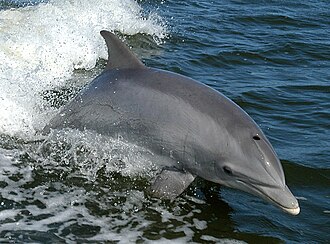
Bottlenose dolphin
Tursiops truncatus
IUCN status: LC · Least Concern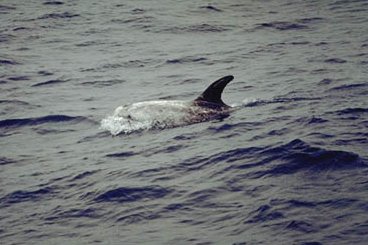
Gray grampus
Grampus griseus
IUCN status: LC · Least Concern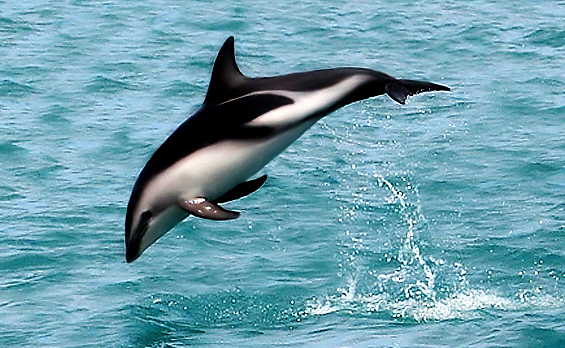
Dusky dolphin
Lagenorhynchus obscurus
IUCN status: LC · Least Concern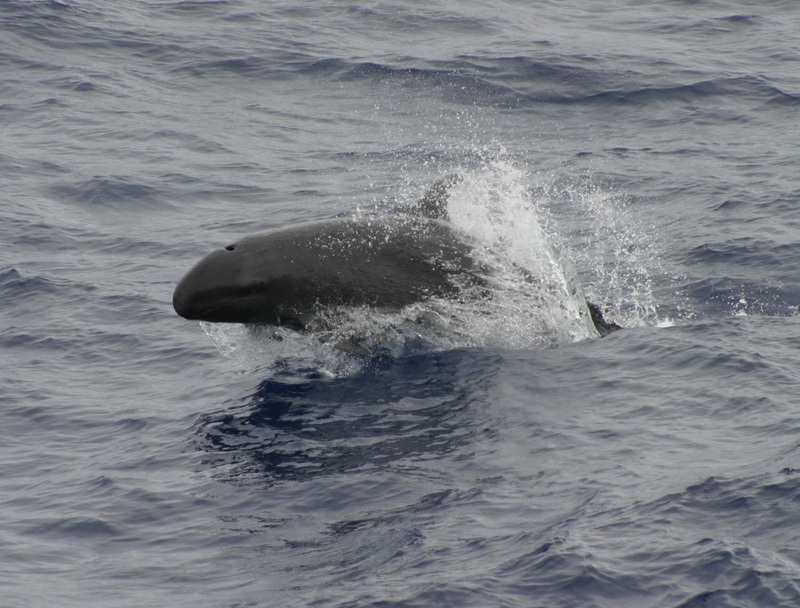
False killer whale
Pseudorca crassidens
IUCN status: NT · Near Threatened
Blackfish
Globicephala macrorhynchus
IUCN status: LC · Least Concern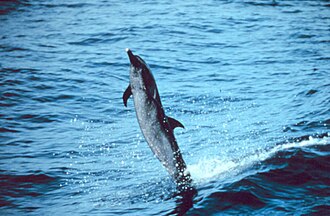
Narrow-snouted dolphin
Stenella attenuata
IUCN status: LC · Least Concern
Slender blackfish
Feresa attenuata
IUCN status: LC · Least Concern
Names and sources
In Spanish
- Delfín común de hocico largo — Peru; SERNANP (2026). Plan Maestro de la Reserva Nacional Mar Tropical de Grau 2026–2031. RPE N.° 000052-2026-SERNANP, p. 29 of the PDF · main name
- Delfín común — WoRMS
- Delfín común de hocico corto — Peru; SERNANP (2025). Plan Maestro de la Reserva Nacional San Fernando 2025-2030. RPE N.° 000167-2025-SERNANP/PE, p. 27 of the PDF
- Delfín común de rostro corto — WoRMS
- Delfín común oceánico — Wikidata
- Delfin panza blanca — WoRMS
- Delfin rayado — WoRMS
- Delfin tollino — WoRMS
- Tonino de mar — WoRMS
In English
- Short-beaked common dolphin — WoRMS; Wikidata
- Common dolphin — WoRMS
- Saddle-backed dolphin — WoRMS
- Sea porpoise — WoRMS
- Short-beaked saddle-backed dolphin — WoRMS
- Short-beaked saddleback dolphin — WoRMS
Classification
Learn more
Conservation status: Least Concern (IUCN Red List, according to Wikidata). Taxonomy: PeRMS / WoRMS (CC BY 4.0).