
Sea snails · Calyptraeidae
Spiny cup-and-saucer
Crucibulum spinosum (G. B. Sowerby I, 1824)
- Peruvian Register of Marine Species
- Listed in PeRMS (IMARPE)
Species account
Summary
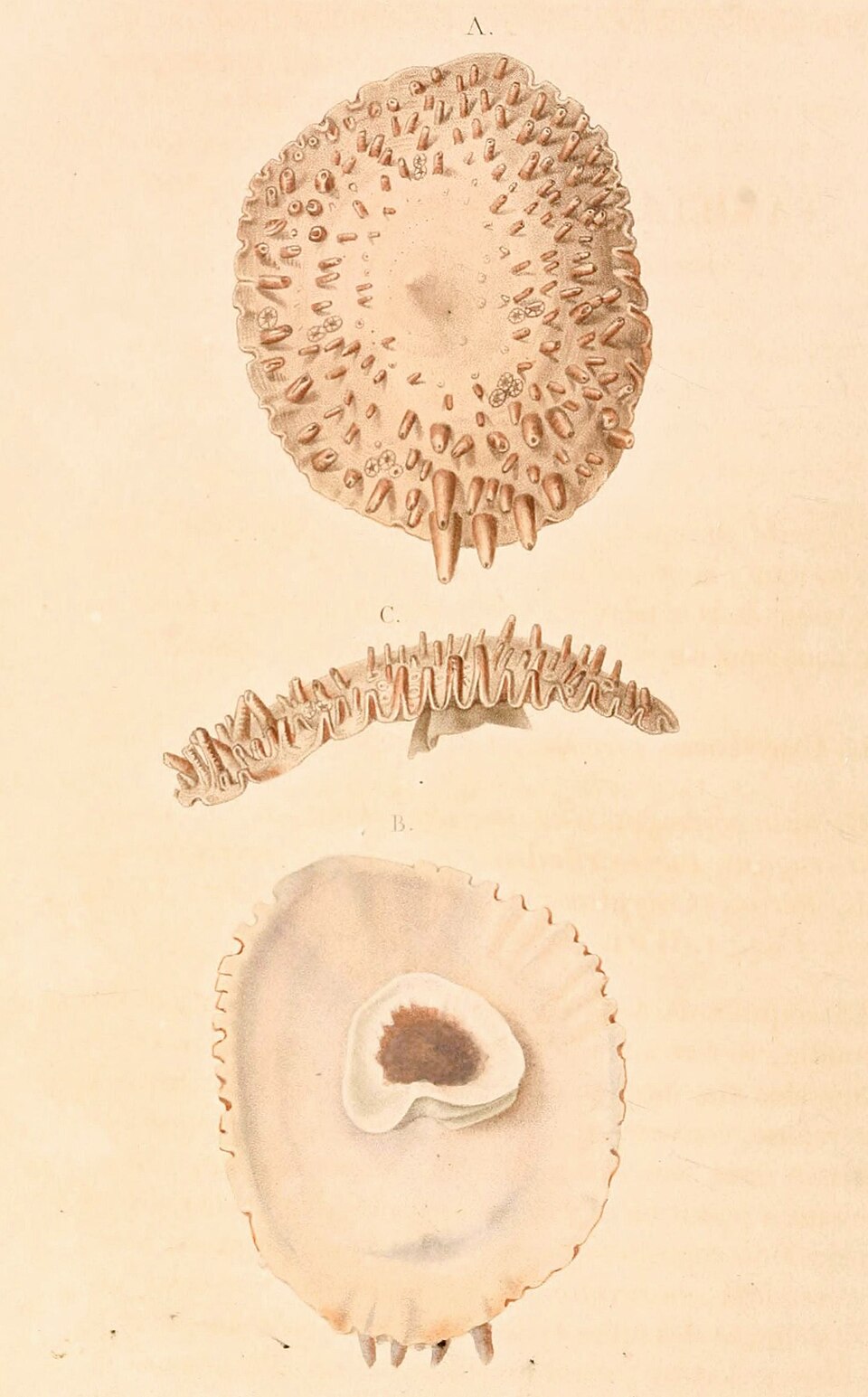
Crucibulum spinosum is a marine snail of the family Calyptraeidae whose low conical shell holds a cup-shaped septum inside [1]. It lives in the eastern Pacific from California to Central America, and in Peru it has been recorded in the infralittoral on sand and stone bottoms [2],[3].
A 1938 study of California animals found that it changes sex with age: young individuals work as males and later become females [4]. The name is now applied to all spiny eastern Pacific Crucibulum, a group that may hide several species [1].
Identification and similar species
The shell is a low cone with the apex set slightly back and its tip curved toward the right side [3]; the base is nearly circular [1]. Its sculpture is made of radial ribs from which tubular spines rise at intervals [3]; some shells are smooth in whole or in part [1]. The overall colour is yellowish brown with a white septum [3]; in the northeastern Pacific it is also described as brown, tan or white with darker radial rays [1].
The cup-shaped septum, attached at the centre of the shell and joined along the left side, is the mark of the genus Crucibulum; in the neighbouring genus Calyptraea the septum is an inclined ramp that traces a loose spiral [1]. The specimen illustrated in the Peruvian review measures 36.5 mm in diameter, and a maximum of 35 mm is given for the northeastern Pacific [3],[1].
Similar species
- Crucibulum scutellatum: Its low cone bears thick scaly radial ribs ending in heavy spines at the margin, and it can reach 67.0 mm [3].
- Crucibulum quiriquinae: It has an almost central apex and soft radial ribs that give the margin a crenulate look [3].
- Calyptraea mamillaris: It is smooth, with growth lines only, a central apex and a septum shaped like a spiral ramp [3].
Distribution and habitat
According to the world register of marine species, the species ranges from San Pedro, in Los Angeles County (California), to Central America, from the low intertidal down to 90 m, on clam shells and rubble in shallow bays [2],[1]. A review of the Peruvian Calyptraeidae lists it from Sinaloa (Mexico) to Santa María, in Lima, with records further south to Tomé, in Chile, which that review takes from earlier literature [3].
In Peru, the 2006 review examined 206 specimens of this species in 27 lots from collections of the Universidad Nacional Mayor de San Marcos, and describes its habitat as infralittoral sand and stones [3]. The same review confirmed 17 calyptraeid species on the Peruvian coast from 1237 specimens [3].
Biology
A 1938 study of California specimens presents it as a typical protandric hermaphrodite: the male phase is already functional when the animal is just 3 to 7 mm long, and the animal later turns female [4]. The earliest-maturing males tend to associate with older individuals in the female phase, while later-maturing ones tend to stay solitary; paired males keep the male phase longer than solitary ones [4]. According to the same work, unfavourable environmental conditions postpone or prevent functional sexuality [4].
The larvae are planktotrophic, meaning they feed in the plankton before settling, according to data compiled for several populations [5]. Hatching size was about 325 µm at Venado, Panama, 250 to 300 µm in southern California and 388 µm in a population from Santa María, in Lima, with females about 55 mm long, identified as cf. Crucibulum spinosum [5]. Because the name probably covers several tropical eastern Pacific species with different development, these figures do not necessarily describe a single species [1].
Where to see it in Peru
In Peru, the 2006 review recorded the species in Tumbes (Cancas and Bocapán), Piura (Máncora, Lobitos, Paita, Bayovar and Islas Lobos de Tierra), Áncash (Tortugas, Los Chimus, Samanco and Casma) and Ica (Laguna Grande, Lagunillas and Bahía Independencia) [3]. The review describes its habitat as infralittoral sand and stones, that is, below the tidal zone [3], without saying where it is easy to see [3].
References (5)
- Collin, R. (2019). Calyptraeidae from the northeast Pacific (Gastropoda: Caenogastropoda). Zoosymposia, 107-130. doi:10.11646/zoosymposia.13.1.12 (accessed 2026-10-25)
- WoRMS Editorial Board (2026). Crucibulum spinosum (G. B. Sowerby I, 1824). World Register of Marine Species. https://www.marinespecies.org/aphia.php?p=taxdetails&id=397064 (accessed 2026-10-25)
- Paredes, C., Cardoso, F. (2006). La Familia Calyptraeidae en el Perú (Gastropoda: Caenogastropoda). Revista Peruana de Biología, 177-184. doi:10.15381/rpb.v13i3.2335 (accessed 2026-10-25)
- Coe, W.R. (1938). Sexual phases in the gastropod Crucibulum spinosum. Journal of Morphology, 345-361. doi:10.1002/jmor.1050630209 (accessed 2026-10-25)
- Collin, R. (2003). Worldwide patterns in mode of development in calyptraeid gastropods. Marine Ecology Progress Series, 103-122. doi:10.3354/meps247103 (accessed 2026-10-25)
More pictures
Where it has been recorded
- Filled: scientific records, or confirmed by a curator
- Hatched: isolated record
- Dotted outline: no scientific records and no curator's confirmation (an ORKA sighting is not drawn here)
- Tropical northern sea
Scientific records (4 records)
- Tropical–cold transition zone
Scientific records (3 records)
- Cold central sea
Scientific records (1 record)
- Cold southern sea
Scientific records (2 records)
From openly licensed OBIS and GBIF records (CC0 or CC BY). How each list is built.
Related species
From the same genus (Crucibulum) and from the same family (Calyptraeidae).

Crucibulum scutellatum
IUCN status: Not evaluated
Crucibulum lignarium
IUCN status: Not evaluatedCrucibulum personatum
IUCN status: Not evaluatedCrucibulum monticulus
IUCN status: Not evaluatedCrucibulum pectinatum
IUCN status: Not evaluated
Crucibulum quiriquinae
IUCN status: Not evaluated
Bostrycapulus aculeatus
IUCN status: Not evaluatedBostrycapulus calyptraeiformis
IUCN status: Not evaluated
Names and sources
In English
- Spiny cup-and-saucer — WoRMS
Classification
Learn more
Conservation status: no data (IUCN). Taxonomy: PeRMS / WoRMS (CC BY 4.0).