
Bony fishes · Coryphaenidae
Mahi mahi
Coryphaena hippurus Linnaeus, 1758
Spanish: Perico
- Names in Peru
- Perico · Dorado
- Peruvian Register of Marine Species
- Listed in PeRMS (IMARPE)

Species account
Summary
The perico, also called dorado, is a fast-growing oceanic fish of tropical and subtropical waters worldwide [1],[1]. In Peru it occurs all along the coast from Paita to Ilo and reaches more than 200 nautical miles offshore; it is fished mostly in spring and summer, when subtropical surface waters move closer to the coast [2].
The IUCN places it in the global category of Least Concern [3]. In Peru it is caught with longlines in a seasonal artisanal fishery [2], and its catch is regulated with a total limit for each season: for the 2022-2023 season it was 44000 tonnes [4].
Identification and similar species
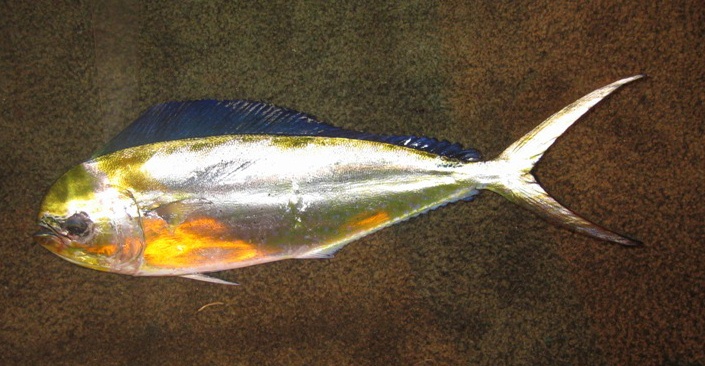
It is an elongate, compressed fish with small scales and a large mouth bearing many fine teeth. The dorsal fin is very long: it starts on the nape and runs almost to the tail, with 58 to 66 rays; the anal fin has 25 to 31 rays and is concave, and the tail fin is deeply forked [1].
Its colour in life is striking: golden on the flanks, metallic blue and green on the back and sides, and white or yellow below, with many small black spots on the head and body [1]. Adult males have a prominent bony crest on the forehead and a very steep head profile; in females the forehead slopes down more gently [1],[1].
Similar species
- Coryphaena equiselis: Its body is deeper (more than 25 % of standard length, against less than 25 % in Coryphaena hippurus), it has 52 to 59 dorsal rays, the anal fin is convex and it has 33 vertebrae instead of 31 [1].
Distribution and habitat
It is a fast-swimming, mainly oceanic fish found in tropical and subtropical waters worldwide. In the Atlantic it is generally held within the 20 °C isotherm [1].
In the eastern Pacific it ranges from San Diego, in California, to Antofagasta, in Chile. In Peru it occurs along the coast from Paita to Ilo and reaches distances of more than 200 nautical miles from shore [2].
In Peruvian waters its distribution and abundance depend on the arrival of subtropical surface waters, and it lives in warm waters of 21 to 30 °C [5]. It is most abundant at 22 to 24 °C; in warm conditions it comes closer to the coast (90 nautical miles on average) and in cold conditions it stays farther out (150 nautical miles on average) [2].
Biology
It grows very fast and lives a short time: its maximum lifespan is estimated at about 4 years [1]. Off southern Florida, 1-year-old fish measured between 475 and 1175 mm fork length, with a mean of 725 mm [1].
It reaches sexual maturity in its first year of life; in the Straits of Florida females began to mature at about 350 mm fork length and all were mature at 550 mm [1]. It has a long spawning season and may spawn several times [1].
Juveniles are rare in the scientific literature and no nursery areas had been described off Peru. On 8 February 2017, during the coastal El Niño summer, an artisanal boat caught a juvenile of 18.3 cm total length and 40.6 g at 34 miles off Punta de Bombón, in Arequipa, a finding the authors interpret as a sign that the species spawns and rears young off this coast [5].
Ecology
It is a voracious carnivorous predator that swallows even large flying fishes whole [1]. In the central Pacific flying fishes were the most numerous food item and the largest by volume in its stomachs, and gempylids and penaeid shrimps also appeared [1].
It associates with floating objects such as logs, rafts and drifting weed, and adults rub against the bottom of rafts and boats, perhaps to rid themselves of parasites or to ease skin irritation [1]. In Peruvian waters it is also a biological indicator of oceanic water masses, and it was highly abundant along the coast during the El Niño events of 1972-1973 and 1982-1983 [5].
Conservation
The IUCN places it in the global category of Least Concern [3].
In Peru its catch is regulated by the fisheries management regulation for the perico, which requires a total maximum catch limit to be set for each season. For 2022-2023 the limit was 44000 tonnes, between 1 October 2022 and 30 April 2023; IMARPE stated that its preliminary assessment placed the biomass near the level of maximum sustainable yield and that it should be updated with more complete models [4].
In the exploratory fishing of September 2023 the perico made up more than 98 % of the catch and sharks 2 %, among them Prionace glauca and Isurus oxyrinchus; on 15 trips 28 turtles, two of them leatherbacks, and 1 albatross were caught incidentally, and according to the fishers all were released alive [2].
Health, toxicological and chemical relevance
Not medical advice. For a sting, a poisoning or an allergy, seek medical care.
The perico is not a scombrid, but it is among the non-scombrid fish implicated in histamine fish poisoning, which occurs when the histidine naturally present in the flesh is converted to histamine by spoilage bacteria after poor handling [6].
In Australia, between 2001 and 2013, 57 outbreaks of this kind were recorded, with 187 people ill; dolphinfish (mahi-mahi) was the second most frequently identified fish, with 8 outbreaks (14 %), after tuna. The most common symptoms were diarrhoea (78 %) and rash (77 %); 14 % of those affected were hospitalised and there were no deaths [6].
Human relevance
In Peru the perico is the focus of a seasonal artisanal longline fishery. It is most accessible in spring and summer, when subtropical surface waters approach the coast, and in that period it makes up more than 90 % of the volumes landed by artisanal fishing [2].
In the exploratory fishing of September 2023, 2332 tonnes were landed by 234 artisanal longline vessels on 238 trips; each trip lasted 15 days on average and yielded about 10 tonnes, and Paita received 72 % of the total, followed by Chimbote with 16 % [2]. The authors of a study of a juvenile also note the importance of this resource's fishery in Peru [5].
Where to see it in Peru
The data available here come from fishing, not from diving. In September 2023 the fishing grounds ran from Talara to Chancay, between 30 and 400 nautical miles from the coast, with the largest catches in the north, from Talara to Pimentel, beyond 100 miles [2].
It is a spring and summer species, when subtropical surface waters approach the coast [2].
References (6)
- Palko, B.J., Beardsley, G.L., Richards, W.J. (1982). Synopsis of the biological data on dolphin-fishes, Coryphaena hippurus Linnaeus and Coryphaena equiselis Linnaeus. NOAA Technical Report NMFS Circular 443 (FAO Fisheries Synopsis No. 130). https://repository.library.noaa.gov/view/noaa/5470 (accessed 2026-10-25)
- Instituto del Mar del Perú (IMARPE) (2023). Informe sobre la pesca exploratoria del recurso perico (Coryphaena hippurus) del 01 al 30 de setiembre del 2023. Informe IMARPE, anexo al Oficio 1426-2023-IMARPE/PCD. https://cdn.www.gob.pe/uploads/document/file/5491899/4896931-anexo-of-1426-2023-imarpe-pcd-informe-de-la-pesca-exploratoria-de-perico-21-11-23-r.pdf (accessed 2026-10-25)
- Collette, B., Acero, A., Amorim, A.F. (2010). Coryphaena hippurus: Collette, B., Acero, A., Amorim, A.F., Boustany, A., Canales Ramirez, C., Cardenas, G., Carpenter, K.E., de Oliveira Leite Jr., N., Di Natale, A., Fox, W., Fredou, F.L., Graves, J., Viera Hazin, F.H., Juan Jorda, M., Minte Vera, C., Miyabe, N., Montano Cruz, R., Nelson, R., Oxenford, H., Schaefer, K., Serra, R., Sun, C., Teixeira Lessa, R.P., Pires Ferreira Travassos, P.E., Uozumi, Y. & Yanez, E. The IUCN Red List of Threatened Species. doi:10.2305/IUCN.UK.2011-2.RLTS.T154712A4614989.en (accessed 2026-10-25)
- Ministerio de la Producción (2022). Resolución Ministerial N° 00334-2022-PRODUCE: Establecen límite máximo total de captura del recurso perico (Coryphaena hippurus) para la temporada 2022-2023. El Peruano, 8 October 2022. https://busquedas.elperuano.pe/dispositivo/NL/2113520-1 (accessed 2026-10-25)
- Campos, S., Barriga, E., Chambilla, J. et al. (2022). Presencia de juvenil de perico Coryphaena hippurus Linnaeus, 1758 frente a la costa sur de Perú durante El Niño Costero 2017. Boletín del Instituto del Mar del Perú, 541-546. doi:10.53554/boletin.v36i2.353 (accessed 2026-10-25)
- Knope, K.E., Sloan-Gardner, T.S., Stafford, R.J. (2014). Histamine fish poisoning in Australia, 2001 to 2013. Communicable Diseases Intelligence. doi:10.33321/cdi.2014.38.47 (accessed 2026-10-25)
More pictures
Where it has been recorded
- Filled: scientific records, or confirmed by a curator
- Hatched: isolated record
- Dotted outline: no scientific records and no curator's confirmation (an ORKA sighting is not drawn here)
- Tropical northern sea
Scientific records (1 record)
- Tropical–cold transition zone
Scientific records (1 record)
- Cold central sea
Scientific records (13 records)
- Cold southern sea
Scientific records (2 records)
From openly licensed OBIS and GBIF records (CC0 or CC BY). How each list is built.
Related species
From the same genus (Coryphaena).
Names and sources
In Spanish
- Perico — Peru; SERNANP (2024). Plan Maestro de la Reserva Nacional Dorsal de Nasca 2024-2029. RP N.° 000040-2024-SERNANP, p. 19 of the PDF; fishbase; Wikidata · main name
- Dorado — Peru; fishbase; Wikidata; WoRMS
- Dorado commún — WoRMS
- Dorado Común — Wikidata
- Dorado Delfin — Wikidata
- Lampuga — Wikidata; WoRMS
- Llampuga — Wikidata
In English
- Mahi mahi — WoRMS; Wikidata
- Common Dolphin Fish — Wikidata; WoRMS
- Common Dolphinfish — Wikidata; WoRMS
- Dolphin — WoRMS
- Dolphin Fish — Wikidata
- Dolphinfish — Wikidata; WoRMS
- Dorado — Wikidata
- Green Dolphin — Wikidata
Classification
Learn more
Conservation status: Least Concern (IUCN Red List, according to Wikidata). Taxonomy: PeRMS / WoRMS (CC BY 4.0).