
Sea snails · Conidae
Conus fergusoni
Conus fergusoni G. B. Sowerby II, 1873
- Peruvian Register of Marine Species
- Listed in PeRMS (IMARPE)

Species account
Summary
Conus fergusoni is a cone snail of the tropical eastern Pacific, a member of the family Conidae [1]. It is the largest Conus species of that region: the shell reaches about 153 mm in length [2]. It ranges from the Gulf of California to Peru, and within Peru it has been recorded in Tumbes and Piura [3].
Etymology
Sowerby described the species in 1873 from several specimens collected at Panama by a Mr Ferguson [4].
An earlier name, Conus fulvocinctus Crosse, 1872, attributed to West Africa, turned out to be based on a specimen of this same species, so in 1979 a request was made to keep the name fergusoni because of its general use [4].
Identification and similar species
The shell is heavy, with a low spire and a body whorl with keeled shoulders; it is white, some specimens carrying two yellowish bands around the base, and the periostracum is velvety and brown. One Peruvian specimen measured 142.6 mm in length and 82.4 mm in diameter [3].
Young shells are yellow-orange with rows of dark brown spots, and fade to white as they grow. The coronations on the shoulder persist through at least the eighth whorl, and the periostracum is thin and pale in small shells and thick and dark brown in large ones [2].
Similar species
- Conus xanthicus: Immature Conus fergusoni have prominent coronations on the early whorls, which mature Conus xanthicus lack; the suture lies at the shoulder rather than below it, and the two species are also separable by their radula [2].
Distribution and habitat
The species lives from the Gulf of California in Mexico to Peru, and also in the Galapagos Islands; the southernmost record McLean and Nybakken give is Isla Lobos de Afuera [2].
In Peru it is known from Tumbes (Cancas) and from Piura (Los Órganos, Sechura, Parachique, Las Delicias and off Lobos de Tierra) [3].
It occupies sandy and muddy infralittoral bottoms, between 4.6 and 152.4 m depth according to the literature compiled for Peru [3].
Biology
The radular teeth of adults are long, with serrations along half their length, two barbs, no blade or waist, and an enlarged base bearing a spur [2].
The tooth of the smallest specimen examined, 26.1 mm long, is proportionally shorter and has the second barb undeveloped, so the radula changes with growth. The operculum is bluntly unguiculate and about 4 times longer than wide [2].
For the genus, the literature notes that cones hunt with a toxoglossan radula whose teeth serve as harpoons to paralyse prey [3].
Ecology
The species is uncommon in the Galapagos Islands and in the central part of its range, where it is mostly known from dredging [2].
McLean observed it on shallow rocky bottoms, but it is not restricted to that substrate: he found large numbers on soft bottoms of the shrimp fishing ground in the Gulf of Guayaquil, off the far north of Peru [2].
In Peru, 14 specimens collected in 7 lots came from sandy bottom at 3–10 m depth [3].
Conservation
The IUCN classifies it globally as Least Concern in its current assessment [5].
Health, toxicological and chemical relevance
Not medical advice. For a sting, a poisoning or an allergy, seek medical care.
Cones fire venom through a single harpoon-like radular tooth, and the Peruvian literature warns that live cone snails of any kind must be handled by hand with great care [3].
Where to see it in Peru
A study published in 2010 lists the species from localities in Tumbes and Piura, among them Los Órganos, and the material examined came from sandy bottom at 3–10 m depth [3].
References (5)
- WoRMS Editorial Board (2026). Conus fergusoni G. B. Sowerby II, 1873. World Register of Marine Species. https://www.marinespecies.org/aphia.php?p=taxdetails&id=426496 (accessed 2026-10-25)
- McLean, J.H., Nybakken, J. (1979). On the growth stages of Conus fergusoni Sowerby, 1873, the reinstatement of Conus xanthicus Dall, 1910, and a new species of Conus from the Galapagos Islands. The Veliger 22(2), 135-144. https://archive.org/details/biostor-133088 (accessed 2026-10-25)
- Paredes, C., Cardoso, F., Altamirano, K. et al. (2011). La familia Conidae en el mar peruano. Revista Peruana de Biología 17(1), 65-73. doi:10.15381/rpb.v17i1.53 (accessed 2026-10-25)
- Tucker, J.K. (1979). Request for the conservation of Conus fergusoni G.B. Sowerby III, 1873, under the plenary powers (Gastropoda: Conidae) Z.n.(S.) 2239. Bulletin of Zoological Nomenclature 35(3), 189-191. doi:10.5962/bhl.part.14626 (accessed 2026-10-25)
- Lorenz, F., Morrison, H. (2023). Conus fergusoni: Lorenz, F. & Morrison, H. The IUCN Red List of Threatened Species 2026-1: e.T192566A250991967. doi:10.2305/IUCN.UK.2026-1.RLTS.T192566A250991967.en (accessed 2026-10-25)
More pictures
Where it has been recorded
- Filled: scientific records, or confirmed by a curator
- Hatched: isolated record
- Dotted outline: no scientific records and no curator's confirmation (an ORKA sighting is not drawn here)
- Tropical northern sea
Scientific records (1 record)
- Cold central sea
Scientific records (4 records)
From openly licensed OBIS and GBIF records (CC0 or CC BY). How each list is built.
Related species
From the same genus (Conus).

Conus gladiator
IUCN status: LC · Least Concern
Pear cone
Conus patricius
IUCN status: LC · Least Concern
Prince cone
Conus princeps
IUCN status: LC · Least Concern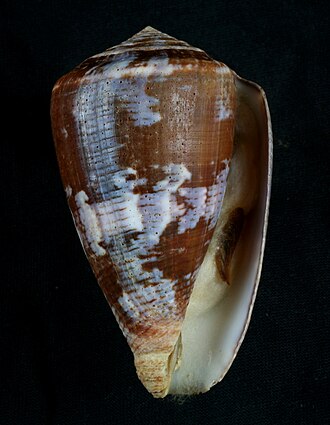
Purple cone
Conus purpurascens
IUCN status: LC · Least Concern
Conus virgatus
IUCN status: LC · Least Concern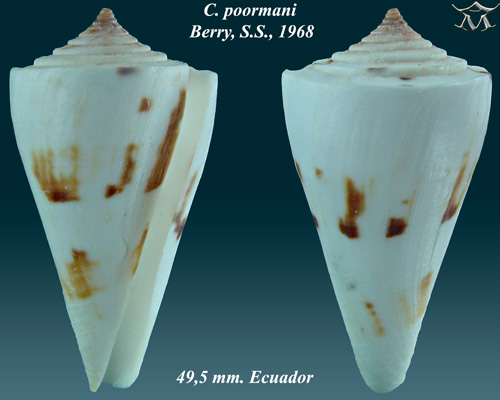
Conus poormani
IUCN status: LC · Least Concern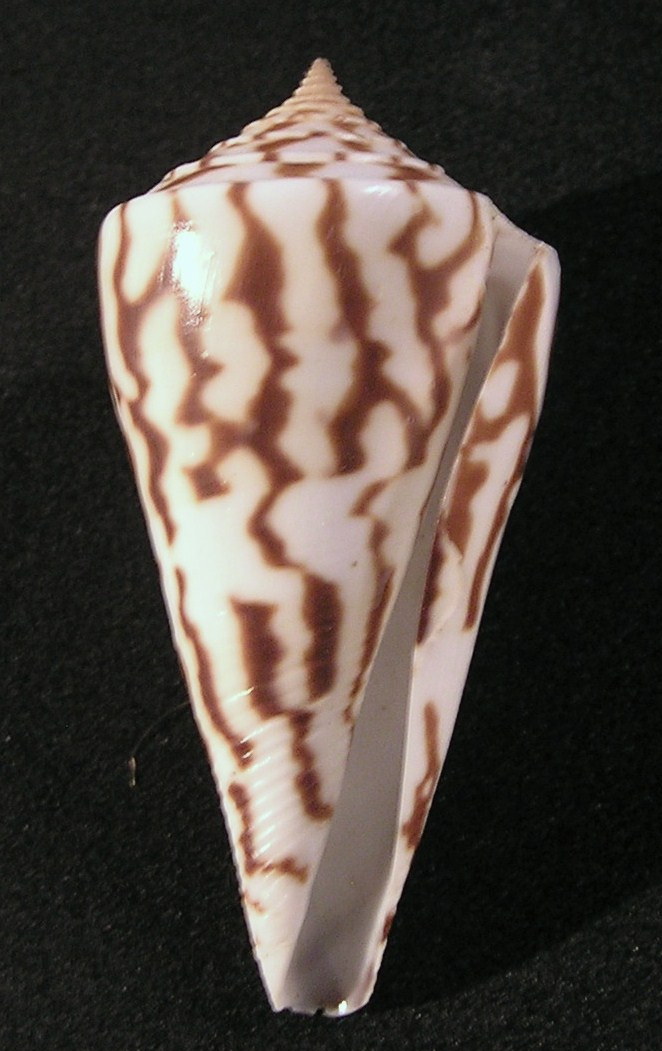
Conus recurvus
IUCN status: Not evaluated
Conus regularis
IUCN status: LC · Least Concern
Names and sources
Classification
Learn more
Conservation status: Least Concern (IUCN Red List, according to Wikidata). Taxonomy: PeRMS / WoRMS (CC BY 4.0).