
Bony fishes · Pomacentridae
Valparaiso chromis
Chromis crusma (Valenciennes, 1833)
Spanish: Castañeta
- Names in Peru
- Castañeta · Castañuela · Castañuela común · Chavela
- Peruvian Register of Marine Species
- Listed in PeRMS (IMARPE)
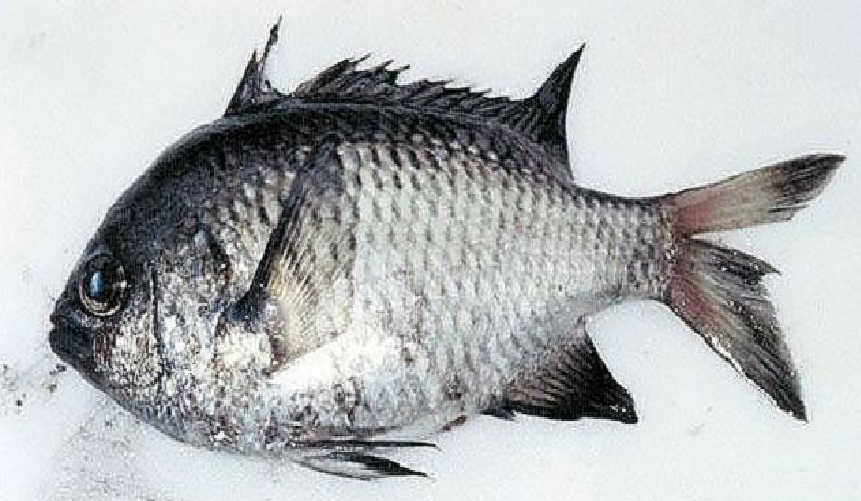
Species account
Summary
Chromis crusma is a rocky-reef fish of the family Pomacentridae that lives in the southeastern Pacific, from Cabo Blanco, in Peru, to Talcahuano, in Chile [1], and as far as Valdivia according to a 2005 finding [2]. Males build nests on the bottom and guard the eggs alone, and eggs kept in the laboratory at 18 °C hatched after 7 to 8 days [3]. Its global category on the IUCN Red List is Least Concern [4].
Etymology
Valenciennes described it in 1833 as Heliases crusma, and the name accepted today is Chromis crusma; its synonyms include Chromis cupreus, by Fowler and Bean (1923) [5]. The original description is in volume 9 of the Histoire naturelle des poissons [2], and the genus Chromis is by Cuvier, 1814 [2]. The genus name starts from the Greek chromis, which named a fish, perhaps a perch [1].
Identification and similar species
It is a deep-bodied damselfish: in 5 specimens from Valdivia, 168 to 190 mm in standard length, maximum body depth was between 52.7 and 56.8 % of that length and the head between 28.4 and 32.1 % [2]. In those specimens the first dorsal fin had the formula XII-XIII + 11-12, the pectoral fin 19 to 20 rays and the anal fin II + 11 [2].
In the key by the authors of the Valdivia finding, the species is told apart from the other Chromis of Chilean waters by having 19 or more tubular scales in the lateral line and 3 exposed caudal procurrent rays [2]. Adults can reach 25 cm in total length, and the males guarding a nest were dark grey, unlike the pelagic individuals and other visitors to the bottom, which were pale grey [3].
Similar species
- Chromis intercrusma: Chromis intercrusma has XII dorsal spines and 13 to 14 anal rays, and is also recorded from Cabo Blanco, in Peru, to Tarapacá, in Chile [2].
- Chromis meridiana: Chromis meridiana has 16 to 18 tubular scales in the lateral line and 2 exposed caudal procurrent rays, and lives on the Desventuradas Islands and the Juan Fernández archipelago, not on the mainland coast [2].
Distribution and habitat
It lives in the southeastern Pacific. FishBase gives its range as Cabo Blanco, in Peru, to Talcahuano, in Chile [1]. In 2005, 6 specimens were found on the coast of Valdivia, at about 39°S, a southern limit some 500 km farther south than the one accepted until then [2]. The same authors recall a record placing it from Santa Rosa Island, in Ecuador, and consider it possible that the Juan Fernández record is an error, because in about ten expeditions to that archipelago not a single specimen was obtained [2].
Adults live on rocky reefs [1]. On the central Chilean coast they are found on rock outcrops between 5 and 35 m deep and on reefs dominated by large brown macroalgae, such as Lessonia trabeculata, where they recruit; they are often seen in schools of up to 100 individuals [3].
Biology
At Zapallar, Valparaíso, at about 32°S, in 2011-2012 reproductive behaviour began in late October and ended in March, in the austral spring and summer. More than 80 nests were observed and 39 were measured, with a mean diameter of 23.5 cm; the 6 adults taken from the nests were all males, and only the male builds the nest and cares for the clutch [3].
Males spent between 80 % and 95 % of their time inside the nest. There, fanning the eggs was the most frequent activity, at 78 % to 94 % of the time, from recordings of 8 nests, and defending the nest was second, at 7 % to 15 %; they also removed debris and dead eggs and lifted eggs in the mouth to aerate them [3]. The nests with the most egg cover were those with few benthic species, and the substrate of defended nests was dominated by filamentous green or red algae or by crustose algae [3].
The eggs are demersal and oval, 0.96 to 1.20 mm along the long axis, with a single reddish to yellow oil globule and adhesive filaments that fix them to the nest. In the laboratory, at 18 °C, development took 7 to 8 days, and newly hatched larvae measured between 2.85 and 3.67 mm; the yolk sac was used up by about 2 days and the oil globule was fully absorbed by 7 days [3].
Ecology
Its diet is made up mainly of planktonic species, according to a source cited by studies of Chilean reefs [3]. Pequeño and colleagues cite a study on the northern Chilean coast (a subtidal Lessonia trabeculata forest) in which the species used a microhabitat differently from other fishes, among them Pinguipes chilensis and Aplodactylus punctatus [2].
During brood care, the male drives predators and competitors from the nest with exaggerated swims and fast chases and by displaying the dorsal and pectoral fins; the predators named are Pinguipes chilensis, the triplefins of the genus Helcogrammoides and the shrimp Rhynchocinetes typus [3].
Conservation
Its global category on the IUCN Red List is Least Concern, assessed on 27 May 2007 [4].
In 2005 it was noted that very little is known of its biology and biogeography even though it is common on the central and northern coast of Chile [2]. A 2014 study describes it as an abundant fish in the kelp ecosystems of the southeastern Pacific [3].
Where to see it in Peru
The species' northernmost records reach Cabo Blanco, in Peru, according to the key published in 2005 [2]. That source does not describe the Peruvian places where it is seen. The data on habitat and depth, 5 to 35 m on rock outcrops and reefs dominated by large brown algae, come from a study made on the central Chilean coast [3].
References (5)
- Froese, R., Pauly, D. (2026). Chromis crusma (Valenciennes, 1833). FishBase. https://www.fishbase.se/summary/Chromis-crusma.html (accessed 2026-10-25)
- Pequeño, G., Vargas, L., Riedemann, A. (2005). La castañeta Chromis crusma (Valenciennes, 1833) en la costa de Valdivia, con comentarios sobre el género Chromis Cuvier, 1814, en aguas chilenas (Osteichthyes: Pomacentridae). Investigaciones Marinas, 101-107. doi:10.4067/s0717-71782005000100007 (accessed 2026-10-25)
- Navarrete-Fernández, T., Landaeta, M.F., Bustos, C.A. et al. (2014). Nest building and description of parental care behavior in a temperate reef fish, Chromis crusma (Pisces: Pomacentridae). Revista Chilena de Historia Natural, 30. doi:10.1186/s40693-014-0030-2 (accessed 2026-10-25)
- Allen, G., Robertson, R. (2007). Chromis crusma: Allen, G. & Robertson, R. The IUCN Red List of Threatened Species 2010: e.T183240A8078672. doi:10.2305/IUCN.UK.2010-3.RLTS.T183240A8078672.en (accessed 2026-10-25)
- WoRMS Editorial Board (2026). Chromis crusma (Valenciennes, 1833). World Register of Marine Species. https://www.marinespecies.org/aphia.php?p=taxdetails&id=273717 (accessed 2026-10-25)
More pictures
Where it has been recorded
- Filled: scientific records, or confirmed by a curator
- Hatched: isolated record
- Dotted outline: no scientific records and no curator's confirmation (an ORKA sighting is not drawn here)
- Tropical northern sea
Scientific records (2 records)
- Tropical–cold transition zone
Scientific records (1 record)
- Cold central sea
Scientific records (13 records)
- Cold southern sea
Scientific records (5 records)
From openly licensed OBIS and GBIF records (CC0 or CC BY). How each list is built.
Related species
From the same genus (Chromis) and from the same family (Pomacentridae).
Silverstripe chromis
Chromis alta
IUCN status: LC · Least ConcernAzurina atrilobata
IUCN status: Not evaluatedAzurina intercrusma
IUCN status: Not evaluated
Southern whitetail major
Stegastes beebei
IUCN status: LC · Least Concern
Dusky seargent
Abudefduf concolor
IUCN status: LC · Least Concern
Panamic sergeant major
Abudefduf troschelii
IUCN status: LC · Least Concern
Coquito damsel
Nexilosus latifrons
IUCN status: LC · Least Concern
Acapulco damselfish
Stegastes acapulcoensis
IUCN status: LC · Least Concern
Names and sources
In Spanish
- Castañeta — Peru; fishbase; Wikidata · main name
- Castañuela — Peru; fishbase
- Castañuela común — Peru; fishbase
- Chavela — Peru; fishbase
In English
- Valparaiso chromis — Wikidata
Classification
Learn more
Conservation status: Least Concern (IUCN Red List, according to Wikidata). Taxonomy: PeRMS / WoRMS (CC BY 4.0).