
Bony fishes · Carangidae
Pacific bumper
Chloroscombrus orqueta Jordan & Gilbert, 1883
Spanish: Pardo
- Names in Peru
- Pardo · Chuyes · Citarita · Parvo · Riki-riki
- ORKA's verified sightings
- 1 · last February 16, 2024
- Peruvian Register of Marine Species
- Listed in PeRMS (IMARPE)

Species account
Summary
Chloroscombrus orqueta is a fish of the family Carangidae, described in 1883 from specimens collected in Panama [1],[2]. It is a small fish with an oval, strongly compressed body that schools in coastal waters of the eastern Pacific, from southern California to Peru [3]. Its juveniles have been found beside jellyfish, and the species turns up in the bycatch of shrimp trawling [4],[5]. Its global category on the IUCN Red List is Least Concern [6].
Etymology
Jordan and Gilbert described the species in 1883 from specimens gathered by Gilbert in Panama, and the name orqueta is the one the local fishermen there used for the fish [1]. The authors treated it as the Pacific counterpart of Chloroscombrus chrysurus, the Atlantic species of the same genus [1]. For Peru, FishBase records the names «pardo», «chuyes», «citarita» and «parvo» [3].
Identification and similar species
The body is oval and strongly compressed, with sharp edges; the belly profile curves more than the back, the head is small and somewhat pointed, and the mouth is small and very oblique, with a projecting lower jaw [1]. The head is almost naked and the body bears well-developed scales; the jaw teeth are very small, and the caudal fin is widely forked, with the upper lobe slightly longer than the lower [1].
In life the back is green with blue reflections and the sides and belly are silvery white; there is a black blotch on the upper angle of the gill cover and another, square one on the back of the tail, over the bases of the upper caudal rays [1]. The fins are yellowish, with the dorsal and anal edged in black and the tip of the upper caudal lobe black [1]. According to FishBase it reaches 30 cm total length, though 18 cm is usual [3].
Similar species
- Chloroscombrus chrysurus: According to the authors, Chloroscombrus chrysurus, of the Atlantic, has essentially the same proportions, fin rays and colouring (that of Chloroscombrus orqueta is somewhat darker), but it is told apart by a much shorter curve of the lateral line and by lacking the marked armature of the tail stalk: Chloroscombrus orqueta has a distinct keel with enlarged, bony lateral-line scales, whereas in the other they differ little from the rest [1].
Distribution and habitat
It lives in the eastern Pacific, from San Pedro, in southern California, to Peru, including the Gulf of California [3]. A study of shrimp bycatch lists it with an affinity from the San Diego to the Panamic province [5], and defines the latter as extending south from El Salvador to around Cabo Blanco, in northern Peru [5].
FishBase describes it as a fish of marine and brackish water whose adults school in coastal waters, including mangrove lagoons [3]. In the Gulf of California it was recorded in the 2004-2005 shrimp-fishing season, in sampling done between 4 and 137 m depth on the shelf of Sonora, Sinaloa and Nayarit [5].
Biology
In Bahía de La Paz, between 2008 and 2011, 71 specimens of this species were collected; the largest measured 60 mm total length and the smallest fish of the three species in the study 8 to 10 mm, and they were post-flexion larvae and early juveniles [4]. The authors cite that fish associated with floating objects are mostly juveniles and that, beside jellyfish, they may gain protection from predators and access to planktonic food [4].
According to FishBase, the estimated trophic level is 2.5, based on diet studies, and the species makes grunting sounds when caught [3].
Ecology
In Bahía de La Paz, in the Gulf of California, this species was the most abundant of the 3 carangids that came up incidentally with the cannonball jellyfish Stomolophus meleagris: 71 of the 96 fish, or 74 % [4]. It was found in 2009, 2010 and 2011, and the authors note that it was present in different seasons and years [4].
The authors state that the reproductive cycle of this species and of Caranx caballus has been reported over most of the year, so larvae and juveniles can be present almost year-round, and that their abundance could depend on other factors such as plankton biomass [4]. In shrimp trawling in the Gulf of California it was classed as an abundant species, meaning a relative abundance above 1 % of the individuals sampled [5].
Conservation
Human relevance
References (6)
- Jordan, D.S., Gilbert, C.H. (1883). Description of two new species of fishes (Myrophis vafer and Chloroscombrus orgueta) from Panama. Proceedings of the United States National Museum, 645-647. doi:10.5479/si.00963801.5-334.645 (accessed 2026-10-25)
- WoRMS Editorial Board (2026). Chloroscombrus orqueta Jordan & Gilbert, 1883. World Register of Marine Species. https://www.marinespecies.org/aphia.php?p=taxdetails&id=276245 (accessed 2026-10-25)
- Froese, R., Pauly, D. (2026). Chloroscombrus orqueta Jordan & Gilbert, 1883: Pacific bumper. FishBase. https://www.fishbase.se/summary/SpeciesSummary.php?id=1937 (accessed 2026-10-25)
- Reza, M., Ocampo, L., Campos-Dávila, L. (2019). Association of three Carangidae juvenile fishes with cannonball jellyfish Stomolophus meleagris in Bahía de La Paz, Gulf of California. Revista de Biología Marina y Oceanografía, 387-391. doi:10.22370/rbmo.2018.53.3.1362 (accessed 2026-10-25)
- López-Martínez, J., Herrera-Valdivia, E., Rodríguez-Romero, J. et al. (2009). Peces de la fauna de acompañamiento en la pesca industrial de camarón en el Golfo de California, México. Revista de Biología Tropical, 925-942. doi:10.15517/rbt.v58i2.5255 (accessed 2026-10-25)
- Smith-Vaniz, B., Robertson, R., Dominici-Arosemena, A. et al. (2008). Chloroscombrus orqueta: Smith-Vaniz, B, Robertson, R., Dominici-Arosemena, A. & Molina, H. The IUCN Red List of Threatened Species 2010: e.T183872A8192316. doi:10.2305/IUCN.UK.2010-3.RLTS.T183872A8192316.en (accessed 2026-10-25)
More pictures
At ORKA's dive sites
- Muelle de Los Órganos
Seen by ORKA on verified outings (1)
Where it has been recorded
- Filled: scientific records, or confirmed by a curator
- Hatched: isolated record
- Dotted outline: no scientific records and no curator's confirmation (an ORKA sighting is not drawn here)
- Tropical northern sea
Scientific records (6 records)
- Tropical–cold transition zone
Scientific records (8 records)
- Cold central sea
Scientific records (3 records)
- Cold southern sea
Scientific records (4 records)
From openly licensed OBIS and GBIF records (CC0 or CC BY). How each list is built.
Related species
From the same family.
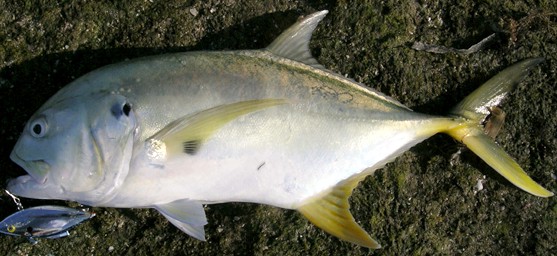
Pacific crevalle jack
Caranx caninus
IUCN status: LC · Least Concern
Jack
Caranx hippos
IUCN status: LC · Least Concern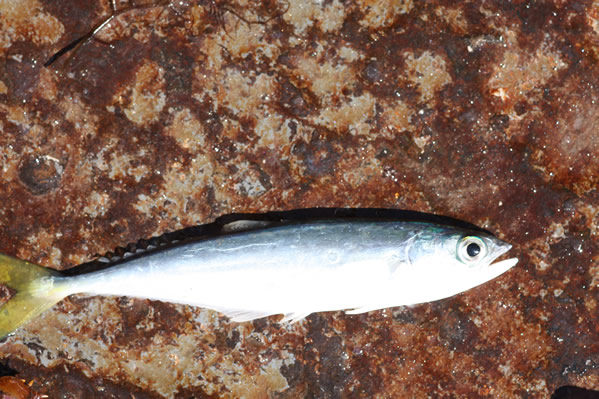
Shortjaw leatherjack
Oligoplites refulgens
IUCN status: LC · Least Concern
Bigeye scad
Selar crumenophthalmus
IUCN status: LC · Least Concern
Pacific moonfish
Selene peruviana
IUCN status: LC · Least Concern
Paloma pompano
Trachinotus paitensis
IUCN status: LC · Least Concern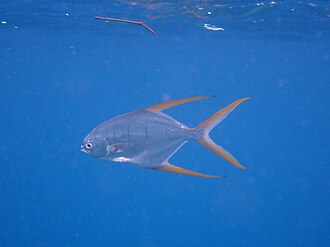
Gafftopsail pompano
Trachinotus rhodopus
IUCN status: LC · Least Concern
Threadfin Jack
Carangoides otrynter
IUCN status: LC · Least Concern
Names and sources
In Spanish
- Pardo — Peru; fishbase; Wikidata · main name
- Abundancia — Wikidata
- Anchoveta — Wikidata
- Casabe — Wikidata
- Casabe orqueta — Wikidata
- Celosa — Wikidata
- Chicharra — Wikidata
- Chuyes — Peru; fishbase; Wikidata
- Citarita — Peru; fishbase; Wikidata
- Cucharita — Wikidata
- Hojita — Wikidata
- Horqueta del Pacífico — Wikidata; WoRMS
- Horqueta or Orqueta — Wikidata
- Jurel — Wikidata
- Jurel de Castilla — Wikidata
- Jurel Orqueta — Wikidata
- Monda — Wikidata
- Orqueta — Wikidata
- Parvo — Peru; fishbase; Wikidata
- Peplillis — Wikidata
- Riki-riki — Peru; fishbase; Wikidata
In English
- Pacific bumper — WoRMS; Wikidata
- Bumper — Wikidata
Classification
Learn more
Conservation status: Least Concern (IUCN Red List, according to Wikidata). Taxonomy: PeRMS / WoRMS (CC BY 4.0).