
Chitons and other molluscs · Chitonidae
Chiton cumingsii
Chiton cumingsii Frembly, 1827
- Peruvian Register of Marine Species
- Listed in PeRMS (IMARPE)
Species account
Summary
Chiton cumingsii is a chiton of the class Polyplacophora and the family Chitonidae [1]. It lives on rocky shores of the temperate Southeast Pacific coast, from northern Peru to southern Chile [2]. At one locality in northern Chile it was the most common and abundant of the 11 chitons found [2]. A study of 723 Peruvian museum specimens describes it as very common in the Southeast Pacific [3].
Identification and similar species
It is a large chiton, reaching almost 60 mm in length in the specimens examined in Chile [2]. The shell is yellowish white, with concentric brown bands that cross the lateral triangle and run forward over the ribs of the central area [2]. The girdle is light olive green or pinkish brown, and the inside of the shell is white, with some dull green in the posterior depression [2].
In the Caldera key it is recognised by carinate valves, green, light brown or pinkish yellow in colour, and a girdle with alternating bands of colour [2]. Some juveniles, and some adults, have a uniform pink or orange colour [2]. Like all chitons it normally has 8 dorsal valves; among 723 specimens reviewed, individuals with 7 valves, split valves or an abnormal insertion plate were found [3].
Similar species
- Chiton granosus: Chiton granosus has a dark brown to greenish brown tegmentum, a black girdle and, on the terminal areas, 10 to 12 radiating rows of widely spaced nodules, whereas Chiton cumingsii has a girdle with alternating bands [2].
Distribution and habitat
Marincovich cited it from Paita, in Peru (5° S), to Puerto Montt, in Chile (41° S), the limit given in the Caldera study [2]. A later study describes it as very common in the Southeast Pacific [3].
In the Caldera area, in northern Chile (near 27° S), it was found at almost every rocky-shore station, collected under rocks and slabs [2]. The same study groups it with the species associated with sheltered intertidal areas [2].
Outside its native range it has been reported from the port of Las Palmas, in the Canary Islands, and is regarded as one of the few alien chitons found in European waters [2]. The first European record was published in 2013 [4].
Biology
What is best documented of the species' biology in Peru is the abnormalities of its valves. Of 723 specimens in the collection of the marine invertebrate laboratory of the Universidad Nacional Mayor de San Marcos, 6 had valve abnormalities, 0.83 % [3]. Two had hypomerism (7 valves instead of 8), two had a split valve, one had two fused valves and one had an abnormal insertion plate on the tail valve [3].
The authors found that the body proportions of the abnormal individuals fell within the range of normal specimens from the same locality (width to length averaging 0.62 in the normal ones) and suggested that fusion, splitting and loss of valves are probably related and represent an attempt by the developmental mechanisms to compensate for a malformation [3].
Ecology
Where to see it in Peru
The museum specimens used to study the abnormalities come from the rocky Peruvian coast at La Punta (Callao), collected in 2013 and 2018, at Ancón (Lima), in 1987, 1999 and 2008, and at Chorrillos beach, in Barranca (Lima), in 2018 [3]. The source does not say whether these places are hard to reach or restricted [3].
References (4)
- WoRMS Editorial Board (2026). Chiton cumingsii Frembly, 1827. World Register of Marine Species. https://www.marinespecies.org/aphia.php?p=taxdetails&id=386774 (accessed 2026-10-25)
- Araya, J.F., Araya, M.E. (2015). The shallow-water chitons (Mollusca, Polyplacophora) of Caldera, Region of Atacama, northern Chile. Zoosystematics and Evolution, 45-58. doi:10.3897/zse.91.8536 (accessed 2026-10-25)
- Cardich-Becerra, L., Mendivil, A., Cardoso, F. (2023). New records of teratology in Chiton cumingsii and Chiton granosus (Mollusca: Polyplacophora) from the Peruvian coast. Papéis Avulsos de Zoologia, e202363036. doi:10.11606/1807-0205/2023.63.036 (accessed 2026-10-25)
- Arias, A., Anadón, N. (2013). Tonicia atrata and Chiton cumingsii (Polyplacophora: Chitonidae): First records in European waters. Zootaxa, 593-596. doi:10.11646/zootaxa.3626.4.14 (accessed 2026-10-25)
More pictures
Where it has been recorded
- Filled: scientific records, or confirmed by a curator
- Hatched: isolated record
- Dotted outline: no scientific records and no curator's confirmation (an ORKA sighting is not drawn here)
- Tropical–cold transition zone
Scientific records (2 records)
- Cold central sea
Scientific records (4 records)
- Cold southern sea
Scientific records (5 records)
From openly licensed OBIS and GBIF records (CC0 or CC BY). How each list is built.
Related species
From the same genus (Chiton) and from the same family (Chitonidae).
Chiton granosus
IUCN status: Not evaluated
Chiton stokesii
IUCN status: Not evaluatedChiton magnificus
IUCN status: Not evaluated
Mesotomura echinata
IUCN status: Not evaluated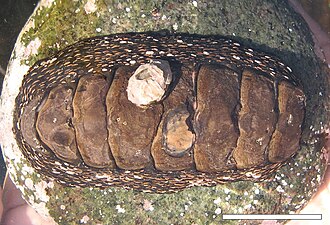
Enoplochiton niger
IUCN status: Not evaluated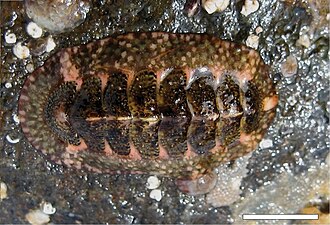
Chilean chiton
Tonicia chilensis
IUCN status: Not evaluatedTonicia swainsoni
IUCN status: Not evaluated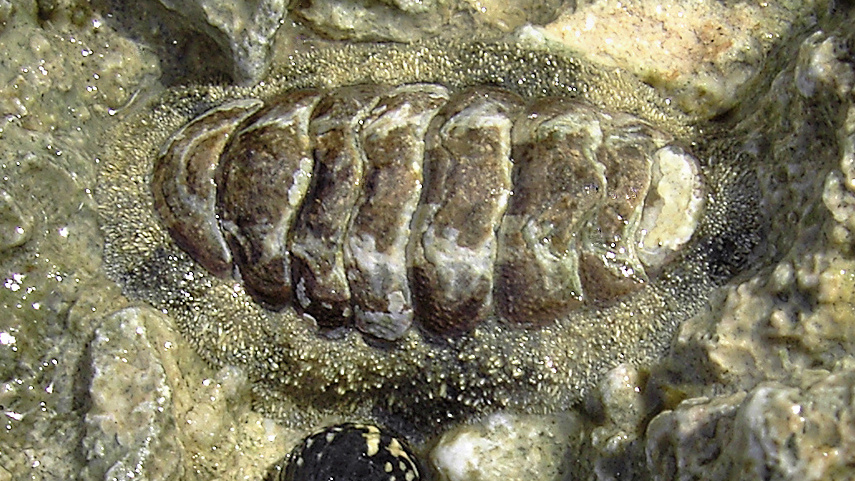
West Indian fuzzy chiton
Acanthopleura granulata
IUCN status: Not evaluated
Names and sources
Classification
Learn more
Conservation status: no data (IUCN). Taxonomy: PeRMS / WoRMS (CC BY 4.0).