
Bony fishes · Engraulidae
Pacific anchoveta
Cetengraulis mysticetus (Günther, 1867)
Spanish: Ayamarca
- Names in Peru
- Ayamarca · Ayamarea
- Peruvian Register of Marine Species
- Listed in PeRMS (IMARPE)
Species account
Summary
Cetengraulis mysticetus is an anchovy of the family Engraulidae [1], of the eastern central Pacific [2]. It is a coastal pelagic fish that forms schools over muddy bottoms and reaches about 17 cm standard length [2]. Its southern limit is in northern Peru, at Sechura Bay [2]. It is recorded in Peru under the names «ayamarca» and «ayamarea» [3]. Its global IUCN Red List category is Least Concern [4]. It is fished for fish meal and as tuna bait [2].
Identification and similar species
It is a compressed, fairly deep-bodied anchovy with a large, deep head and a short, pointed snout. The lower gillrakers are fine and numerous and increase with size: about 25 in a fish of 5 cm standard length and about 60 in one of 12 cm [2]. The anal fin has 17 to 24 rays, usually 20 to 22, and its origin lies below the last third of the dorsal fin base. Small fish carry a silver stripe along the flank that disappears at about 8 to 10 cm [2].
The feature that separates it from the other Pacific anchovies is the broad branchiostegal membrane, which covers the whole isthmus, with 8 long, slender branchiostegal rays. The other Pacific anchovies are usually more slender, with a less deep head, a longer maxilla and fewer gillrakers [2]. It reaches 17 cm standard length, and 14 or 15 cm is usual [2].
Similar species
- Anchovia macrolepidota: It is very similar in general appearance, but the broad branchiostegal membrane, covering the whole isthmus, sets it apart from it and from the other Pacific anchovies [2].
Distribution and habitat
It lives in the eastern central Pacific: from the southern Pacific coast of Baja California and the Gulf of California southward through Panama, Colombia and Ecuador to northern Peru, at Sechura Bay, 5°30' S [2]. Records from Los Angeles may be fish that escaped from the bait tanks of tuna boats [2]. The other species of the genus, Cetengraulis edentulus, lives in the Atlantic, from the Caribbean to Brazil [2].
It is a marine, pelagic fish living close to shore, down to about 9 m depth, in large schools that break up and re-form quickly. It is found mainly over mud flats and does not appear to make long migrations across sandy or rocky ground to other mud flats, although other migrations do occur [2]. Off Colombia it usually spawns within 10 nautical miles of the coast [5].
Biology
In the Gulf of Panama it spawns over shallow mud flats between October and January, with a peak in November and December, somewhat earlier to the north and south. The eggs are oval, are shed between 01:00 and 04:30 and hatch about 20 hours later [2].
In the Colombian Pacific it is regarded as a total spawner. In normal years the gonadosomatic index is low from February to June, rises from July and peaks in October and November, and falls sharply in December and January [5]. Juveniles feed mostly on diatoms, and also on silicoflagellates, dinoflagellates and small crustaceans; adults too live mainly on diatoms, and most stomachs contain mud along with benthic diatoms [2].
Ecology
It is found mainly over shallow mud flats, where it feeds on diatoms and spawns [2]. A mitochondrial DNA analysis groups the two species of Cetengraulis as sisters of the Californian anchovy, Engraulis mordax, with a common ancestor about 4 million years ago (4.2 by the central estimate) [6]. The authors suggest that the ancestors of Cetengraulis may have been trapped in the Gulf of California, and evolved a gut form suited to feeding in warm coastal habitats where plankton is scarce [6].
The ocean affects it strongly. During El Niño and La Niña off Colombia, the distribution and abundance of larvae fell and several spawning peaks appeared within a year; the anomalous behaviour lasted about 2 to 3 years after the event, depending on its intensity, and abundance fell dramatically when the events followed one another in 1997, 1998 and 1999 [5]. Adult reproductive indices dropped, notably the hepatosomatic index, perhaps because the fish fed poorly [5]. In normal conditions it spawns in three zones between Charambirá and Tumaco; during and after the events the spawning grounds expanded north to Cabo Corrientes. Larvae returned to more than 2330 per 10 m2 when normal conditions came back [5].
Conservation
The current IUCN Red List assessment classifies it globally as Least Concern (LC) [4]. For the Gulf of California, a 2026 study applied the CMSY++ method and estimated that fishing mortality lies below the value corresponding to maximum sustainable yield and biomass above the value corresponding to that yield, although biomass has declined [7].
The authors warn that the relative abundance of the Pacific anchoveta is inferred from catch per unit effort, so the estimate should be read with caution, and they propose an exploitation threshold of 0.8 times the fishing mortality at maximum sustainable yield [7]. Catches by the tuna-bait fleet rose from 1946 to 1956 and fell afterwards, when the fleet switched to purse seining and the bait fishery declined [2].
Health, toxicological and chemical relevance
Not medical advice. For a sting, a poisoning or an allergy, seek medical care.
In the Gulf of California, a study using molecular markers found anisakid larvae in 67 % of the Pacific anchovies examined, identified as Contracaecum bioccai. According to the authors it could be zoonotic given its relationship to other anisakids, but its pathogenicity has hardly been studied [8]. The work was done in the Gulf of California, not on Peruvian fish [8].
Human relevance
Little is eaten, fresh or canned; it is used mainly for fish meal and as bait for tuna. It is caught with cast nets for local consumption, with lampara nets for the bait fishery and with purse seines for the reduction fishery, mostly within 8 km of the shore [2]. In the Colombian Pacific it was, at the time of that study (2002), the most caught of the small pelagic fishes, and it went mainly into fish meal and fish oil [5].
In Colombia it is called cardume, and in Ecuador chuhueco, esmeraldas or ojito [2]. A carduma paste was tested in a leberkäse-type product: it retained less liquid and gave less stable emulsions than paste from plumuda, another pelagic species [9].
Where to see it in Peru
Data compiled up to 1988 place its southern limit in northern Peru, at Sechura Bay, 5°30' S, in shallow water down to 9 m over muddy bottoms [2]. The catalogue also lists the Gulf of Guayaquil (Ecuador and Peru) among its important fishing areas, and the source says nothing about restricted access or dive sites [2].
References (9)
- Froese, R., Pauly, D. (2026). Cetengraulis mysticetus (Günther, 1867). World Register of Marine Species. https://www.marinespecies.org/aphia.php?p=taxdetails&id=280092 (accessed 2026-10-25)
- Whitehead, P.J.P., Nelson, G.J., Wongratana, T. (1988). FAO Species Catalogue. Vol. 7. Clupeoid fishes of the world (suborder Clupeoidei). Part 2 - Engraulididae. FAO Fisheries Synopsis No. 125, Vol. 7, Part 2, 383-385. https://www.fao.org/3/t0835e/t0835e00.htm (accessed 2026-10-25)
- Froese, R., Pauly, D. (2026). Cetengraulis mysticetus, Pacific anchoveta. FishBase. https://www.fishbase.se/summary/Cetengraulis-mysticetus.html (accessed 2026-10-25)
- Di Dario, F. (2019). Cetengraulis mysticetus: Di Dario, F. The IUCN Red List of Threatened Species 2020: e.T183878A102902497. doi:10.2305/IUCN.UK.2020-1.RLTS.T183878A102902497.en (accessed 2026-10-25)
- Beltrán-León, B.S. (2002). Changes in the Distribution, Abundance and Spawning Season of the Anchovy Cetengraulis mysticetus, in the Pacific Ocean off Colombia during the Events of El Niño and La Niña. Investigaciones marinas 30. doi:10.4067/s0717-71782002030100021 (accessed 2026-10-25)
- Grant, W.S., Lecomte, F., Bowen, B.W. (2010). Biogeographical contingency and the evolution of tropical anchovies (genus Cetengraulis) from temperate anchovies (genus Engraulis). Journal of Biogeography 37, 1352-1362. doi:10.1111/j.1365-2699.2010.02291.x (accessed 2026-10-25)
- Nevárez-Martínez, M.O., Martínez-Zavala, M.A., González-Máynez, V.E. et al. (2026). Population status of mackerel (Scomber japonicus), anchovy (Engraulis mordax), and Pacific anchoveta (Cetengraulis mysticetus) in the Gulf of California, México. Egyptian Journal of Aquatic Research 52, 265-275. doi:10.1016/j.ejar.2026.04.003 (accessed 2026-10-25)
- López-Moreno, D., Valmaseda-Angulo, M., Hernández-Orts, J.S. et al. (2026). Occurrence and molecular identification of anisakid nematodes in anchovies from the Gulf of California, Mexico. Food Control 180, 111657. doi:10.1016/j.foodcont.2025.111657 (accessed 2026-10-25)
- Humberto López Vargas, J., Patricia Muñoz Ramírez, A., Paola Rodríguez Triviño, A. et al. (2024). Potential application of carduma (Cetengraulis mysticetus) and plumuda (Opisthonema spp.) fish paste for the development of a leberkäse (liver loaf) fish product: Physicochemical and functional properties. Heliyon 10, e28939. doi:10.1016/j.heliyon.2024.e28939 (accessed 2026-10-25)
More pictures
Where it has been recorded
- Filled: scientific records, or confirmed by a curator
- Hatched: isolated record
- Dotted outline: no scientific records and no curator's confirmation (an ORKA sighting is not drawn here)
- Tropical northern sea
Scientific records (6 records)
- Tropical–cold transition zone
Scientific records (3 records)
- Cold central sea
Scientific records (1 record)
From openly licensed OBIS and GBIF records (CC0 or CC BY). How each list is built.
Related species
From the same family.
Bignose anchovy
Anchoa nasus
IUCN status: LC · Least Concern- No openly licensed image yet
Short anchovy
Anchoa curta
IUCN status: LC · Least Concern 
Bigscale anchovy
Anchovia macrolepidota
IUCN status: LC · Least Concern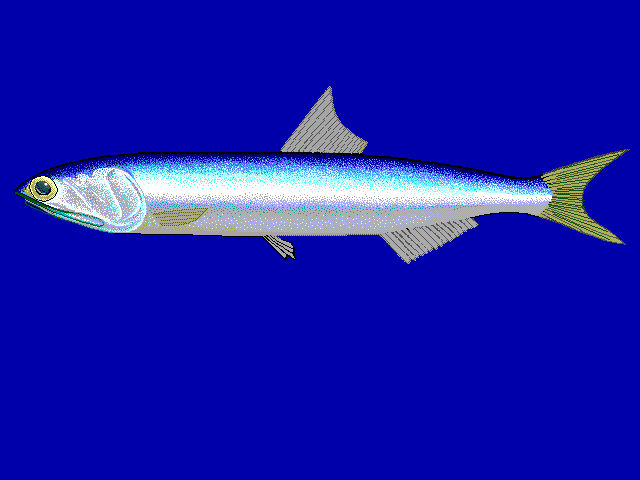
Anchoveta
Engraulis ringens
IUCN status: LC · Least Concern- No openly licensed image yet
Slender anchovy
Anchoa exigua
IUCN status: LC · Least Concern - No openly licensed image yet
Sharpnose anchovy
Anchoa ischana
IUCN status: LC · Least Concern 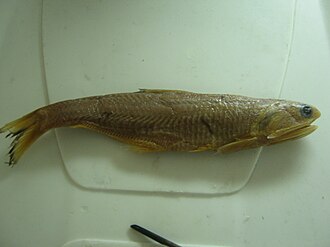
Bright anchovy
Anchoa lucida
IUCN status: LC · Least Concern- No openly licensed image yet
Anchovy
Anchoa panamensis
IUCN status: LC · Least Concern
Names and sources
In Spanish
- Ayamarca — Peru; fishbase · main name
- Anchoveta — Wikidata
- Anchoveta bocona — WoRMS
- Ayamarea — Peru; fishbase
- Carduma — Wikidata
- Chuhueco ojito — Wikidata
- Esmeraldas — Wikidata
- Ojito — Wikidata
- Sardina bocona — Wikidata
In English
- Pacific anchoveta — WoRMS; Wikidata
- Anchoveta — WoRMS
- Anchovy — Wikidata
Classification
Learn more
Conservation status: Least Concern (IUCN Red List, according to Wikidata). Taxonomy: PeRMS / WoRMS (CC BY 4.0).