
Sea turtles and reptiles · Cheloniidae
Loggerhead turtle
Caretta caretta (Linnaeus, 1758)
Spanish: Tortuga boba
- Names in Peru
- Tortuga boba · Cahuama · Tortuga amarilla · Tortuga cabezona
- Peruvian Register of Marine Species
- Listed in PeRMS (IMARPE)

Species account
Summary
The loggerhead turtle, Caretta caretta, is a large-headed sea turtle with a reddish-brown shell that lives in tropical, subtropical and temperate seas around the globe [1],[2]. In Peru its names include tortuga cabezona and tortuga boba [3],[4]. It does not nest in Peru: the turtles found here are almost all juveniles hatched on beaches of the southwest Pacific, eastern Australia or New Caledonia, which cross the ocean to feed in oceanic waters off the centre and south of the country [5],[6]. The IUCN Red List classifies it as Vulnerable globally [7], and in Peru it is categorised as Endangered [4]. A serious threat in the southeast Pacific is bycatch in small-scale fisheries, above all on longlines [6],[8].
Etymology
Linnaeus described it in 1758 as Testudo caretta, and the FAO catalogue lists more than 30 later synonyms; the name accepted today is Caretta caretta [1],[9]. In Peru it is known locally as tortuga amarilla or tortuga cabezona; the first refers to the colour yellow and the second to the large head [6]. That same trait, a large head with jaws able to crush hard prey, is what the Peruvian turtle-watching manual gives as the origin of the name cabezona [3].
Identification and similar species
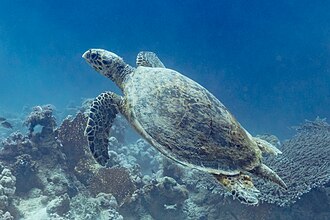
The adult carapace is heart-shaped and longer than wide; its width is between 76 and 86 % of its length [1]. It has 5 pairs of lateral scutes, the first touching the precentral scute, plus 5 central scutes and usually 12 or 13 pairs of marginals; the scutes are rough and often carry barnacles [1]. The broad head measures 23 to 28 % of the shell's length and bears 2 pairs of prefrontal scales; under the bridge of the plastron there are 3 pairs of inframarginal scutes, almost always without pores [1].
The adult back is reddish brown, the flanks shade towards orange and the underside is creamy yellow; hatchlings are dark brown above [1]. Like other sea turtles, it cannot pull its head or flippers into its shell [2]. Scute counts vary: in 2002 a carapace with only 4 lateral scutes, uncommon in the species, was found in Tacna [10].
Similar species
- Chelonia mydas: The green turtle has 4 pairs of lateral scutes, the first not touching the precentral, and a single pair of prefrontal scales; the loggerhead has 5 pairs of laterals and 2 pairs of prefrontals [1].
- Lepidochelys olivacea: The olive ridley also has 5 or more lateral scutes, but its carapace is nearly round and olive grey, and its inframarginals carry pores; the loggerhead's carapace is longer than wide, rough and reddish brown, with poreless inframarginals [1].
Distribution and habitat
It is found worldwide, mainly in subtropical and temperate waters of the Atlantic, Pacific and Indian Oceans and the Mediterranean; in the eastern Pacific it has been recorded from Alaska to Chile [2]. The 1990 FAO catalogue listed it as absent from the coasts of Peru, although anecdotal reports went back to the 1950s [1],[10]. A note published in 2003 confirmed its presence with 3 carapaces found in Tacna and Moquegua and with 7 turtles taken by longline between January and May 2003 in the central and southern Peruvian sea [10].
Between 2000 and 2007, observers on board the small-scale fleet recorded 323 captures between 13 and 22° S, 46.5 to 637.1 km from the coast; 82 % came from boats sailing out of Ilo and, of the turtles with a depth record, all but 1 were over oceanic waters [6]. The national conservation plan also cites records in the north, between 7 and 9° S, and notes concentrations between 15 and 25° S off Peru and Chile [11]. To the south, the species reaches about 32° S off Chile [12].
Turtles fitted with satellite transmitters off Peru moved straight off the continental shelf and spent more than 97 % of their time over depths greater than 1000 m, in waters with a mean surface temperature of 21.1 °C [12]. An unusual case was a 62.2 cm juvenile found in September 2015 at the shore of La Aguada, Paracas, the first record from a strictly neritic area of the country [11].
Biology
Loggerheads in Peru are overwhelmingly juveniles. Of 307 turtles measured between 2000 and 2007, the curved shell length went from 35.9 cm to 86.3 cm, averaging 57.2 cm; 91.5 % were classed as juveniles, 8.1 % as subadults and only 1 individual as a possible adult [6]. Since the smallest documented breeding size in eastern Australia is 80 cm, the authors note that even that possible adult may have been a large subadult [6]. The 7 turtles caught in 2003 averaged 57.0 cm and weighed between 15 and 28 kg [10].
No nesting beaches of the species are known in the eastern Pacific [10]. Mitochondrial DNA from 22 turtles caught by Peruvian longliners showed the same 2 haplotypes, CCP1 and CCP5, as females nesting in the southwest Pacific, at frequencies that did not differ from those rookeries; the authors conclude that turtles hatched in eastern Australia or New Caledonia cross the ocean and spend part of their youth off South America [5]. Peruvian sizes, smaller than those of juveniles that recruit to Australian coastal waters, suggest that they return west before maturing [6].
On the beaches, females lay 2 to 5 times per season, about 2 weeks apart, with 40 to 190 eggs per clutch and a mean of 110; they usually breed every 2 or 3 years [1]. In Australia the nesting season runs from October to April, peaking between November and January [1]. Age at first maturity is not well established: tagging data from the southeastern United States give between 12 and more than 30 years [1].
Ecology
Off Peru the loggerhead leads a pelagic life. Between 2003 and 2007, 14 juveniles were tracked by satellite; of the 11 followed for more than 60 days, 8 were less than 750 km from their release point when tracking ended, while the other 3, followed for 249 to 297 days, ranged between 1607 and 2337 km away [12]. The authors regard many of these turtles as residents of the waters off Peru and Chile, which would be a key feeding area for those hatched in the southwest Pacific [12].
According to the stable isotope studies reviewed in the national plan, it feeds in oceanic settings at an intermediate trophic level, below the sea lion and the jumbo squid and above anchoveta and chub mackerel; its important prey include cnidarians and molluscs, and it also eats the jumbo squid and mackerel used as longline bait [11]. The juvenile found at Paracas in 2015 carried 3 pelagic crabs, Planes cyaneus, in its cloaca and stalked barnacles, Conchoderma virgatum and Lepas anatifera, on its body, signs that it had come from the open sea [11].
Elsewhere in its range, hatchlings and juveniles gather at fronts, eddies and convergence zones where floating animals and debris accumulate, and usually spend more than a year there [1]. It is essentially carnivorous and only now and then eats algae [3].
Conservation
The current global IUCN Red List assessment classifies it as Vulnerable [7]. In Peru it is categorised as Endangered by D.S. N.° 004-2014-MINAGRI [4]. In 2014 the Convention on Migratory Species adopted a single species action plan for the South Pacific loggerhead, and in 2015 the Inter-American Convention for the Protection and Conservation of Sea Turtles agreed to coordinate recovery plans for the species [3].
A major threat in Peruvian waters is bycatch. With observers at only 3 ports between 2000 and 2007, an annual catch of about 3200 loggerheads was estimated for the small-scale fisheries of those ports, and the authors consider it likely that, adding all species together, the catch across the country reaches tens of thousands of turtles a year [8]. Nearly all become entangled in the lines or take the hooks of longlines; of 51 hooked turtles whose wounds could be assessed, 41.2 % were severely injured [6]. In the mahi-mahi and shark longline fishery of central Peru, every loggerhead caught was a juvenile [13].
Tracked loggerheads passed 75 % of their tracking time inside the fishing grounds of the Peruvian small-scale longline fleet, and divided their time between Peruvian (51 %), international (39 %) and Chilean (9 %) waters, which the authors say calls for conservation and fisheries management coordinated between countries [12]. On the eastern Australian beaches that some of these turtles come from, nesting fell by 86 % over a 23-year period [12].
Human relevance
Loggerhead meat is sometimes eaten on board or in fishing coves, or sold in domestic markets [6]. That use is illegal; a study of Peruvian small-scale fisheries likens it to bushmeat and sees little prospect of controlling it without taking into account the economy of coastal communities that live off the sea [8].
Much of what is known about the species in Peru was gathered on board the small-scale fleet: observers measured, photographed and sampled turtles caught incidentally, and those in good condition were tagged and returned to the sea [6]. Catches by Peruvian longliners also supplied the genetic samples that linked these turtles to the southwest Pacific rookeries [5].
Where to see it in Peru
It is very hard to see in Peru. Data from 2000 to 2007 place it almost always in oceanic waters, tens to hundreds of kilometres offshore, between 13 and 22° S, and most captures were by boats sailing from Ilo; the authors note that these areas are hard for researchers to reach [6]. Satellite-tracked turtles did not appear to return to coastal waters shallower than 200 m [12]. A record close to shore, such as the one at La Aguada, Paracas, in 2015, is exceptional [11].
References (13)
- Márquez M., R. (1990). FAO species catalogue. Vol. 11: Sea turtles of the world. An annotated and illustrated catalogue of sea turtle species known to date. FAO Fisheries Synopsis No. 125, Vol. 11. Rome, FAO. https://www.fao.org/3/t0244e/t0244e00.htm (accessed 2026-10-20)
- NOAA Fisheries (2026). Loggerhead Turtle. National Oceanic and Atmospheric Administration, species directory. https://www.fisheries.noaa.gov/species/loggerhead-turtle (accessed 2026-10-20)
- Ministerio de Comercio Exterior y Turismo (MINCETUR) (2026). Manual de buenas prácticas de gestión de servicio turístico para la actividad de observación de tortugas marinas en el litoral del Perú. MINCETUR, con la Cooperación Alemana (GIZ). https://cdn.www.gob.pe/uploads/document/file/10015997/8167744-manual-_buenas_practicas-tortugas-marinas.pdf (accessed 2026-10-20)
- Ministerio de Agricultura y Riego (2014). Decreto Supremo N.° 004-2014-MINAGRI, que aprueba la actualización de la lista de clasificación y categorización de las especies amenazadas de fauna silvestre legalmente protegidas. El Peruano (08-04-2014); ficha en SINIA, Ministerio del Ambiente. https://sinia.minam.gob.pe/normas/lista-especies-amenazadas-fauna-silvestre-legalmente-protegidas (accessed 2026-10-20)
- Boyle, M.C., FitzSimmons, N.N., Limpus, C.J. et al. (2009). Evidence for transoceanic migrations by loggerhead sea turtles in the southern Pacific Ocean. Proceedings of the Royal Society B: Biological Sciences, 1993-1999. doi:10.1098/rspb.2008.1931 (accessed 2026-10-20)
- Alfaro Shigueto, J., Mangel, J.C., Seminoff, J.A. et al. (2008). Demography of loggerhead turtles Caretta caretta in the southeastern Pacific Ocean: fisheries-based observations and implications for management. Endangered Species Research, 129-135. doi:10.3354/esr00142 (accessed 2026-10-20)
- Casale, P., Tucker, A.D. (2015). Caretta caretta: Casale, P. & Tucker, A.D. The IUCN Red List of Threatened Species 2015: e.T3897A119333622 (errata version published in 2017). doi:10.2305/IUCN.UK.2017-2.RLTS.T3897A119333622.en (accessed 2026-10-20)
- Alfaro-Shigueto, J., Mangel, J.C., Bernedo, F. et al. (2011). Small-scale fisheries of Peru: a major sink for marine turtles in the Pacific. Journal of Applied Ecology, 1432-1440. doi:10.1111/j.1365-2664.2011.02040.x (accessed 2026-10-20)
- WoRMS Editorial Board (2026). Caretta caretta (Linnaeus, 1758). World Register of Marine Species. https://www.marinespecies.org/aphia.php?p=taxdetails&id=137205 (accessed 2026-10-20)
- Kelez, S., Vélez-Zuazo, X., Manrique, C. (n.d.). New evidence on the loggerhead sea turtle Caretta caretta (Linnaeus 1758) in Peru. Ecología Aplicada 2(1), 2003, 141-142. doi:10.21704/rea.v2i1-2.262 (accessed 2026-10-20)
- Servicio Nacional Forestal y de Fauna Silvestre (SERFOR) (2019). Plan Nacional de Conservación de las Tortugas Marinas en el Perú, Período 2019-2029. Ministerio de Agricultura y Riego; aprobado por R.D.E. N.° 253-2019-MINAGRI-SERFOR-DE. https://cdn.www.gob.pe/uploads/document/file/3462540/Plan%20Nacional%20de%20Conservaci%C3%B3n%20de%20Tortugas%20Marinas%20del%20Per%C3%BA%202019-2029.pdf.pdf (accessed 2026-10-20)
- Mangel, J.C., Alfaro-Shigueto, J., Witt, M.J. et al. (2011). Post-capture movements of loggerhead turtles in the southeastern Pacific Ocean assessed by satellite tracking. Marine Ecology Progress Series, 261-272. doi:10.3354/meps09152 (accessed 2026-10-20)
- Ayala, L., Sánchez-Scaglioni, R. (2014). Captura, esfuerzo y captura incidental de la pesca con espinel en el centro de Perú. Revista Peruana de Biología, 243-250. doi:10.15381/rpb.v21i3.10898 (accessed 2026-10-20)
More pictures
If you come across it
Protected or threatened species. Watch it without touching, feeding, chasing or taking it, and keep the recommended viewing distances.sea turtle protected by law — Supreme Decree No. 026-2001-PE (protection of sea turtles in Peru)
Related species
From the same family.

Names and sources
In Spanish
- Tortuga boba — Peru; D.S. N.° 004-2014-MINAGRI, categorización de especies amenazadas de fauna silvestre (El Peruano, 08-04-2014), p. 7 of the PDF; Wikidata; WoRMS · main name
- Caguama — Wikidata
- Cahuama — Peru; sealifebase
- Tortuga amarilla — Peru; SERFOR (2019). Plan Nacional de Conservación de las Tortugas Marinas en el Perú 2019-2029, p. 9 of the PDF
- Tortuga cabezona — Peru; MINCETUR (2026). Manual de buenas prácticas para la actividad de observación de tortugas marinas en el litoral del Perú, p. 16 of the PDF; Wikidata
- Tortuga Careta — Wikidata
- Tortuga Comun — Wikidata
In English
- Loggerhead turtle — WoRMS; Wikidata
- Loggerhead — WoRMS
- Loggerhead sea turtle — Wikidata; WoRMS
Classification
Learn more
Conservation status: Vulnerable (IUCN Red List, according to Wikidata). Taxonomy: PeRMS / WoRMS (CC BY 4.0).