
Sharks, rays and chimaeras · Carcharhinidae
Silky shark
Carcharhinus falciformis (Müller & Henle, 1839)
Spanish: Cazón-tiburón
- Names in Peru
- Cazón-tiburón · Tollo mantequero
- Peruvian Register of Marine Species
- Listed in PeRMS (IMARPE)

Species account
Summary
Carcharhinus falciformis is a shark of the family Carcharhinidae, in the order Carcharhiniformes [1]. It is a grey, slender, oceanic and coastal shark that occupies tropical seas around the world and reaches Peru through the eastern Pacific [2]. It has been recorded in the Peruvian sea [3]. Its global category on the IUCN Red List is Vulnerable [4].
Etymology
Bibron described it in 1839 in the work of Müller and Henle on sharks and rays; the holotype is a 528 mm female foetus held at the Muséum national d'Histoire naturelle in Paris as MNHN 1134, and the type locality is Cuba [2]. The FAO catalogue gives it the English name silky shark and, in Spanish, tiburón jaquetón [2]. In the tropical eastern Pacific it is called the net-eater shark for the damage it does to the nets and catches of tuna purse seiners [2].
Identification and similar species
It is a large, slender-bodied shark with a moderately long, rounded snout, moderately large eyes and no conspicuous markings [2]. The upper teeth have oblique, serrated cusps, and there are usually 15 rows of teeth in each half of each jaw [2]. A ridge lies between the two dorsal fins, the first dorsal fin begins behind the free rear tips of the pectorals, and the second dorsal is very low, with a greatly elongated inner margin [2].
The pectoral fins are long, narrow and sickle-shaped, especially in adults [2]. The back is dark grey or grey-brown, sometimes almost blackish, and the belly is white; the fin tips, except on the first dorsal, are dusky but not black, and there is an inconspicuous white band on the flank [2]. It reaches about 330 cm in length [2].
Similar species
- Carcharhinus galapagensis: Carcharhinus galapagensis has the first dorsal fin starting over the middle of the inner margins of the pectorals, not behind their tips, and the inner margin of its second dorsal is short, less than twice its height, whereas in Carcharhinus falciformis it is usually more than twice [2]. It is also recorded in the Peruvian sea [3].
Distribution and habitat
It is a circumtropical species, both oceanic and coastal [2]. In the central and eastern Pacific it is reported from southern Baja California to Peru [2]. It is on the list of chondrichthyans of the Peruvian sea [3].
It lives near the edge of the continental and insular shelves and also far from the coast; it sometimes enters shallow water of 18 m, and in the open sea it has been recorded from the surface down to at least 500 m [2]. It tends to occur above reefs in deep water and close to the slopes of islands, at recorded temperatures of 23 to 24 °C [2]. Longline sampling in the central and eastern Pacific found it much more abundant near land than in the open ocean [2].
Biology
It is viviparous, with a yolk-sac placenta, and each litter has 2 to 14 young; in that catalogue the length of gestation was not known and births did not seem to have a marked season [2]. The pups measure 70 to 87 cm at birth [2].
Males mature between 187 and 217 cm and reach 270-300 cm; females mature between 213 and 230 cm and reach at least 305 cm [2]. There is segregation by size: the young occupy nursery areas away from the coast and the adults are further out [2]. Its slow life cycle, with few young, late maturity and long life, makes it vulnerable to overfishing [5].
Ecology
It eats mostly fishes, both pelagic and coastal, among them sea catfishes, mullets, mackerels, yellowfin tuna, albacore and porcupinefish, and also squid, paper nautiluses and pelagic crabs [2]. It is associated with schools of tuna [2].
It is an active, fast swimmer, and when divers approach it may arch its back, raise its head and lower its tail, a possible threat signal [2]. According to the FAO catalogue it is one of the three most common oceanic sharks, together with the blue shark and the oceanic whitetip [2].
Conservation
Its global category on the IUCN Red List is Vulnerable [4]. Its numbers have fallen steeply in recent decades as a result of fishing for fins and of incidental catch in pelagic fleets, and it is listed in Appendix II of CITES and Appendix II of CMS [5].
It is managed as a single stock within each of the four regional tuna fisheries organisations, but a genetic study of 628 specimens from 11 regions found significant population structure among all of them, a result that does not fit that assumption [5]. In 2017 a vessel carrying 7639 sharks was seized in the Galápagos Islands; among the 929 examined, 257 were of this species, and 195 of 228 assessed were immature [6]. In the Central and South American Pacific it qualifies in 24 of 65 important shark and ray areas [7].
In Peru, Ministerial Resolution 209-2001-PE sets a minimum capture size of 150 cm for the genus Carcharhinus as a whole [8]. The same source notes that IMARPE classifies it as a highly migratory species, and that, according to an official 2014 reference that work cites, no shark species of Peruvian waters was categorized as threatened [8].
Human relevance
According to the FAO catalogue it is very often caught in pelagic longline fishing and also in fixed bottom nets; its meat is used fresh or dried and salted, its skin as leather, its fins for soup and its liver for oil [2]. It is one of the most abundant species in fin markets [5].
In Peru, onboard observers on the small-scale longline fishery of Ilo, in the south of the country, recorded it among the other species, which together made up 1 % of the sharks identified to species level, in a catch dominated by Prionace glauca and Isurus oxyrinchus [9]. The FAO catalogue considers it potentially dangerous because of its size and abundance, although no attack was attributed to it [2].
Where to see it in Peru
The Peruvian sources consulted document it in species lists and through fishing, not through sightings at sea: it is on the list of chondrichthyans of the Peruvian sea [3], and observers on the small-scale longline fishery based in Ilo recorded it among the other species [9]. IMARPE classifies it as a highly migratory species [8].
References (9)
- Froese, R., Pauly, D. (2026). Carcharhinus falciformis (Müller & Henle, 1839). World Register of Marine Species. https://www.marinespecies.org/aphia.php?p=taxdetails&id=105789 (accessed 2026-10-21)
- Compagno, L.J.V. (1984). FAO species catalogue Vol. 4. Sharks of the world. An annotated and illustrated catalogue of shark species known to date. Part 2. Carcharhiniformes. FAO Fisheries Synopsis No. 125, Vol. 4, Part 2. FAO, Rome, 471-475. https://www.fao.org/4/ad123e/ad123e00.htm (accessed 2026-10-21)
- Cornejo, R., Vélez-Zuazo, X., González-Pestana, A. et al. (2015). An updated checklist of Chondrichthyes from the southeast Pacific off Peru. Check List, 1809. doi:10.15560/11.6.1809 (accessed 2026-10-21)
- Rigby, C.L., Sherman, C.S., Chin, A. et al. (2017). Carcharhinus falciformis: Rigby, C.L., Sherman, C.S., Chin, A. & Simpfendorfer, C. The IUCN Red List of Threatened Species 2021: e.T39370A205782570. doi:10.2305/IUCN.UK.2021-3.RLTS.T39370A205782570.EN (accessed 2026-10-21)
- Kraft, D.W., Conklin, E.E., Freel, E.B. et al. (2025). Global stock structure of the Silky shark (Carcharhinus falciformis, Carcharhinidae) assessed with high-throughput DNA sequencing. PeerJ, e19493. doi:10.7717/peerj.19493 (accessed 2026-10-21)
- Bonaccorso, E., Ordóñez-Garza, N., Pazmiño, D.A. et al. (2021). International fisheries threaten globally endangered sharks in the Eastern Tropical Pacific Ocean: the case of the Fu Yuan Yu Leng 999 reefer vessel seized within the Galápagos Marine Reserve. Scientific Reports, 14959. doi:10.1038/s41598-021-94126-3 (accessed 2026-10-21)
- García-Rodríguez, E., Gonzalez-Pestana, A., Charles, R. et al. (2025). Mapping Important Shark and Ray Areas (ISRAs) in the Central and South American Pacific: Existing knowledge and data needs. PLOS ONE. doi:10.1371/journal.pone.0322445 (accessed 2026-10-21)
- Gonzalez-Pestana, A., Kouri J., C., Velez-Zuazo, X. (2016). Shark fisheries in the Southeast Pacific: A 61-year analysis from Peru. F1000Research, 164. doi:10.12688/f1000research.4412.2 (accessed 2026-10-21)
- Doherty, P.D., Alfaro-Shigueto, J., Hodgson, D.J. et al. (2014). Big catch, little sharks: Insight into Peruvian small-scale longline fisheries. Ecology and Evolution, 2375-2383. doi:10.1002/ece3.1104 (accessed 2026-10-21)
More pictures
If you come across it
Protected or threatened species. Watch it without touching, feeding, chasing or taking it, and keep the recommended viewing distances.
Where it has been recorded
- Filled: scientific records, or confirmed by a curator
- Hatched: isolated record
- Dotted outline: no scientific records and no curator's confirmation (an ORKA sighting is not drawn here)
- Cold central sea
Scientific records (1 record)
From openly licensed OBIS and GBIF records (CC0 or CC BY). How each list is built.
Related species
From the same genus (Carcharhinus).

Copper shark
Carcharhinus brachyurus
IUCN status: VU · Vulnerable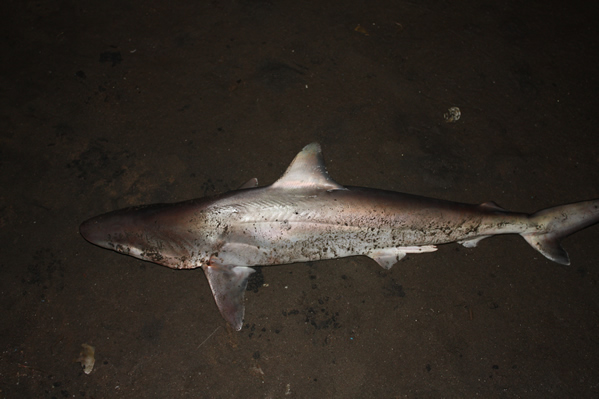
Pacific smalltail shark
Carcharhinus cerdale
IUCN status: CR · Critically Endangered
Oceanic whitetip shark
Carcharhinus longimanus
IUCN status: CR · Critically Endangered
Bignose shark
Carcharhinus altimus
IUCN status: NT · Near Threatened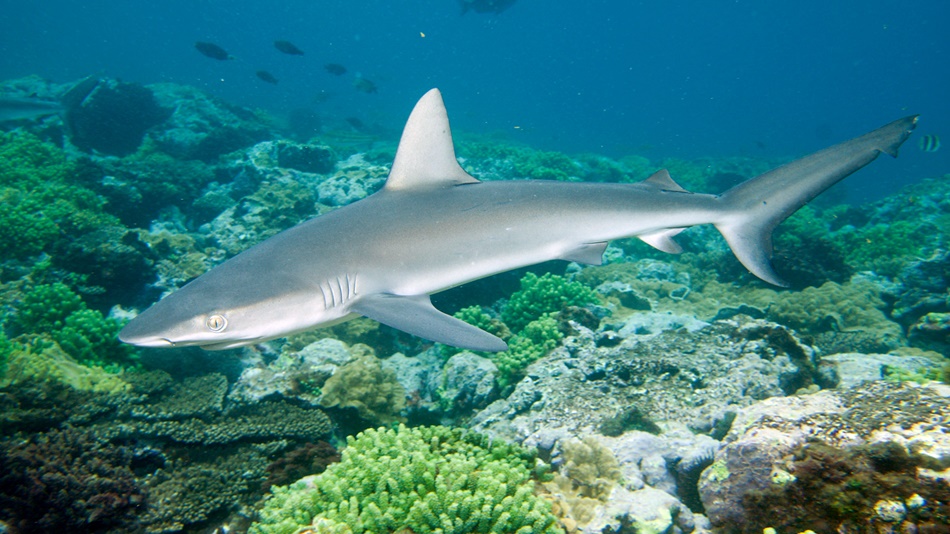
Galapagos shark
Carcharhinus galapagensis
IUCN status: LC · Least Concern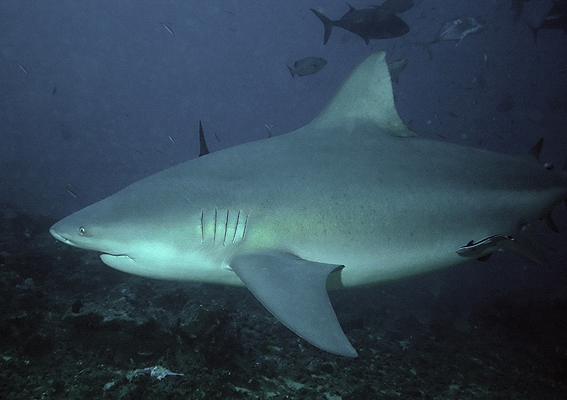
Bull shark
Carcharhinus leucas
IUCN status: VU · Vulnerable
Blacktip shark
Carcharhinus limbatus
IUCN status: VU · Vulnerable
Dusky shark
Carcharhinus obscurus
IUCN status: Not evaluated
Names and sources
In Spanish
- Cazón-tiburón — Peru; fishbase · main name
- Jaquetón sedoso — WoRMS
- Tiburón lustroso — WoRMS
- Tiburón piloto — WoRMS
- Tollo mantequero — Peru; fishbase
In English
- Silky shark — WoRMS; Wikidata
Classification
Learn more
Conservation status: Vulnerable (IUCN Red List, according to Wikidata). Taxonomy: PeRMS / WoRMS (CC BY 4.0).