
Sharks, rays and chimaeras · Carcharhinidae
Pacific smalltail shark
Carcharhinus cerdale Gilbert, 1898
Spanish: Cazón
- Names in Peru
- Cazón
- Peruvian Register of Marine Species
- Listed in PeRMS (IMARPE)
Species account
Summary
Carcharhinus cerdale is a small, slender shark of the family Carcharhinidae that lives in the coastal waters of the American Pacific [1],[2]. The 1984 FAO shark catalogue treated it as a synonym of the Atlantic smalltail shark, Carcharhinus porosus, and in 2011 it was again recognised as a separate Pacific species; that is why much of the literature, the Peruvian included, still calls it Carcharhinus porosus [2],[3],[4]. The global IUCN Red List classifies it as Critically Endangered [5].
Identification and similar species
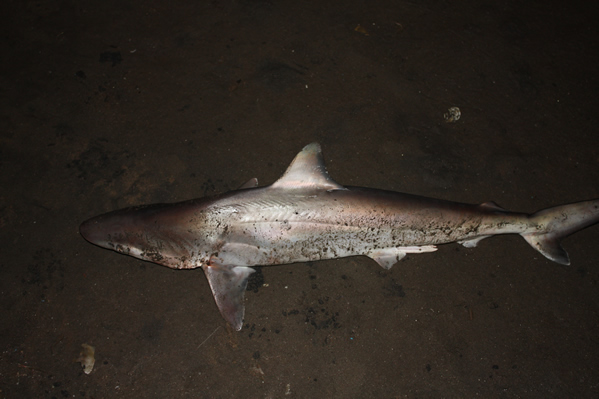
The FAO shark catalogue, which still lumped the Atlantic and Pacific populations into a single species, describes a grey, slim shark under 1.5 m long, with a moderately long, pointed snout, large round eyes, short and inconspicuous labial furrows and no ridge between the two dorsal fins [2]. The first dorsal is large and sickle-shaped; the second is medium-sized and rather low and begins over the middle of the anal-fin base or slightly behind it, and the anal fin is deeply notched; the pectorals are small and falcate [2].
It usually has 14 to 15 rows of teeth in each half of the jaws; the upper ones carry narrow, tall and strongly serrated cusps [2]. It is grey above and pale below; the tips of the pectoral, dorsal and caudal fins are often dark but carry no striking marks, and the pale flank band is barely visible [2]. That description mixes specimens from both oceans, so not every feature in it need hold for the Pacific animal [2],[3].
Similar species
- Carcharhinus porosus: They are so alike that they were treated as one species for decades; since the split, the checklist of Colombian elasmobranchs keeps Carcharhinus porosus for the Caribbean and recognises Carcharhinus cerdale as the valid Pacific species, so in Peruvian waters the second name is the right one [3],[2].
Distribution and habitat
In the eastern Pacific it ranges from the Gulf of California to Peru, without reaching the oceanic islands [2]. It appears in the checklist of chondrichthyans of Mexico's Pacific coast [6], in that of the Colombian Pacific, backed by museum specimens [3], and in the list of Peruvian sharks, where it is named Carcharhinus porosus [4].
According to the FAO catalogue, which pooled data from both oceans, it is a tropical shark of the continental shelf that lives near the bottom, from the shoreline down to at least 36 m, and favours muddy bottoms and estuaries [2]. On the Colombian Pacific coast, where it was recorded as Carcharhinus porosus, it turned up in the nets of a single shrimp trawler sampled each October, whose hauls averaged 11.6 to 31.0 m deep depending on the year [7].
Biology
It is viviparous with a yolk-sac placenta and gives birth to 2 to 7 pups; the FAO catalogue credits it with a maximum length that probably does not exceed 150 cm and a size at birth of 31 to 40 cm [2]. These figures were put together when the Atlantic and Pacific populations were considered one species, so they should be applied to Carcharhinus cerdale with caution [2],[3].
In shrimp trawls on the Colombian Pacific coast, the individuals caught averaged between 37.6 and 41.0 cm in total length in the sampling years in which the species appeared, from 1995 to 2004 [7].
Ecology
It is a harmless shark that feeds mainly on fish: the FAO catalogue lists sardines, sea catfishes, croakers, jacks, grunts and small sharks, young hammerheads among them, as well as shrimp [2].
As of 2016 there were no published studies of its diet in the tropical eastern Pacific, so an analysis of trawl fishing in Colombia had to use for it a trophic level of 4.1 taken from an estimate published in 1999 [7]. In a stable-isotope study of 7 shark species from the Colombian Pacific, this one among them, the species' feeding areas overlapped in coastal habitats [8].
Conservation
Its global category on the IUCN Red List is Critically Endangered [5].
In the monitoring of a single shrimp trawler on the Colombian Pacific coast, its catch per fishing hour fell from 0.24 in 1995 to 0.01 in 2001; it rose to 0.17 in 2003, was 0.02 in 2004, and none were caught in 2007 [7].
Between 2016 and 2018, 689 sharks landed by small-scale fishers in northern Chocó, Colombia, were sequenced, and only 5 turned out to belong to this species [9]. Sharks there usually reach port without heads or fins, which is why DNA is needed to find out which species are being caught [9].
In Peru, Ministerial Resolution 209-2001-PE sets a minimum catch length of 150 cm for the species of the genus Carcharhinus, and the 2016 analysis of the Peruvian shark fishery applies it to this species as well, which it lists as Carcharhinus porosus [10].
Health, toxicological and chemical relevance
Not medical advice. For a sting, a poisoning or an allergy, seek medical care.
A study of mercury in sharks confiscated at the port of Buenaventura, on Colombia's Pacific coast, measured total mercury in fins and muscle of 7 species, this one included [8]. About 24 % of the muscle samples exceeded the recommended international limits for human consumption, mostly in Alopias pelagicus and Sphyrna lewini [8].
Human relevance
The FAO catalogue records it as an incidental longline catch throughout its range, used fresh, frozen or dried and salted for human consumption; oil was extracted from the liver and the carcasses went into fishmeal [2].
In Peru it appears, as Carcharhinus porosus, among the 18 shark species with recorded landings; from 1996 to 2010, six species made up 98 % of what was landed and the other 12, this one among them, only 2 % together [10]. There it is known by the name «cazón» [11]. In Colombia sharks are caught for human consumption and their fins are exported illegally; this species was among the sharks seized at the port of Buenaventura that a 2021 study analysed [8].
Where to see it in Peru
Its range reaches Peru [2]. The 2015 updated checklist of Peruvian chondrichthyans includes it under the name Carcharhinus porosus, based on the 2001 catalogue of marine fishes and the 2014 national plan of action for sharks [4], and the 2016 analysis of Peru's shark fishery counts it among the 18 species with recorded landings, with species-level data from 1996 to 2010 [10]. None of these sources names particular places or recent sightings in the country [4],[10].
References (11)
- WoRMS Editorial Board (2026). Carcharhinus cerdale Gilbert, 1898. World Register of Marine Species. https://www.marinespecies.org/aphia.php?p=taxdetails&id=298424 (accessed 2026-10-20)
- Compagno, L.J.V. (1984). FAO species catalogue. Vol. 4. Sharks of the world. An annotated and illustrated catalogue of shark species known to date. Part 2: Carcharhiniformes. FAO Fisheries Synopsis No. 125, Vol. 4, Part 2. FAO, Rome, 496-497. https://www.fao.org/4/ad123e/ad123e00.htm (accessed 2026-10-20)
- Navia, A.F., Mejía-Falla, P.A. (2019). Checklist of marine elasmobranchs of Colombia. Universitas Scientiarum, 241-276. doi:10.11144/Javeriana.SC24-1.come (accessed 2026-10-20)
- Cornejo, R., Vélez-Zuazo, X., González-Pestana, A. et al. (2015). An updated checklist of Chondrichthyes from the southeast Pacific off Peru. Check List, 1809. doi:10.15560/11.6.1809 (accessed 2026-10-20)
- Pollom, R., Avalos, C., Bizzarro, J. et al. (2019). Carcharhinus cerdale: Pollom, R., Avalos, C., Bizzarro, J., Burgos-Vázquez, M.I., Cevallos, A., Espinoza, M., Herman, K., González, A., Mejía-Falla, P.A., Morales-Saldaña, J.M., Navia, A.F., Pérez Jiménez, J.C., Sosa-Nishizaki, O. & Velez-Zuazo, X. The IUCN Red List of Threatened Species 2020: e.T144137478A144137594. doi:10.2305/IUCN.UK.2020-3.RLTS.T144137478A144137594.en (accessed 2026-10-20)
- Ehemann, N.R., González-González, L.V., Chollet-Villalpando, J.G. et al. (2018). Updated checklist of the extant Chondrichthyes within the Exclusive Economic Zone of Mexico. ZooKeys, 17-39. doi:10.3897/zookeys.774.25028 (accessed 2026-10-20)
- Navia, A.F., Mejía-Falla, P.A. (2016). Fishing effects on elasmobranchs from the Pacific Coast of Colombia. Universitas Scientiarum, 9-22. doi:10.11144/Javeriana.SC21-1.feoe (accessed 2026-10-20)
- Vélez, N., Bessudo, S., Barragán-Barrera, D.C. et al. (2021). Mercury concentrations and trophic relations in sharks of the Pacific Ocean of Colombia. Marine Pollution Bulletin, 113109. doi:10.1016/j.marpolbul.2021.113109 (accessed 2026-10-20)
- Villate-Moreno, M., Cubillos-M, J.C., Stibor, H. et al. (2022). Molecular identification and first demographic insights of sharks based on artisanal fisheries bycatch in the Pacific Coast of Colombia: implications for conservation. PeerJ, e13478. doi:10.7717/peerj.13478 (accessed 2026-10-20)
- Gonzalez-Pestana, A., Kouri J., C., Velez-Zuazo, X. (2016). Shark fisheries in the Southeast Pacific: A 61-year analysis from Peru. F1000Research, 164. doi:10.12688/f1000research.4412.2 (accessed 2026-10-20)
- Froese, R., Pauly, D. (2026). Common names of Carcharhinus cerdale. FishBase. https://www.fishbase.se/comnames/CommonNamesList.php?ID=66939&GenusName=Carcharhinus&SpeciesName=cerdale (accessed 2026-10-20)
More pictures
If you come across it
Protected or threatened species. Watch it without touching, feeding, chasing or taking it, and keep the recommended viewing distances.
Related species
From the same genus (Carcharhinus).

Copper shark
Carcharhinus brachyurus
IUCN status: VU · Vulnerable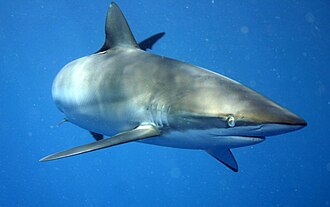
Silky shark
Carcharhinus falciformis
IUCN status: VU · Vulnerable
Oceanic whitetip shark
Carcharhinus longimanus
IUCN status: CR · Critically Endangered
Bignose shark
Carcharhinus altimus
IUCN status: NT · Near Threatened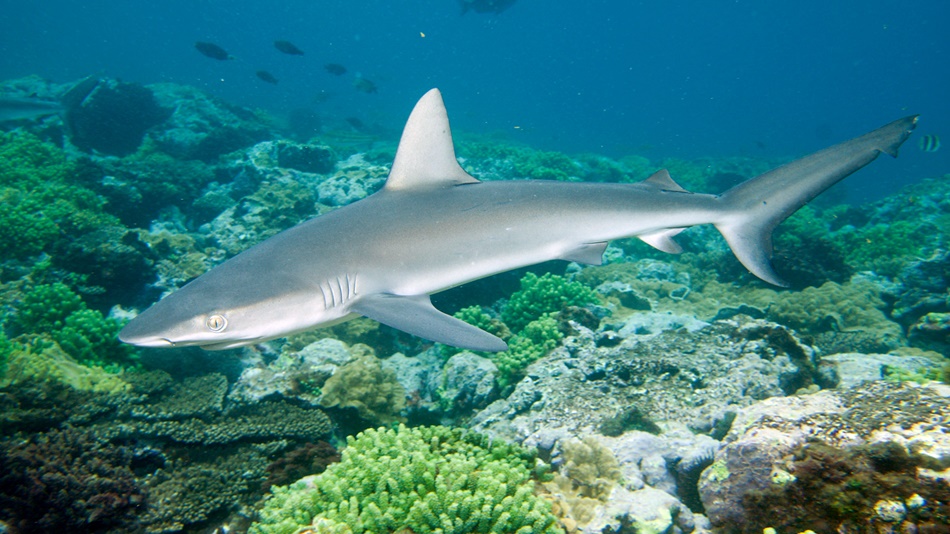
Galapagos shark
Carcharhinus galapagensis
IUCN status: LC · Least Concern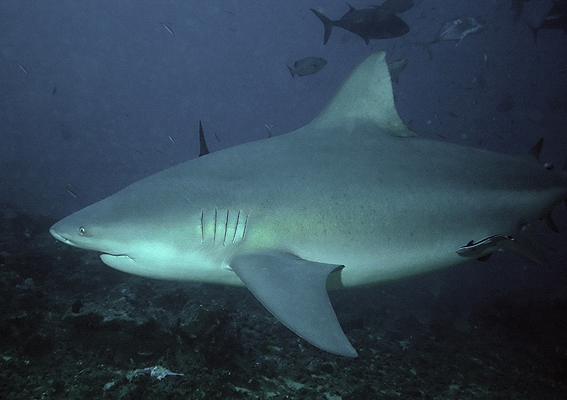
Bull shark
Carcharhinus leucas
IUCN status: VU · Vulnerable
Blacktip shark
Carcharhinus limbatus
IUCN status: VU · Vulnerable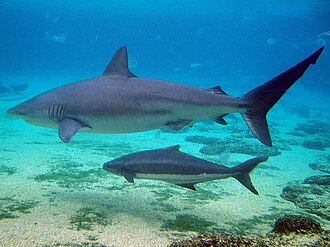
Dusky shark
Carcharhinus obscurus
IUCN status: Not evaluated
Names and sources
In Spanish
- Cazón — Peru; fishbase · main name
In English
- Pacific smalltail shark — Wikidata
Classification
Learn more
Conservation status: Critically Endangered (IUCN Red List, according to Wikidata). Taxonomy: PeRMS / WoRMS (CC BY 4.0).