
Seabirds · Scolopacidae
Least sandpiper
Calidris minutilla (Vieillot, 1819)
Spanish: Playerito menudo
- Names in Peru
- Playerito menudo
- Peruvian Register of Marine Species
- Not in PeRMS: recorded by OBIS, or by ORKA at our dive sites
Species account
Summary
Calidris minutilla is a shorebird of the family Scolopacidae, described by Vieillot in 1819 under the name Tringa minutilla [1]. It is the smallest of the Nearctic Calidris; it nests in northern North America, from the boreal forests to the subarctic tundra, and moves south outside the breeding season [2]. In Peru it is called «playerito menudo» [3]. The IUCN Red List classifies it as Near Threatened in its 2024 assessment [4].
Identification and similar species
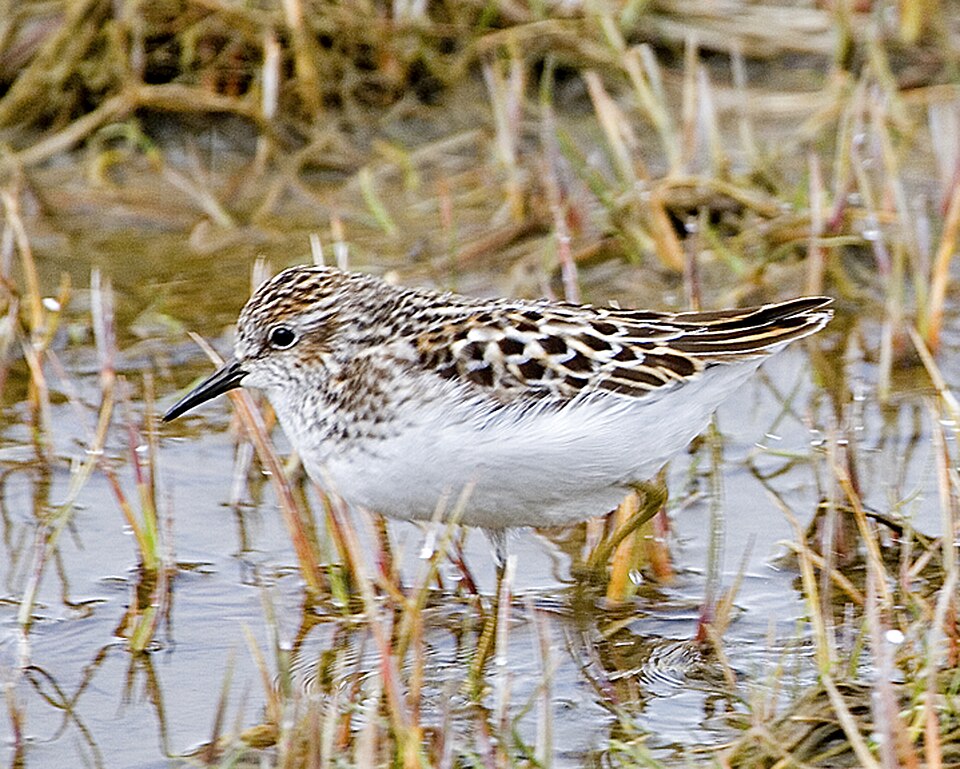
It is a very small sandpiper. In Buenos Aires, a bird standing next to a Calidris fuscicollis was easy to identify by its smaller size and its short, yellowish-green legs with fairly long toes; it was feeding by probing the mud with its bill [5]. Females are somewhat larger than males, and in birds caught from California to Ecuador both wing and bill were longer in those that winter farther south [6].
A single measurement is not enough to sex birds from their dimensions. In 110 birds collected in Cuban wetlands and sexed by dissection, a function combining culmen length and wing length assigned sex correctly to 91 % of individuals, whereas the method based on bill length alone was right in only 44 % of cases and was biased towards females [7].
Similar species
- Calidris fuscicollis: Calidris minutilla is smaller and has short, yellowish-green legs [5].
Distribution and habitat
Outside the breeding season it lives mainly from the south of the United States through Central America and the Caribbean to the north of South America; in Argentina it is a rare visitor [5]. In Surinam it is a numerous migrant, most abundant from mid-August to early May, and a few birds remain there through the northern summer [8]. Females tend to winter farther south than males [6].
In winter it uses lakes, marshes, mudflats, flooded farmland, drainage ditches and coastal salt marshes, among other settings [2]. At the Caucato wetland in Pisco, most of the birds counted were on the lagoon shore (91 of 164) and in the rush beds (43) [9]. At Poza de La Arenilla in La Punta (Callao), it was very scarce in the 2013 to 2015 surveys, and the study's species list marks it only in spring [10].
Biology
On Sable Island, Nova Scotia, near the southern edge of its breeding range, males are the first to arrive in mid-May, and clutches are completed between late May and late June [11]. Eggs are laid at a mean interval of 1.2 days, incubation lasts 20 to 21 days, and mortality of nests and chicks is high, mainly through predation by the herring gull [11].
Before pairing, males fly over the site where they will nest at about 10 to 30 m, alternating glides with bursts of rapid wingbeats and repeating a call about 2 times per second; in Nova Scotia these flights lasted 3.4 minutes on average [12]. On Sable Island it was strictly monogamous: males tended to incubate by day and females by night [13].
Chicks fly well at 14 to 16 days of age, but the female stays with them for about 6 days on average and the male for about 20 [13]. On the Queen Charlotte Islands, British Columbia, broods of different pairs were regularly seen to merge, and adults to care for chicks not their own, though at a low rate [14]. During the 2002 autumn migration in the lower Mississippi valley, 293 colour-marked birds were followed: the estimated stay at each stopover site was 4.1 to 6.9 days depending on site and age, and body condition explained little of that length of stay [15].
Ecology
It eats mostly small invertebrates, and on its wintering grounds its diet is more varied than on its breeding grounds. In organic rice fields in the Valle del Cauca, Colombia, 50 birds were caught between October and December 2012: 30 regurgitates containing food held 1410 items from 22 groups, and insects were by far the best represented (91 %), followed by plant remains (8 %), such as rice seeds and grass stems, and spiders (1 %) [2]. These birds swallowed 221 small stones of 0.01 to 1 mm that help grind hard prey such as beetles, and the authors suggest the species helps to control beetles that are rice pests [2].
At two wetlands in Cuba it made up more than 70 % of the mixed flocks it shared with Calidris pusilla and Calidris mauri, and in birds collected there in October 2008 its diet was dominated by fly eggs, larvae and pupae [16]. On the coast of Ecuador it was found carrying the chewing louse Actornithophilus umbrinus, which also occurs on other migratory shorebirds [17].
Conservation
Its global category is Near Threatened [4]. It depends on wetlands along its whole route: in the St. Lawrence River estuary, Canada, during the autumn migrations of 2011 and 2012 the probability of finding it rose with the width of the upper salt marsh; the authors note that salt marshes are vulnerable to sea-level rise and that in this estuary they can no longer shift inland, so they call for careful management of the shoreline [18].
At the Caucato wetland in Pisco, vehicle noise, people and domestic animals made the birds go on alert, shift position or take flight within the wetland [9].
Where to see it in Peru
In the north it appears on the fauna list of the Los Manglares de Tumbes National Sanctuary, in its 2023 management plan [3]. On the southern coast, at the Caucato wetland in Pisco, 164 individuals were counted in surveys from 2017 to 2019, 5.12 % of the birds recorded [9]. On the seashore of San Andrés, also in Pisco and in the northern part of the buffer zone around the Paracas National Reserve, 50 birds were counted in January 2023 and 12 in December 2024, on sandy, stony and rocky beaches [19].
References (19)
- WoRMS Editorial Board (2026). Calidris minutilla (Vieillot, 1819). World Register of Marine Species. https://www.marinespecies.org/aphia.php?p=taxdetails&id=159054 (accessed 2026-10-20)
- Cifuentes-Sarmiento, Y., Renjifo, L.M. (2016). Dieta del correlimos diminuto (Calidris minutilla) en cultivos de arroz orgánico de Colombia. Ornitología Neotropical, 89-96. doi:10.58843/ornneo.v27i0.61 (accessed 2026-10-20)
- Servicio Nacional de Áreas Naturales Protegidas por el Estado (2023). Plan Maestro del Santuario Nacional Los Manglares de Tumbes 2023-2027. SERNANP, RP N.° 064-2023-SERNANP. https://cdn.www.gob.pe/uploads/document/file/4137567/RESOLUCION%20PRESIDENCIAL%20N%20064-2023-SERNANP.pdf.pdf (accessed 2026-10-20)
- BirdLife International (2024). Calidris minutilla: BirdLife International. The IUCN Red List of Threatened Species 2024: e.T22693396A255801668. doi:10.2305/IUCN.UK.2024-2.RLTS.T22693396A255801668.en (accessed 2026-10-20)
- Martínez-Curci, N.S., Pretelli, M.G., Cavalli, M. et al. (2018). First record of Least Sandpiper Calidris minutilla for Buenos Aires province and review of its status in Argentina. Wader Study, 51-53. doi:10.18194/ws.00095 (accessed 2026-10-20)
- Nebel, S. (2006). Latitudinal clines in sex ratio, bill, and wing length in Least Sandpipers. Journal of Field Ornithology, 39-45. doi:10.1111/j.1557-9263.2006.00021.x (accessed 2026-10-20)
- Jiménez, A., García-Lau, I., González, A. et al. (2015). Sex Determination of Least Sandpiper (Calidris minutilla) and Western Sandpiper (Calidris mauri): Comparing Methodological Robustness of Two Morphometric Methods. Waterbirds, 10-18. doi:10.1675/063.038.0103 (accessed 2026-10-20)
- Spaans, A.L. (1976). Molt of Flight and Tail Feathers of the Least Sandpiper in Surinam, South America. Bird-Banding, 359-364. doi:10.2307/4512271 (accessed 2026-10-20)
- Pisconte-Vilca, J.A., Anchante-Aparcana, J.C., Aparcana Mendoza, M.A. et al. (2020). Variación de la abundancia y diversidad de las aves migratorias en el humedal de Caucato, Pisco Perú. Ñawparisun - Revista de Investigación Científica, 103-110. doi:10.47190/nric.v3i1.132 (accessed 2026-10-20)
- Cotillo, A., Podestá, J., Segura-Cobeña, E. et al. (2018). Distribución espacial de las aves playeras limícolas para once zonas descritas en el humedal costero Poza de La Arenilla - La Punta, Callao. The Biologist (Lima), 119-137. doi:10.24039/rtb2018161226 (accessed 2026-10-20)
- Miller, E.H. (1983). Habitat and breeding cycle of the Least Sandpiper (Calidris minutilla) on Sable Island, Nova Scotia. Canadian Journal of Zoology, 2880-2898. doi:10.1139/z83-376 (accessed 2026-10-20)
- Miller, E.H. (1983). Structure of Display Flights in the Least Sandpiper. The Condor, 220-242. doi:10.2307/1367260 (accessed 2026-10-20)
- Miller, E.H. (1985). Parental behavior in the Least Sandpiper (Calidris minutilla). Canadian Journal of Zoology, 1593-1601. doi:10.1139/z85-236 (accessed 2026-10-20)
- Cooper, J.M., Miller, E.H. (1992). Brood amalgamation and alloparental care in the Least Sandpiper, Calidris minutilla. Canadian Journal of Zoology, 403-405. doi:10.1139/z92-060 (accessed 2026-10-20)
- Lehnen, S.E., Krementz, D.G. (2007). The Influence of Body Condition on the Stopover Ecology of Least Sandpipers in the Lower Mississippi Alluvial Valley during Fall Migration. Avian Conservation and Ecology, 9. doi:10.5751/ACE-00176-020209 (accessed 2026-10-20)
- González, A., Jiménez, A., García-Lau, I. et al. (2022). Ecología trófica de Calidris minutilla, Calidris pusilla y Calidris mauri (Aves: Scolopacidae) en dos humedales naturales de Cuba. Caldasia, 154-164. doi:10.15446/caldasia.v44n1.85223 (accessed 2026-10-20)
- Haase, B., Alava, J.J. (2014). First records of chewing lice (Phthiraptera: Menoponidae) in Pacific migratory shorebirds wintering in Ecuador. Revista Brasileira de Parasitologia Veterinária, 260-263. doi:10.1590/S1984-29612014026 (accessed 2026-10-20)
- Turcotte, Y., Lamarre, J.-F., Duchesne, É. et al. (2021). Salt marsh width positively affects the occurrence of Least and Pectoral Sandpipers in the St. Lawrence River Estuary during fall migration. The Canadian Field-Naturalist, 192-202. doi:10.22621/cfn.v135i2.2659 (accessed 2026-10-20)
- Pulido-Capurro, V. (2025). Las aves de la orilla marina de San Andrés, Pisco, Ica. The Biologist (Lima), 55-70. doi:10.62430/rtb20252311926 (accessed 2026-10-20)
More pictures
If you come across it
Protected or threatened species. Watch it without touching, feeding, chasing or taking it, and keep the recommended viewing distances.
Where it has been recorded
- Filled: scientific records, or confirmed by a curator
- Hatched: isolated record
- Dotted outline: no scientific records and no curator's confirmation (an ORKA sighting is not drawn here)
- Tropical northern sea
Scientific records (339 records)
- Tropical–cold transition zone
Scientific records (827 records)
- Cold central sea
Scientific records (3027 records)
- Cold southern sea
Scientific records (4840 records)
From openly licensed OBIS and GBIF records (CC0 or CC BY). How each list is built.
Related species
From the same genus (Calidris) and from the same family (Scolopacidae).

Sanderling
Calidris alba
IUCN status: LC · Least Concern
Baird's sandpiper
Calidris bairdii
IUCN status: LC · Least Concern
Pectoral sandpiper
Calidris melanotos
IUCN status: LC · Least Concern
Semipalmated Sandpiper
Calidris pusilla
IUCN status: NT · Near Threatened
Spotted sandpiper
Actitis macularius
IUCN status: LC · Least Concern
Names and sources
In Spanish
- Playerito menudo — Peru; SERNANP (2023). Plan Maestro del Santuario Nacional Los Manglares de Tumbes 2023-2027. RP N.° 064-2023-SERNANP, p. 140 of the PDF · main name
- Correlimos menudillo — Wikidata; WoRMS
- Playerito menor — Wikidata
In English
- Least sandpiper — WoRMS; Wikidata
Classification
Learn more
Conservation status: Near Threatened (IUCN Red List, according to Wikidata). Taxonomy: PeRMS / WoRMS (CC BY 4.0).