
Seabirds · Scolopacidae
Sanderling
Calidris alba (Pallas, 1764)
Spanish: Playero blanco
- Names in Peru
- Playero blanco · Playero arenero · Tintil de orilla
- Peruvian Register of Marine Species
- Not in PeRMS: recorded by OBIS, or by ORKA at our dive sites

Species account
Summary
Calidris alba (Pallas, 1764) is a shorebird of the family Scolopacidae [1]. In Peru it is called «playero blanco», «playero arenero» and «tintil de orilla» [2]. According to the management plan of the Illescas National Reserve, it breeds in Alaska and northern Canada and winters along the coasts of the continent, from southern Alaska and the north-eastern United States to northern Chile and Argentina [2]. Its global category on the IUCN Red List is Least Concern [3].
Identification and similar species
The management plan of the Illescas National Reserve gives it a length of 20 to 25 cm and a wingspan of about 40 to 45 cm [2], while a study in Callao describes a small bird of 19 to 21 cm [4]. Measurements vary with age: in a wintering population in Portugal, the wing of adults averaged 127.1 mm and that of first-winter juveniles 125.0 mm [5].
In that study birds were classed as first-winter juveniles or adults by plumage, and the sex of adults was estimated with a function based on measurements of the wing, tarsus, bill and head, derived from 990 birds sexed by molecular methods in Mauritania and Ghana; that function assigned sex correctly in 84% of them [5].
Distribution and habitat
The management plan of the Illescas National Reserve states that it breeds in Alaska and northern Canada and winters along the coasts of the continent, down to northern Chile and Argentina, and that it frequents mostly open beaches, sometimes rocky shores and, less often, marshes [2]. A study in Portugal describes it as associated mainly with coarse sediments, such as sandy beaches and sand or muddy-sand flats, which change quickly through sediment movement and coastal erosion [5].
In Peru, a study of the birds of the marine shore of San Andrés, in Pisco, classes it as a Nearctic migrant of the sandy and stony beaches; according to that study, Nearctic birds arrive there in the austral summer, between September and March [6]. On the central coast it also uses an urban coastal wetland, Poza La Arenilla, in Callao, formed after two rocky barriers were built between 1965 and 1967, where it takes advantage of sandy shores and a cobble zone [4].
Biology
At Poza La Arenilla the species' behaviour was analysed from observations on 12 days in August and September 2019, with 670 minutes of effective observation and 58 behaviour types grouped into 8 categories [4]. On the sandy shores foraging and moving about dominated, while in the cobble zone resting was the most frequent behaviour and foraging appeared only at mid-tide [4].
At low tide foraging declined on one of the sandy shores and grooming increased; at high tide no behaviour was recorded in the cobble zone or on that sandy shore [4]. The greatest diversity of behaviours occurred at mid-tide in the cobble zone [4].
In an estuary in western Portugal, 160 colour-ringed sanderlings were sighted 1249 times between November 2009 and March 2013, and the vast majority were seen at a single site; hardly any movements exceeded 15 km [5]. Juveniles were less faithful to their wintering site than adults and, among adults, females less than males [5].
Ecology
At Poza La Arenilla the authors conclude that the species prefers soft, moist substrates with less competition from larger birds, conditions that occur mainly at mid-tide [4]. The authors note that at high tide several species have difficulty finding roosting sites, and recall that an earlier study attributed the absence of shorebirds in summer from several areas of the wetland to human activities [4].
In winter it forms flocks: in the Portuguese estuary average counts were 75 to 126 birds per site [5]. Hardly any movements over 15 km were recorded, suggesting small home ranges; the authors note that its limited tendency to explore other wintering sites might affect its survival if habitat changes or is lost, for example through severe beach erosion [5].
Conservation
Its global category on the IUCN Red List is Least Concern [3]. The management plan of the Illescas National Reserve, by contrast, states that its population may be suffering a serious decline and names human activity as the main threat, both at breeding sites and at resting and wintering places [2].
That plan also mentions illegal hunting and pollution, which make it harder to find food, extreme heat that endangers chicks in the nest, and sea-level rise, which alters coastal habitats [2]. In the plan's workshops, local residents said that pickup trucks driving along the shore often run over them, although in their view the population fluctuates between years [2].
Human relevance
The management plan of the Illescas National Reserve includes the «tintil de orilla» and the «playero blanco» among the priority fauna species of that protected area [2]. Among the effects of abandoned dogs and cats in the reserve, the plan cites those suffered by priority species, these shorebirds among them [2].
Where to see it in Peru
In the bird censuses of the San Andrés beaches, in Pisco, made on 100 m morning transects, the summed counts were 722 birds in January 2023 and 457 in December 2024 (1179 when both are added; an average of 147.38 per day) [6]. On the central coast, at Poza La Arenilla, in Callao, it was observed in August and September 2019 [4].
In the north, the beaches of the Illescas National Reserve are a seasonal stopping place for at least 23 species of migratory birds, this one among them [2].
References (6)
- WoRMS Editorial Board (2026). Calidris alba (Pallas, 1764). World Register of Marine Species. https://www.marinespecies.org/aphia.php?p=taxdetails&id=159084 (accessed 2026-10-21)
- Servicio Nacional de Áreas Naturales Protegidas por el Estado (2024). Plan Maestro de la Reserva Nacional Illescas 2024-2028. SERNANP, aprobado por Resolución Presidencial N.° 000025-2024-SERNANP. https://cdn.www.gob.pe/uploads/document/file/5865360/5197343-anexo.pdf (accessed 2026-10-21)
- BirdLife International (2024). Calidris alba: BirdLife International. The IUCN Red List of Threatened Species 2024: e.T22693369A154671400. doi:10.2305/IUCN.UK.2024-2.RLTS.T22693369A154671400.en (accessed 2026-10-21)
- Barona, D., Podestá, J. (2024). Habitat variety and behaviour of the Sanderling (Calidris alba) in an urban neotropical coastal wetland. Neotropical Biology and Conservation, 1-15. doi:10.3897/neotropical.19.e115562 (accessed 2026-10-21)
- Lourenço, P.M., Alves, J.A., Reneerkens, J. et al. (2016). Influence of age and sex on winter site fidelity of sanderlings Calidris alba. PeerJ, e2517. doi:10.7717/peerj.2517 (accessed 2026-10-21)
- Pulido-Capurro, V. (2025). Las aves de la orilla marina de San Andrés, Pisco, Ica. The Biologist (Lima), 55-70. doi:10.62430/rtb20252311926 (accessed 2026-10-21)
More pictures
Where it has been recorded
- Filled: scientific records, or confirmed by a curator
- Hatched: isolated record
- Dotted outline: no scientific records and no curator's confirmation (an ORKA sighting is not drawn here)
- Tropical northern sea
Scientific records (120 records)
- Tropical–cold transition zone
Scientific records (511 records)
- Cold central sea
Scientific records (2472 records)
- Cold southern sea
Scientific records (4411 records)
From openly licensed OBIS and GBIF records (CC0 or CC BY). How each list is built.
Related species
From the same genus (Calidris) and from the same family (Scolopacidae).

Baird's sandpiper
Calidris bairdii
IUCN status: LC · Least Concern
Pectoral sandpiper
Calidris melanotos
IUCN status: LC · Least Concern
Least sandpiper
Calidris minutilla
IUCN status: NT · Near Threatened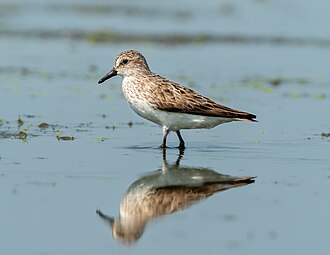
Semipalmated Sandpiper
Calidris pusilla
IUCN status: NT · Near Threatened
Spotted sandpiper
Actitis macularius
IUCN status: LC · Least Concern
Names and sources
In Spanish
- Playero blanco — Peru; SERNANP (2024). Plan Maestro de la Reserva Nacional Illescas 2024-2028. RP N.° 000025-2024-SERNANP, p. 20 of the PDF · main name
- Correlimos tridáctilo — Wikidata; WoRMS
- Playerito blanco — Wikidata
- Playero arenero — Peru; SERNANP (2024). Plan Maestro de la Reserva Nacional Illescas 2024-2028. RP N.° 000025-2024-SERNANP, p. 20 of the PDF
- Tintil de orilla — Peru; SERNANP (2024). Plan Maestro de la Reserva Nacional Illescas 2024-2028. RP N.° 000025-2024-SERNANP, p. 20 of the PDF
In English
- Sanderling — WoRMS; Wikidata
Classification
Learn more
Conservation status: Least Concern (IUCN Red List, according to Wikidata). Taxonomy: PeRMS / WoRMS (CC BY 4.0).