
Sea stars, urchins and sea cucumbers · Echinometridae
Caenocentrotus gibbosus
Caenocentrotus gibbosus (L. Agassiz in L. Agassiz & Desor, 1846)
- Peruvian Register of Marine Species
- Listed in PeRMS (IMARPE)
Species account
Summary
Caenocentrotus gibbosus is a sea urchin of the family Echinometridae, described in 1846 as Echinus (Toxopneustes) gibbosus [1]. In Peru it appears in the echinoderm inventory of the Lobos de Afuera islands, where numerous specimens were found on rocks fallen into the sea and it is cited among the dominant species of submarine walls [2]. In March 2024 it was among the urchins stranded at San Bartolo Sur, on the central coast [3].
Identification and similar species
Published morphological data are scarce. In the specimens analysed, the protractor muscles of Aristotle's lantern are flat and no lobes were identified, unlike in other echinometrids [4]. The authors could not decide whether the missing lobes reflect the size of the specimens analysed or a loss of that character in the species [4].
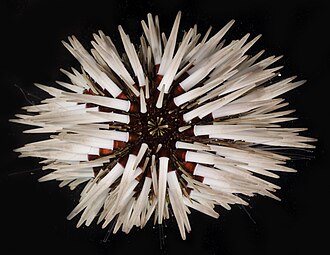
In the family Echinometridae the test is oval or circular, and in this species the anterior part of the stomach lies mostly in ambulacrum III [5]. These are internal, group-level features that do not suffice to recognise it underwater; the Peruvian records cited here do not describe its appearance [2].
Distribution and habitat
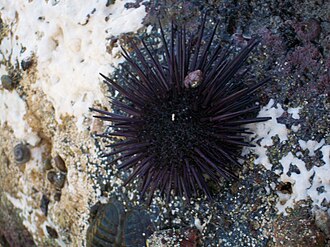
The species was recorded at the Lobos de Afuera islands (Lambayeque), where collecting took place over six days in June 1999 (19–24) by hookah diving, from the intertidal zone down to 20 m depth [2]. Numerous specimens were found there on the surface of angular rocks fallen into the sea from hills and cliffs [2]. The authors regard it as a wide-ranging species, present in both tropical and temperate waters [2].
In deeper water it occurs on rocks larger than 1 m, together with other urchins and sea stars, and on the vertical walls of submarine cliffs and rocky reefs it is one of the dominant species, alongside Arbacia spatuligera [2]. On the central coast it was recorded stranded at San Bartolo Sur in March 2024 [3].
Biology
Its internal anatomy is known from comparative studies of sea urchins. In the specimens analysed the protractor muscles of the lantern are flat, without the frilled lobes of other echinometrids [4]. The anterior stomach lies mostly in ambulacrum III, as in several species of Echinometra and other genera of the family [5].
The authors of the 2012 study tentatively placed the genus Caenocentrotus at a basal position within Echinometridae, relying on identification keys and phylogenetic studies of selected taxa [4].
Ecology
At Lobos de Afuera it shares the habitat with urchins such as Lytechinus semituberculatus, Toxopneustes roseus and Tripneustes depressus, with the sea cucumber Isostichopus fuscus and with sea stars such as Nidorelia armata and Pharia piramidatus [2].
In March 2024, at San Bartolo Sur, a stranding of 33 species was recorded in which echinoderms exceeded 90 % of relative abundance. It coincided with sea surface temperatures well above normal, very high chlorophyll a concentrations and a localised episode of anoxia with a pH drop [3]. Caenocentrotus gibbosus is among the four echinoderm species the study abstract names for that event [3].
Where to see it in Peru
The Lobos de Afuera islands, off Lambayeque, are where the literature reviewed records this species in most detail: it was found on rocks fallen into the sea and on submarine walls in a June 1999 survey that reached 20 m depth [2]. Those data are more than two decades old and do not tell where or when it can be seen today [2].
References (5)
- WoRMS Editorial Board (2026). Caenocentrotus gibbosus (L. Agassiz in L. Agassiz & Desor, 1846). World Register of Marine Species. https://www.marinespecies.org/aphia.php?p=taxdetails&id=513158 (accessed 2026-10-25)
- Hooker, Y., Solís-Marín, F.A., Lleellish, M. (2005). Equinodermos de las Islas Lobos de Afuera (Lambayeque, Perú). Revista Peruana de Biología. doi:10.15381/rpb.v12i1.2360 (accessed 2026-10-25)
- Cabanillas, R., Ledesma, J., Fabian, G. et al. (2026). Varamiento de organismos bentónicos en la costa central del Perú durante 2024. Boletín Instituto del Mar del Perú. doi:10.53554/boletin.v41i2.449 (accessed 2026-10-25)
- Ziegler, A., Schröder, L., Ogurreck, M. et al. (2012). Evolution of a Novel Muscle Design in Sea Urchins (Echinodermata: Echinoidea). PLoS ONE. doi:10.1371/journal.pone.0037520 (accessed 2026-10-25)
- Ziegler, A., Mooi, R., Rolet, G. et al. (2010). Origin and evolutionary plasticity of the gastric caecum in sea urchins (Echinodermata: Echinoidea). BMC Evolutionary Biology. doi:10.1186/1471-2148-10-313 (accessed 2026-10-25)
More pictures
Where it has been recorded
- Filled: scientific records, or confirmed by a curator
- Hatched: isolated record
- Dotted outline: no scientific records and no curator's confirmation (an ORKA sighting is not drawn here)
- Cold central sea
Scientific records (6 records)
- Cold southern sea
Scientific records (3 records)
From openly licensed OBIS and GBIF records (CC0 or CC BY). How each list is built.
Related species
From the same family.
Names and sources
Classification
Learn more
Conservation status: no data (IUCN). Taxonomy: PeRMS / WoRMS (CC BY 4.0).